Month: April 2014

  • Shapeshifter Tarot | Review | DJ Conway, Sirona Knight and Lisa Hunt | Llewellyn

    I’ve not done a deck review for a long time, so here’s my review of Llewellyn’s Shapeshifter Tarot. And it will be a review primarily through the Courts! Oh yes, I like to make life tricky for myself 🙂

    Let’s get the basics out of the way:  This is the new version of the deck, not the original kit – so there is no accompanying book, just a LWB. The card size is 7 cm wide x 10.5 cm tall with a triskele as the card back design.  While it’s not a perfectly reversible image, it’s as close as makes no difference, so I’d say YES, this deck is suitable for reversals.
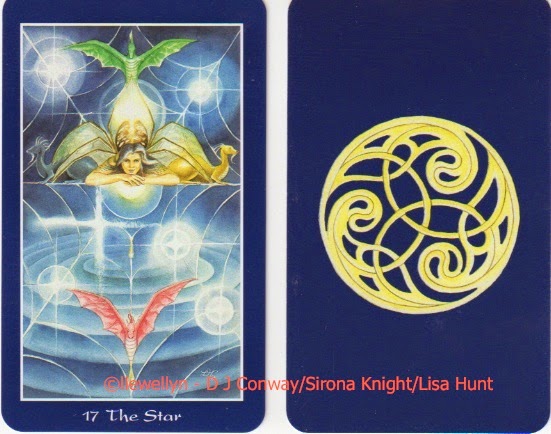
    The Star – Shapeshifter Tarot and Triskele card back

    There are 81 cards in this deck, in honour of the ’81 Knights of the 9 Rings of Condemanons Celtic Gwyddionic Druid Tradition’.  

    Other than that statement, there is very little in the LWB to explain further what this tradition is, nor where the authors recommend that you find out more.

    The additional cards are to be found in the Major Arcana, with the two additional cards stemming from the ‘energetic double’ of this particular Druidic tradition.

    The Majors themselves are mostly renamed, but won’t cause any headaches for anyone familiar with the RWS.  All the cards, including the Majors, are numbered with Arabic numerals, so they’re immediately accessible.

    The Minors each have their suit details at the top of each card and the number and keyword along the bottom.  The images themselves are surrounded by a dark blue border (same shade as card-back) and provides a great ‘neutral’ for Hunt’s images.

    Now to the Courts!

    We have 4 Court cards for each of the suits:  Water, Earth, Fire and Air, with the Air suit attributed to the traditional ‘Wands’ and Fire to Swords.  So be warned if you like your Air and Fire attributions the other way around 🙂

    The Courts themselves are renamed in the LWB:

    Page = Seeker
    Knight = Warrior
    King = God
    Queen = Goddess

    According to the LWB, the change in priority, with Goddess at the top of the tree, reflects the Gwyddion system where the High Priestess has the final say in all matters.

    As with the other cards of the deck, the Courts show figures in transformation to another shape where centaurs and unicorns mix with white harts and bears.  Each image is beautifully rendered in the delicate water-colour shades associated with Hunt’s work, really lovely to look at – dreamlike and full of detail.

    In the LWB each Court figure is named according to Celtic myth – there is Bridget, Angus mac Og, Ceridwenn and a whole host of recognisable names.  However – and this is a MASSIVE however, the LWB is stonily silent on the relationship of those Celtic heroes to the Court figures AND there is not a breath of a mention as to what the shape-shifting animal might contribute to our understanding of the card.

    I reckon that this might be because the deck was originally available in 1998 as a book/deck set from Llewellyn and in order to fit everything into the smaller box for this smaller edition, the book has been whittled to within an inch of its life!

    The result is that you have a beautiful deck but one whose accompanying book has had most of the meat removed and we’re left the bare bones of structure.

    To illustrate, I managed to procure a copy of the original accompanying book’s information about The Goddess of Earth (thank you Emma Sunerton-Burl) and provide it here purely to illustrate the quantity of work that has had to be omitted for the non-kit edition:
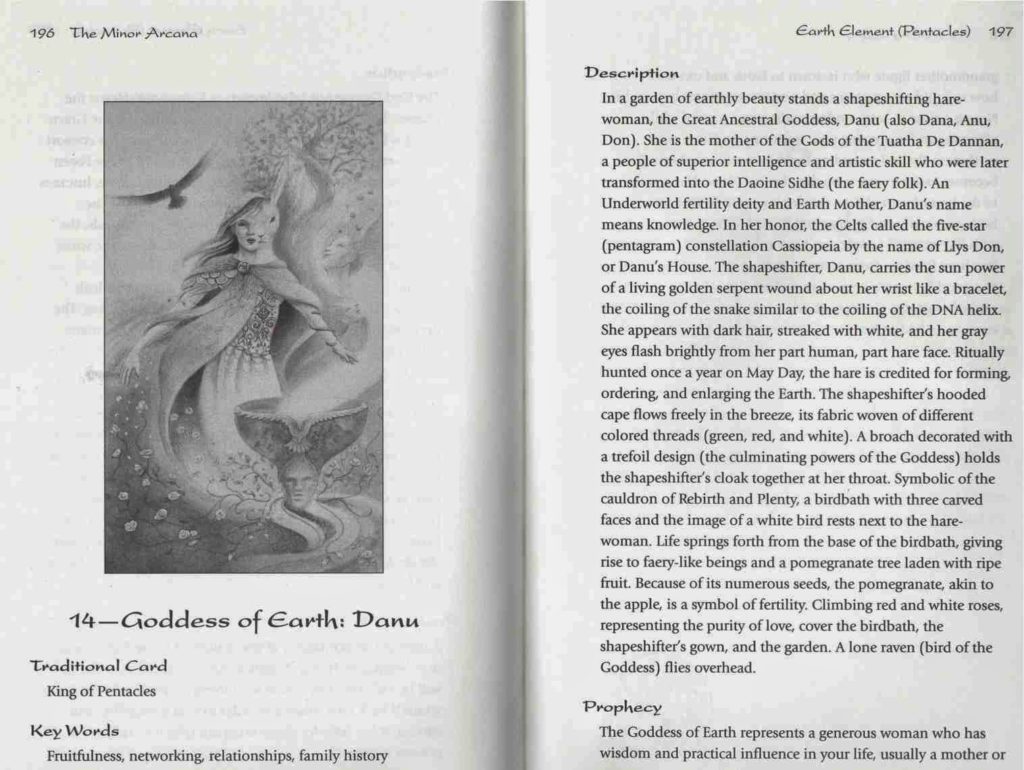
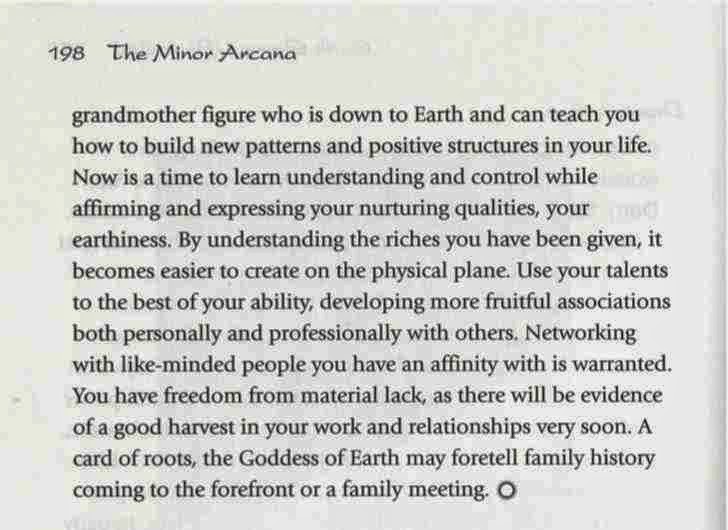
    This is the information provided for the Goddess of Earth from the original accompanying book.

    See? Massive difference in the quantity of information provided.  The answer? Somehow get your hands on the original accompanying book.

    So – in summary – I absolutely love the artwork and the concept behind this deck, but without the original accompanying book, you are left with lots of unanswered questions.  Come on Llewellyn – let people buy the accompanying book as a pdf download!! 😀

  • My Favourite Court | Chloe McCracken | Page of Pentacles

    Once upon a time, I decided to offer other Tarot bloggers the opportunity to come into the Kingdom of the Courts and have a chat about their favourite court card.  Chloe McCracken, who writes the TABItarot blog eloquently and possesses the stamina of a HORSE to post every DAY, was invited to be my first guest.

    But lo! The post failed to schedule.  Yes, I was going through a phase of trying to be organised and practical – very Queen of Pentacles – but failing miserably!

    So, I trawled back my posts to 2012 *oh the SHAME!* and share it with you on this Easter Monday!


    Take it away, Chloe!

    “When Ali asked me to write a post on my favourite Court card, it wasn’t my astrologically and age- and gender-related card that popped into my head, nor the one assigned to me by the Thoth system of decans.  (To find out about those, take a look at Ali’s posts…..)  Despite having written – here , here http://innerwhisperscouk.blogspot.co.uk/2010/10/bad-rep-well-deserved-knight-of-swords.html , here http://innerwhisperscouk.blogspot.co.uk/2010/10/bad-rep-well-deserved-queen-of-swords.html and here  – about the undeservedly bad reputation of the Swords court, it was none of them that I thought of.  Nor was it the Queen of Wands, who has been appearing to me a lot of late, and whose energy and characteristics I love.  Instead, it was the studious Page of Pentacles who clamoured to be heard and seen.

    Ali suggested I choose my favourite version of whichever Court card, and the one that sprang to mind was this one from the Ancestral Path Tarot (OOP, U.S. Games, 1996).   This was the first deck I chose for myself, after buying the Radiant Rider Waite (U.S. Games, 2005) for a tarot for beginners course I took at Mysteries in Covent Garden (London). Yet, looking at it again now, I was surprised that the Ancestral Path image – renamed Princess of Sacred Circles – doesn’t actually speak to what is in my mind when I think of this card!  She has been influenced by the Thoth version, and while I like the idea of pregnancy suggesting our own creative forces, and bringing something new into the world, it doesn’t really match with my main thoughts about the Page.

    You see, the first book I read about tarot was Rachel Pollack’s classic “78 Degrees of Wisdom” (HarperCollins, 1997, but first published in 1980!), which deeply influenced my understanding of tarot.  Digging it out again and turning to the suit of Pentacles, and the Page in particular, I found the roots of my enthusiasm and the mental picture I have of this card: “the Page need not refer to someone actually in school, but simply anyone approaching any activity with those qualities of fascination, of involvement, of caring less for rewards or social position than for the work itself.” (p. 239)  

    I love that sense of being an eternal student, ever fascinated with the world, constantly learning something new just for the joy of it, caught up in what you’re doing.  Not just learning through reading, but through trying and playing and doing again.  Rachel Pollack points out that the Page of Pentacles: “partakes of the suit’s practical nature by symbolising the actual work of the student, the study and scholarship, as compared to the inspiration symbolised by the Page of Cups.” (ibid)  Or, it might be added, compared to the rational thought processes and joy in reading of the Page of Swords!  So, looking through my decks, although the Page of Pentacles from Lisa Hunt’s Celtic Dragon Tarot (Llewellyn, 1999) comes closer to what I had in mind, it’s still not quite there.  

    More than just learning through doing and learning for fun, for me the Page of Pentacles is  also about learning something spiritual.  Once again, Rachel Pollack talks of this mystical side to the suit of Pentacles: “However far we may travel in spiritual meditations we must begin and return here – or lose ourselves in the process.” (ibid, p.232)  As she explains: “the natural world, because it carries a firmer reality than the other elements, because it does not lead so easily to confusion or misconception or ill use, opens the way to more mystic experience.” (ibid. 233)  I think that’s part of what I loved about the Ancestral Path take on the Page/Princess of Pentacles/Sacred Circles – her connection to spirit as well as her groundedness in her own body.  

    Not that you have to get all mystical about it.  For me, a perfect example of Page of Pentacles energy is found in practising yoga.  You always feel things a little differently, and are open to learning something new about your own body, your mind, what it is to be human, or the pose that you’re in.  It’s spiritual, without being woo-woo.  More simply, it’s just about bringing “beginner’s mind” to whatever you do.  

    In that sense, I love Joanna Powell-Colbert’s take on the Page of Pentacles/Child of Earth (Gaian Tarot, Llewellyn, 2011). Looking at anything, even an apple, as though you had never seen it before.  Feeling its smooth skin, smelling its crisp, fresh scent, enjoying the crunch as your teeth break through the peel, and the spray of yummy juice that squirts into your mouth before you’ve even finished biting off a chunk.  Still, it’s not my favourite version of this card.

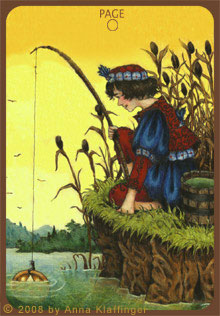
    After trawling through my decks, I realised that my absolute favourite depiction of the Page of Pentacles is from Anna K (self-published).   The sky is sunny and warm as our intrepid Page goes fishing.  S/he is doing something practical, and s/he might even get dinner out of it, but that really doesn’t matter – it’s just so amazingly interesting.  S/he looks intently at the bobbing pentacle, enjoying the feeling of the grass under foot, gazing at the sparkles in the water and the ripples from where the fishing line enters the water.  Engrossed in the moment, in the possibilities, s/he is learning a new skill, but doesn’t see it that way, just enjoying the day and the fun of doing something new.  Without even realising it, s/he slips into meditating on the nature of water, or the life cycle of fish, or the best way to sit so as not to get a dead leg.  It’s all good!  

    For me, learning tarot is like that, too.  No matter how long you’ve been playing with the cards, every reading, every draw, offers new possibilities.  The context is different every time depending on who you’re reading for, what spread you use, what deck you choose, what’s going on in your life.  Each day, we can see the cards with new eyes, and there’s the potential to spot something we never thought of before.  Yet, no matter how mystical the question, or how emotional, there is something grounded about using the cards.  Not just because they are (mostly) physical bits of card that we hold in our hands (though that helps).  But because they’re talking about our lives, here and now.  Even if we’re asking about the nature of the universe, it’s about how we can see and experience it in this moment.  We learn, we explore, we play, we experience.  Definitely Page of Pentacles 🙂


    Chloe McCracken writes the TABITarot blog, the Inner Whispers blog and is about to publish the Celtic Lenormand Oracle (artist: Will Worthington)