Tag: Comparative Tarot

  • Comparative Tarot | Page of Swords

    I’m running a workshop for the Glasgow Tarot Meetup Group at the beginning of April on using the comparative method of working with the Tarot.  I first heard about this method from Valerie Sim and the Comparative Tarot deck that she created specially for it.

    I though that it would prove an interesting exercise to do with the court cards, here on m’blog.

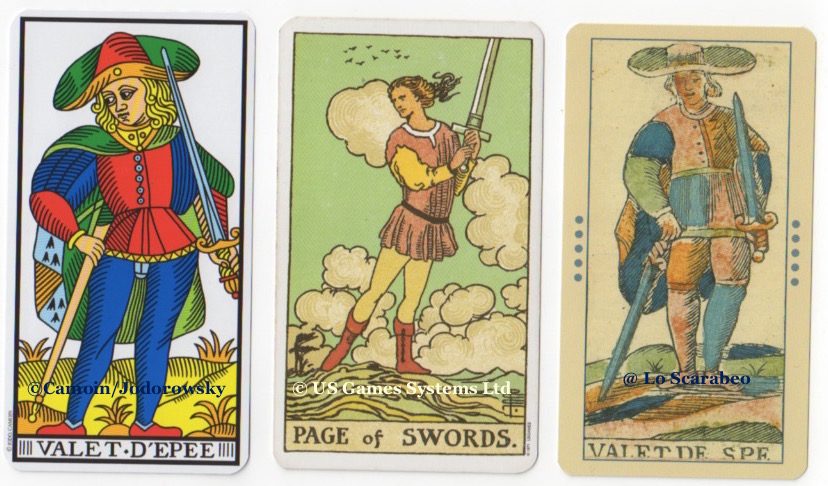
    From the left we have the Valet d’Epee from the Camoin/Jodorowsky Marseille deck, then the Page of Swords from the Rider Waite Smith in the centre and the Valet De Spe from the Ancient Tarot of Bologna on the right.

    They all have different names, but henceforth I shall refer to them all as the Page of Swords, for ease of reference.

    What do the books say about them?

    Ancient Tarot of Bologna (Lo Scarabeo) says that the Valet is a researcher, investigator, revelations, search for truth, surveillance

    In A E Waite’s Pictorial Key to the Tarot, the Page of Swords is described as: Authority, overseeing, secret service, vigilance, spying, examination, and the qualities thereto

    Tarot de Marseille Jodorowsky/Camoin – The deck’s LWB is silent on entire Minor Arcana.  But in his book The Way of The Tarot, Jodorowsky uses the words: ‘foundation of intelligence’, ‘student or young seeker’ ‘caution’.

    So our Pages are most definitely associated with intelligence, a Swords’ suit trait.  But also perhaps with secret intelligence too – spying, secret service, surveillance, investigator etc.

    What can we actually see in these cards?

    They are each looking to the left, which I associate with the past. Perhaps they are each looking over their shoulder.  We look over our shoulder when we are being wary.

    They each hold a sword in their left hand.  The left has always had slightly sinister (did you see what I did there?!) overtones.  Our little valets could, in theory, shake your hand (traditionally the right hand is proffered …unless I’m shaking hands with you and then, being a leftie m’self, I extend my left hand!) and stab you in the arris with a cunningly concealed left-handed stroke!

    Two of them have empty scabbards, so we could say that they have drawn their swords and are alert to attack.

    They each have their feet pointing in different directions, the Page on the right is on a path and, for me, this means that he is not certain which way to go.    This lack of clear direction is most obvious in the RWS Page whose body language is clearly carrying him forward, but his gaze is behind him.

    They all stand on uneven ground.  In the RWS I associate that rolling landscape underfoot with a lack of confidence or experience.  That could also apply to the other youthful Pages too.

    The RWS Page is quite different in many respects – without a hat, cloak or scabbard.  He seems altogether more theatrical than the two Marseille Pages.  He does, of course, come from a period much later than the two Marseille decks (being printed in 1910).  The Camoin deck original dates from 1760, with the Bologna version from the 1780s).

    Perhaps Pamela Colman Smith decided:  NO CAPES! *in the manner of Edna from The Incredibles*

    Amazon.co.uk Widgets

  • Comparative Tarot | The Prince of Cups

    The first time I encountered the comparative method of looking at cards was via Valerie Sim’s deck, the Comparative Tarot.  The cards in this cleverly designed deck have not one image, but four different images of the same card.   It was one of the first decks that I bought and I still regard it fondly.

    Not familiar with the Comparative Method? Here’s the skinny:  You don’t just interpret ONE card, you interpret the others on the card too – each one adding depth and colour to the over all ‘character’. 

    So I thought we’d try it here with The Prince of Cups – just comparing three images – but you can do it with as many cards as takes your fancy.  Or you can fit onto your table top.  Or bedroom floor.

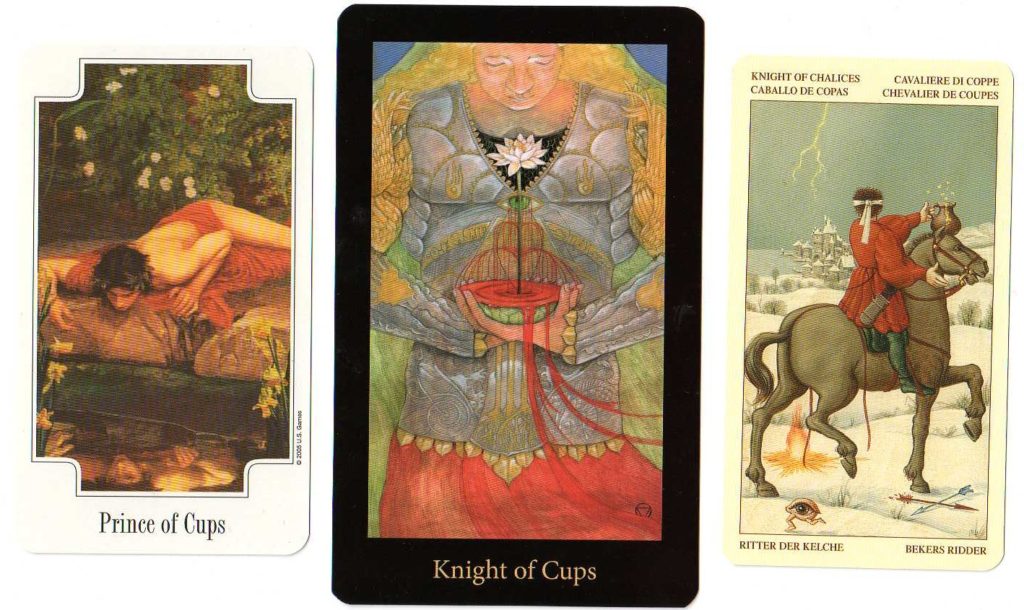
    I chose the Prince/Knight of Cups from the outrageously stunning Mary El deck by Marie White; the Prince of Cups from the Transformational Tarot by Arnell Ando and the Knight of Chalices from the Breugal Tarot by Guido Zibordi Marchesi.

    First of all, although one of these is a Prince, he DOES fill the Knight’s role in the deck.  He’s not a Thoth Knight

    click on image to enlarge.  I think.

    Arnell’s Prince (left hand card above) perfectly captures that romantic, self-absorbed feeling that comes with the Prince of Cups. It shows the youth Narcissus gazing ito his own reflection by the pool.  Poor old Narcissus was so wrapped up in himself that he drowned trying to embrace his own reflection.  I’ve had boyfriends like that.

    In the LWB Arnell explains that he represents the Artistic Idealist; someone who uses ‘creativity as a means to self-expression, but whose moods don’t always reflect his actions.’

    The Knight of the Mary El (central image) is also introspective, protectively clasping a grail that overflows with blood and from whose depths a lotus flower rises and blossoms.  This is the Grail Knight.  Marie White, creator of the Mary-El says: ‘Searching for matters of the heart; love, meaning in life. Compassion, experience and maturity is the key.’  If you don’t know the story of Percival, the Grail Knight here’s a 10 second summary:  In his naivity, Percival, a knight who is searching for the Holy Grail fails to recognise it the first time he encounters it and so he is compelled to set off on his quest again – older, wiser – and finds it.  And heals the Fisher King. The end.

    Our final Knight is the Breugal Knight (right hand image).  His horse steps confidently to the right of the card, but he is not looking in the same direction as his horse.  In fact, he looks as though he has a blindfold on.  Even with the blindfold, he is looking towards a distant village that lies beneath a fork of lightning.  He doesn’t hold a grail, but a tankard filled with flowers.

    Neither hand holds the horse’s reins. Either side of the horse we see a camp fire, crossed arrows and – bizzarely – an eye running to the left on a pair of little legs!

    We also have an eye in the armour of our Mary El Knight – in the centre of her chest.  And the Knight of the Transformational Tarot is gazing at his own reflection.  Sight is an important symbol of this card – one sees only himself, one sees only her Grail, one sees….nothing (with his eyes!)

    I think that the Breugal LWB perfectly encapsulates what’s going on here: ‘Where there is love, the eye follows’. 

    Using this Comparative Tarot method then, I would say that this Knight DOES have focus – but he doesn’t always focus it on what he SHOULD be focussed on, as far as the outside world is concerned.  As a result, he can seem dreamy and self-absorbed to other people and can display a level of cold-heartedness to that which is outwith his field of vision.

    For me he’s the guy who will spend weeks finely crafting you a love song, but never remembers to put the bins out at night.  Someone who will whisk you away for a romantic candle lit meal, but forget to organise his cash….or put fuel in the car 🙂

    What do YOU think of the Knight of Cups or the Comparative method?