Tag: Druidcraft Tarot

  • 30 Day Tarot Challenge | Day 6

    This Game of Thrones | 30 Day Tarot Challenge | Day 6
    Celtic Cross Tarot Spread
    What do you think of it?

    The question for Day 6 of the Challenge is:  What was the first Tarot spread that you learned?

    I can’t actually remember, but the one that DOES stick in my mind is the Celtic Cross spread from the TABI Training course, so that must have been one of the first.

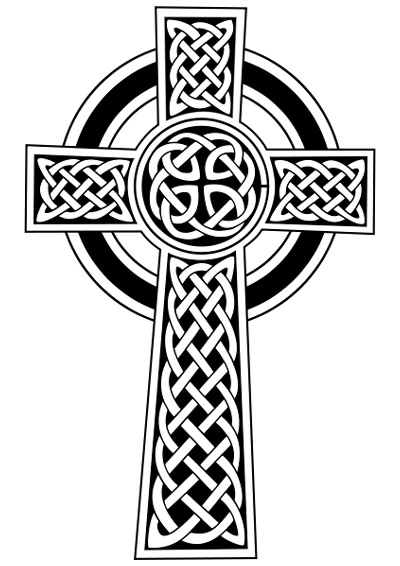
    And when you think about it, the Celtic Cross tarot spread looks nothing like a real Celtic Cross, does it?


    Certainly it’s one of the most popular spreads but I’m not very sure of its history.  I know that it’s mentioned in A E Waite’s ‘Pictorial Key To The Tarot’ but I’m unclear as to whether there are any written records of it before the clever clogs of the Golden Dawn got involved….

    If anyone has any more info about this, I’d love to hear from you!

    There are lots of variations on the Celtic Cross theme and, of course, I luff it to death because, not only is it a good-sized spread to use,  it has a significator!

    And since this blog is about Court Cards, anything that promotes the Courts as A Force For Good is FINE by me 😀

    Why do I bother with a significator? Primarily because it allows me

    a) to gain some insight into my client’s view of themselves – if I’m letting them pick a significator based purely on the imagery of the card.  I like them to explain to me why they’ve chosen the card that they have – it can be very revealing!

    b) to get my head in the zone by taking my client INTO the spread with me.

    I like to use the Druidcraft Tarot court as significators, because they are so expressive.  Doesn’t matter what deck I’m using, it will be the Druidcraft Court they select from!  Why don’t I just use the courts from the deck that I’m working with?  Well, if I do that, then the card used as the significator cannot possibly come up in the reading.  But by using a different set of 16 courts, I have the full 78-card deck at my client’s disposal.

    Anyway, enough of me, what about you?  What was the first spread that you learned?! Share it – one can never have too many good spreads at your disposal!

  • Here’s looking at you, Court

    Honestly, I’m wearing a battered fedora and the smoke from a cigarette drifts nonchalantly from the corner of my mouth as I utter those words to you.  Look *points to Ingrid Bergman in the corner*.

    This post has got nothing to do with fedoras, fags or Casablanca.  It’s about the courts.  Of course.

    I find that working with the direction that a Court Card is facing can yield some interesting interpretative options to your Tarot readings.

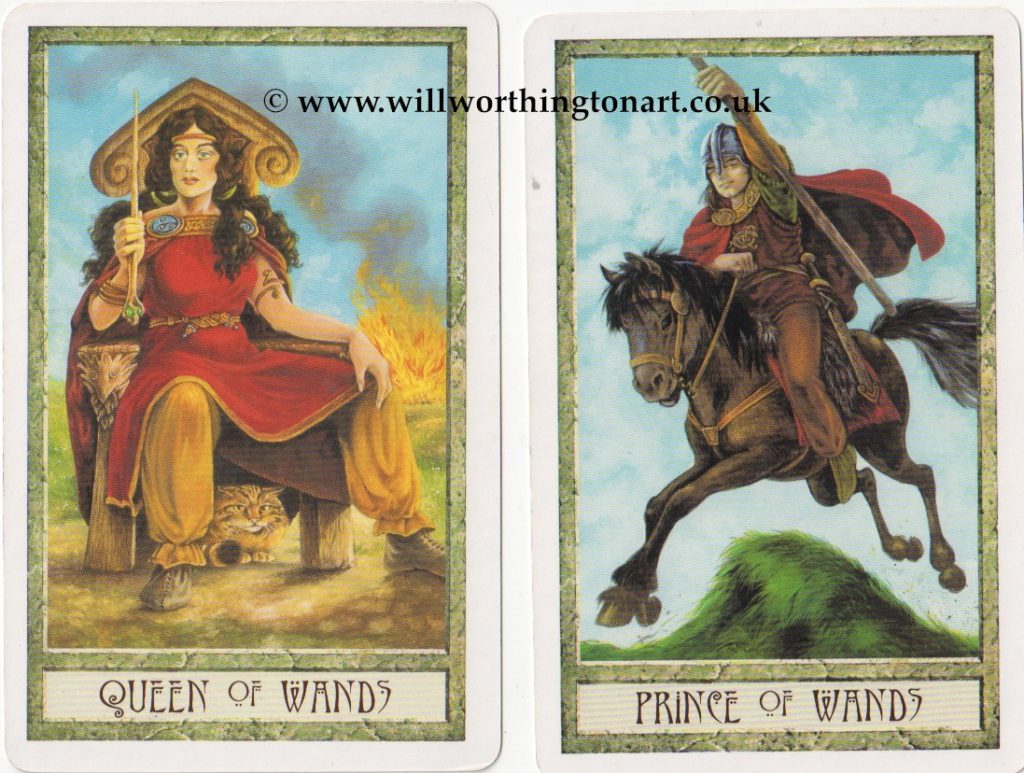
    Here are a couple of random samples from the DruidCraft’s court:

    The Queen of Wands doesn’t seem in the least perturbed by the galloping of her Prince (the equivalent of the more usual Knight) towards her at a great rate of knots.  He is moving towards her – so for me he’s riding home.

    Maybe he’s having difficulty breaking the familial bonds with his mother?

    Swap ’em about and you still have the Queen not looking terribly bothered about her offspring, but now we have him riding off,  away from her.  The bonds are broken, he’s away to do his own thang – possibly helped by a swift point in his horse’s rump by his mother’s Wand?!

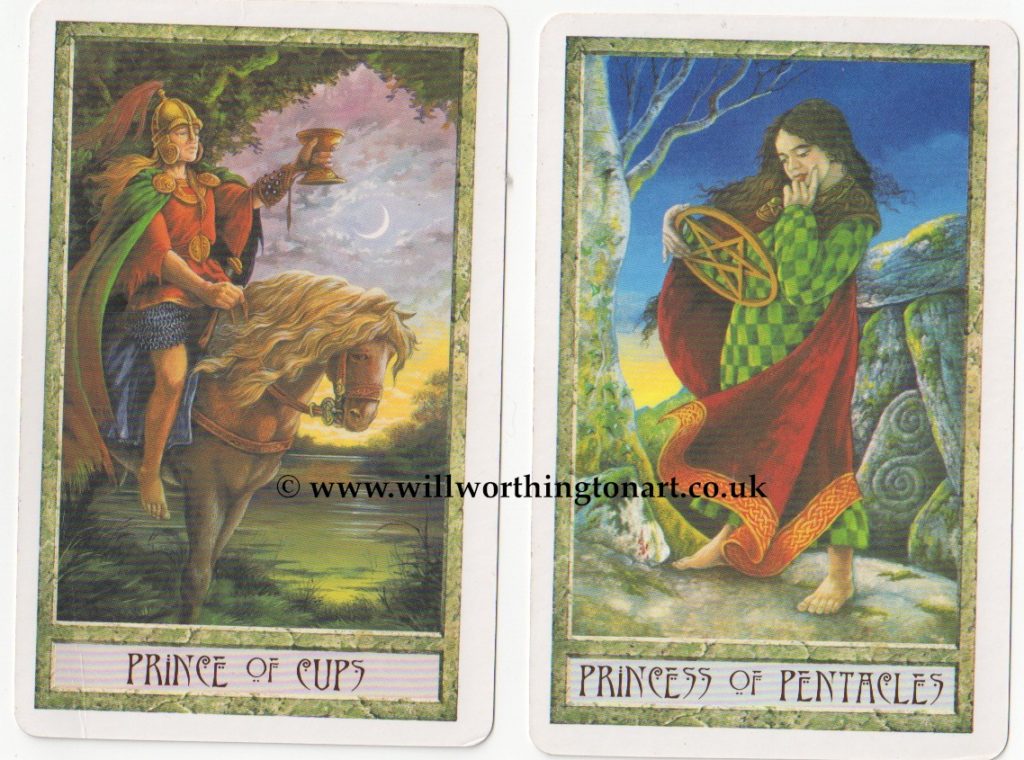
    In the second example, we have the dreamy Prince of Cups holding his golden chalice aloft, towards the Princess of Pentacles.  It looks as if he is raising his glass in a toast to her.  But the little Princess is completely focussed on her Pentacle.  She’s got no time for dreamy boys.  Yet.

    Switch them around, now they are standing back to back.  Is he her protector, her defender? Does his presence allow her the freedom to be a child a little longer?

    Mix the pairings up.  Now we have the Prince of Wands riding slap bang into the back of the little Princess.  This guy could seriously do her a damage – she’s no idea that he is bearing down.  Her Princely protector is gone….. it feels like there is going to be the most awful crash, and the innocence of the little Princess may be lost!

    In the other pairing, the Prince of Cups is now looking at our somewhat detached Queen of Wands.  He offers up his Chalice and she offers up her Wand.  Although she doesn’t look at him, I get the feeling that she won’t exactly send him off with his tail between his legs if he comes a knocking on her bedroom door at night!

    The Courts don’t even have to be looking at another Court for this technique to add a little more colour to your readings.  What do you think? Give it a try and let me know how you get along!

  • Meet The King and Queen of Cups

    Reverting once more to the glorious Court Cards of the Druidcraft Tarot, I’m introducing you to Mr and Mrs Cups.

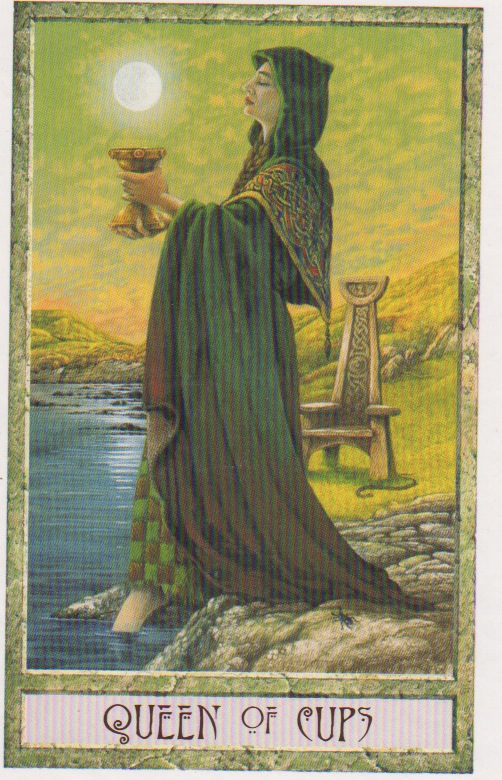
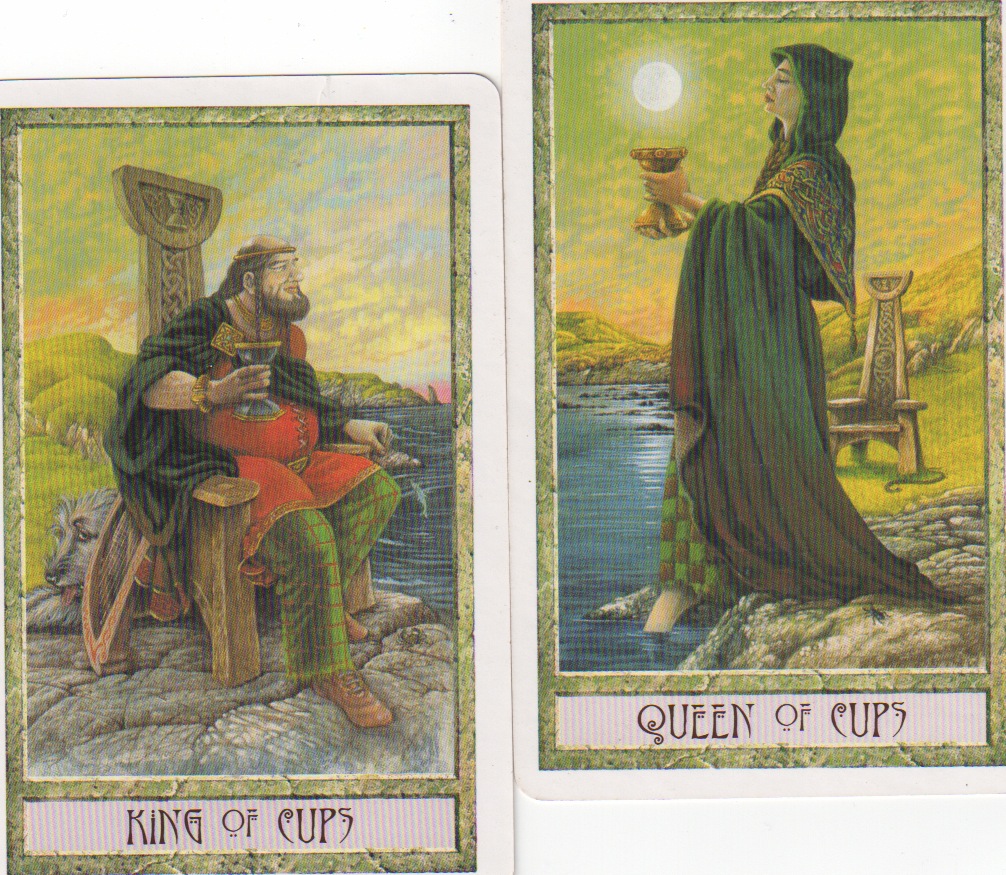
    The Queen of Cups stands on the shore of some tranquil waters, her bare toes dipping into the glassy cool depths.  Unlike the other Queens of the Druidcraft, she is standing, her throne can be seen some steps away with a serpent lying close at hand.

    Her hair is covered by an elaborately embroidered hood and she stands, eyes closed (or downcast?) as she holds her golden cup before her, as if she is working a ritual.

    The full moon floats eerily above the chalice, almost like an accessory in a conjuring trick.

    The sky is changing – either dawn or dusk.  I like to think of it as dusk because the Cups rule the Autumn and the West and so dusk is the time of day that resonates with these qualities (Wands being midday, Pentacles being midnight and Swords being dawn).  These times of the day are special – offering us gateways to travel between worlds.

    There is also a black beetle near the edge of her cloak. …. some people think that this is a scarab beetle, but I’m not sure and the book is silent – as is the Druid Animal Oracle by the same creators (Will Worthington and Phillip & Stephanie Carr-Gomm).  But I’ll find out 😀

    The atmosphere in the card feels silent, but somehow charged-up by the Queen’s actions.  The characters feel like Irish Celts – from the embroidery and colouring of her robes to the snake on the ground.  In Ireland the Christian church drove out the druids (the adders) and that’s why there are no snakes in Ireland.  Or so the story goes.  So she’s definitely got Irish Druidy connections for me.

    As Water of Water, she vibrates to a single element – love, compassion, empathy and the creative impulse are very strong.  An ‘unhealthy’ Queen of Cups (ie reversed position) could be manipulative, selfish, clinging and *cough* wet.

    She doesn’t need her eyes to see you, she can tap into your emotional state.  This can leave her vulnerable to energy vampires (oh, you know what that is – the toxic friend that leaves you washed out and exhausted after a self-absorbed telephone call)

    To remain healthy, she needs to ensure that it’s only her toes that get into that emotional water!

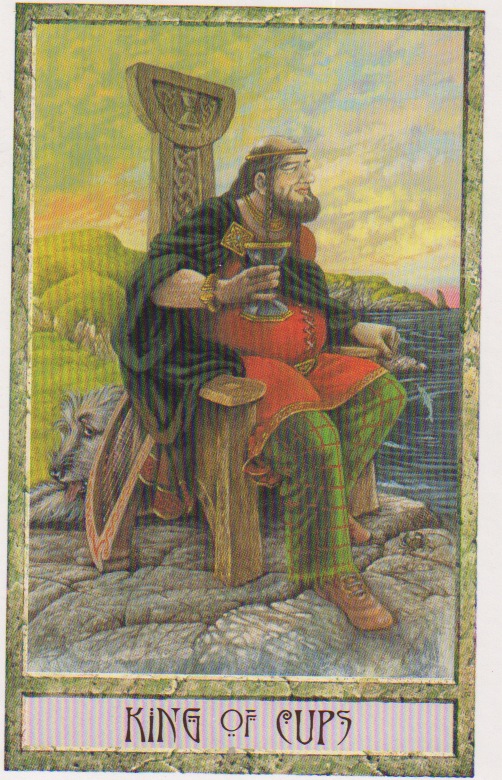
    Take a look at the King.  He sits on his throne like a well-stuffed sofa!

    His crown is bald and he wears a circlet of gold.  He does not face out towards us like the Wands King and his close relation the King of Swords.  Instead he looks off to the right, an attitude that I associate with looking to the future.

    He is musical – his harp lies by his side.  And a great wolfhound lies behind his throne.  This is a loyal husband and a wise man (see the salmon of wisdom in the watery depths).

    He does not enter the water.  Unlike the Queen, the King is Water and Fire. He is aware of the emotions (he looks out over rippling water) but he does not act from them. He can understand your emotions but is perhaps better at knowing what needs to be actually DONE.  In this respect he is a master of diplomacy.

    But he can be found working in the caring professions, where what you need is a compassionate response, but someone who is still able to take action.

    There can be a conflict going on within this man.  Sometimes what he needs to do is at odds with how he really feels.  So he can really feel stressed out by situations when this conflict arises.

    He sits in a similar dusky landscape with the sun just going down.  But whereas the Queen has Irish connections for me, the rock formation in the distance of the King’s card looks like the Old Man of Hoy, which is on the Orkney islands of Scotland.  So you can make up your own mind about this duo’s Celtic origins!

    There have been ruins found on Orkney of a settlement called Skara Brae that archaeologists are increasingly convinced are the ruins of a centre of artistic/spiritual leaders…. perhaps like Anglesey was for the Druids?  Perhaps the Cups are from this community?

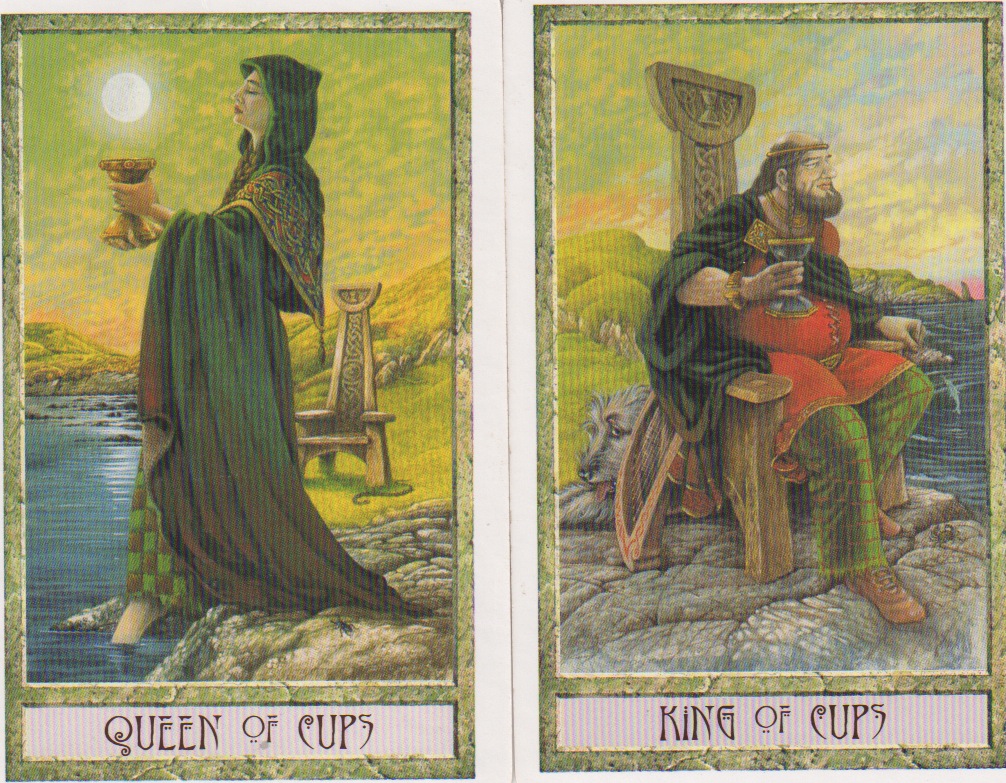
    Placing them side by side, The King looks at his Queen.  More specifically,  he looks at her cup.  In fact, even if you line up their horizons, the King still looks at her Cup.  His focus is not on her beauty or form, even though they face each other.  And her eyes, as we have noted, are closed.

    Placing them the other way around, the figures are back to back.  With the Queen looking to the left which is, for me, looking back to the past, to the Old Ways.  Whereas the King looks out to the right, to the future….

    What do you think? What would you add to the King and Queen of Cups?

  • Meet the Swords!

    So far we’ve met the Wands family and today it’s the turn of the Swords – which is entirely appropriate given the recent Spring Equinox.  As with the Wands, I find that taking a look at the rest of the Swords realm gives me good clues as to what I can expect from the ruling family.

    Decision, Frustration, self-limiting beliefs, grief, thought, mental agility, drama queen behaviour, honesty

    In my system, Swords are associated with:

    Air
    Spring Equinox
    Dawn
    Mental faculties/communication
    East

    Other systems are available, so just find one that works for you and stick with it!


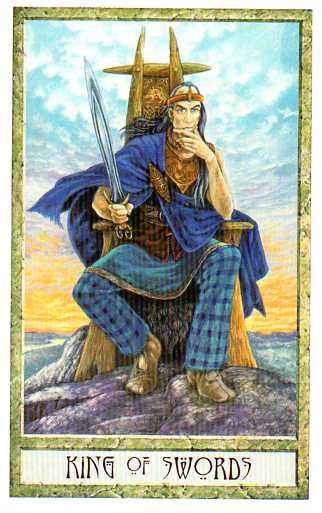
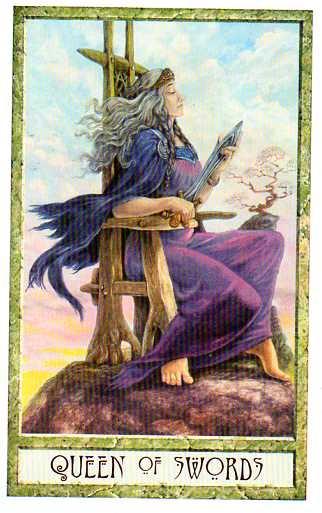
    The first thing that I notice about these two cards is the wind lifting their clothing and hair.  Their thrones are quite plain – which suits them, they’re plain-speaking sort of people. Behind them both we have a sky unfolding into a bright, but cloudy dawn.  The landscape that they sit in is harsh, with little in the way of greenery to take the hard edge off.  The Queen at least sits by a distant tree – but it looks gnarled by the wind at best or bonsai-ed to tiny, clipped perfection by the Queen’s blade.

    Neither of the two of them looks much like fun.

    The King engages with us, looking out directly, but the Queen faces off to the right, her eyes downcast, focusing on the blade in her hand.  She is barefoot – on stone – her feet will be cold; she feels austere, distant.  She looks self-contained.  What do you think her positioning with her back to her Consort means.  Even if you place them the other way around, she is still not engaged with him, her gaze is elsewhere.

    The King of Swords is Fire of Air – a productive mingling of elements that means he is well-suited to his Kingly role – able to take action, but more importantly, able to think through the ramifications of his actions before he steps away from his throne. But left unattended – air and fire can rage out of hand! He’s not got great emotional input into what he does – he’s hard on others, and hard on himself too.

    The Queen is Water of Air – another blending of elements that show that her emotional base and her thoughts are quite congruent (think of air and water coming together to make bubbles!) Although she doesn’t look it, there IS an effervescence about the Queen of Swords.  Witty and clued-up, she’s ideal company at a party.  Just watch out that she doesn’t get too handy with that little blade though – her honesty can be cutting.

    Traditionally, she is associated with a woman on her own.  Not necessarily a widow or divorcee.  One can be married and feel quite alone too.

    They both seem older than the Wands – the King with his high forehead (receding hair?!) and the Queen with her beautiful grey locks.

    What about the Juniors?

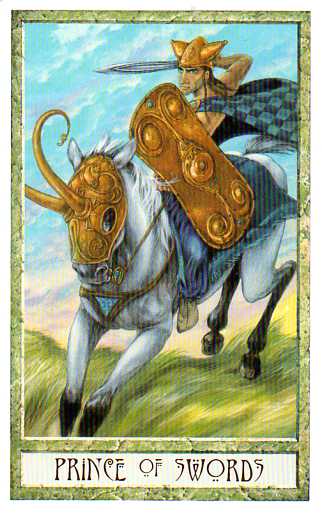
    The Prince of Swords is not on a hilltop like his parents – therefore he’s not got the same breadth of vision as they do.  Look at the Wind in this card!  The grass is blown flat, his cloak flies out behind him.  This character is Air of Air – with no other elements to moderate him.  He’s someone whose thoughts are still being formed and as a result, he flies about – latching on to one thing only to discard it when he learns something else.  Consistency is not his strong point!

    Although his parents have their swords drawn, neither of the two of them look much like they are going to give you a jab.  Not so the Prince of Swords – shield up, sword out, riding to the attack.  He has much in common with the Prince of Wands – both rattle into action at the drop of a hat – but whereas the Prince of Wands is motivated by the thrill of the chase, the Prince of Swords is motivated by what he believes is right or wrong.  Trouble is, he’s not always right about what he thinks is wrong!

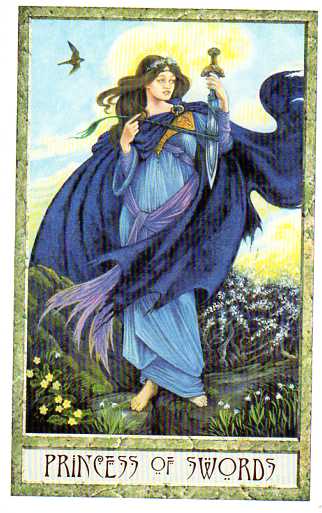
    The most junior member of the clan is the Princess of Swords.  Again, a lot of wind in this card! The Princess’s robes are whipped almost to shreds by the wind blowing around her.  Like her mother, she stands barefoot, but unlike her mother, her stony surroundings are tempered into softness by the beauty of spring blossom.

    As far as elemental associations go, the Princess of Swords has the most trouble – she’s Earth of Air.  Look how she winds a green ribbon (earth) around her blade (air).  That’s just going to get ripped to bits!  Still, she’s got to learn…..also, she might want to think about how she’s holding her sword – that’s going to be a lot worse than a paper cut!

    Blessed with a quick mind, The Princess is also shackled to a slow experiential curve.  She’s keen to learn a lot of things, but it will take time to put them into practise – this can manifest as frustration, bad temper, and a tendancy to gossip…and shredded ribbons 🙂

    What do you think about the Swords?

    The Sword family are provided courtesy of the DruidCraft Tarot.  Published by Eddison Sadd (Connections). Artwork Will Worthington and words by Philip and Stephanie Carr-Gomm.