I thought I’d give you something really lovely that doesn’t put a single inch on your hips for Valentine’s Day. And here it is – my Tarot Court interview with Mary Greer! I hope that you enjoy it:
I asked top Tarot author Mary K Greer whether she would like to answer some Court Card questions for Tarot Thrones and, ever gracious, she agreed:
Mary – thank you so much for agreeing
to answer questions for my Court Card blog.
I endeavour NOT to use your ideas and
exercises on my own Court Card blog here, but, more often than not,
when I re-read your book, Understanding the Tarot Court (UTTC) I realise that you got there YEARS before
me! I apologise for inadvertently using your work – you really have
created the Go-To book for working with the Tarot Court. There
doesn’t seem to be any aspect of working with the Courtly characters
that you have left unexplored, how did that book come about?
Great minds think
alike! Tom Little and I were on a Tarot discussion group way back and
the court cards came up quite frequently as problematic. Because Tom
worked with Marseilles-style decks and I work more with the
Rider-Waite, some different perspectives were produced that started
expanding the possibilities for everyone. Tom started his own group
to specifically explore the older French and Italian decks and Court
Cards. We found that people told really intriguing stories about the
“families” they saw in each suit’s court. So, I proposed we
work together on a book that would work well for any deck.
Why do you think that people struggle
with Court Cards more than the other sections of the deck?
A Court Card, by
itself, doesn’t tell a story in the same way other cards do – at
least in most modern decks. Its meanings don’t usually describe
events. There’s no action except sitting, standing or riding. Nor
are we familiar with the classical references made to European
playing cards. Once people get that it is more about a style,
attitude or “way” of doing things then it becomes easier to
understand their role in a reading. That’s why most people enjoy
the learning games. It’s not that difficult to know what cars the
four Knights would be driving, instead of riding a horse. But, we
still don’t know where they are going in their cars or why—unless
we ask them [more about that later].
The esoteric organisation, The Golden
Dawn did a great deal of work with the Tarot Court – what’s your
favourite contribution of theirs to the understanding of the Tarot
Court today?
I don’t often
pay attention to their correspondence with the last 10° of one Sign
and the subsequent 20° of the next Sign. Primarily I focus on what
element they are most aligned with—all of the Wands Court are Fire,
and all Queens are somewhat Watery—so that the Queen of Wands is
the “Watery part of Fire”. I like the GD use of elementals and
other esoteric insignia in the designs. Mostly, I found that the
reconceptualization of the Courts as Knight – Queen –
Prince/Emperor – Princess was liberating. Oh, and I also like that
the only use for reversals was to determine what direction the Court
Cards were looking or moving.
Preference – RWS court or Thoth court?!
I feel really
comfortable with both as long as I am clear on which one I am using
in a particular situation.
What makes a ‘good’ Tarot Court in your
opinion? And when I say good, I mean ‘readily accessible for
readers’!
A well-designed
Court Card cannot be confused with either a Major Arcana or a pip
card, plus the ranks are each distinct. I don’t want to mistake a
Page for a Queen or King. I want to be able to tell each apart
immediately. I also want them depicted so that, when described by a
person, it naturally goes with adjectives that are characteristic of
their suit, element and rank. A Cups Knight can be anything from
romantic to wishy-washy and yet slightly “fired up” (in a
Knightly sort of way)—if you use those conventions. A Pentacles
Page should definitely be earthy but young. The William
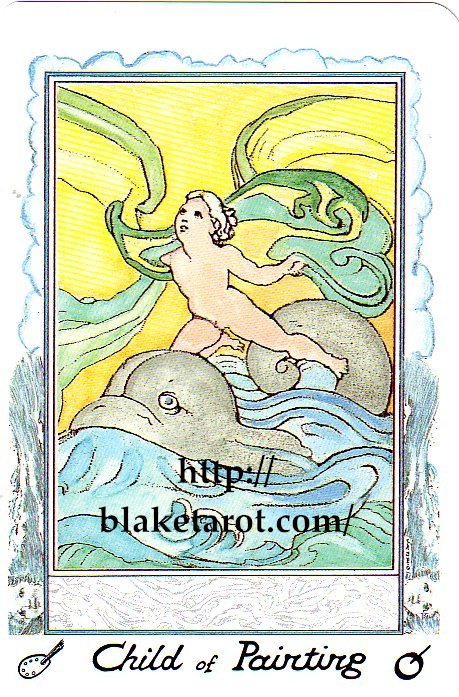
Blake Tarot uses Angel, Man, Woman,
and Child. Each can be clearly discerned, has distinct
characteristics, and fits with its suit. Also, I generally don’t
like them so personalized that they seem like real people as I can
get too caught up in a specific personality. I prefer a “type”
rather than an individual. The Gaian
Tarot is an exception to this,
although it was a hurdle I had to overcome.
 |
William Blake Tarot:
Trad: Page of Pentacles |
[Ali: Dear
Reader, I promise to post about the Courts in the William Blake Tarot
by Ed Buryn next week :-)]
Given the huge swathe of decks you have
come across in your career, which deck’s courts do you love best (and
why!)
That’s really
hard to say. I have favorite individual Major Arcana cards from
different decks, but not many Court Cards. When checking out a new
deck, I often look at the Queen of Swords to see if the designers
have conveyed her in a way I can appreciate. Maybe, Kat Black’s
“Golden Tarot” comes closest to my favorite Court Cards, although
the Thoth and RWS are so well known to me that they are like parts of
myself.
If you were to create the perfect Tarot
court, what would it consist of? Would you choose the ranks and sexes
of the RWS style deck, or a more 21st century
representation of life?
I’d probably
stick fairly closely to the RWS. I really love the William
Blake Tarot of the Creative Imagination with
its Angel, Man, Woman, Child concept. It has, therefore, the higher
self/superego/spirit messenger, the masculine, the feminine, and the
inner-child. I like that.
What’s your favourite deliberate use
for a Court Card?
For me, a Court
Card always, always represents an aspect of myself—that I may or
may not be giving away (projecting on) to someone else (having them
play the role for me). I try to always “own” the role it is
taking in a spread even if it is clearly also my mother coming to
visit. In readings I often ask querents what each Court Card advises
that they do (which helps them to see the projection). If the Court
Card is in a past
position, then I might say, “What would your father, if he was this
card, have wanted you to do back then?”—given that we had
perceived qualities of the father in that card. I might even ask a
querent to dialog back-and-forth with a Court Card. A person doesn’t
have to follow the advice, but they need to recognize the voice of
that person (“the internalized father,” for instance) that they
carry around in their own psyches and which may still be influencing
them. The Court Cards are rather like a council of more or less
helpful advisors and opinionated voices, arising from different parts
of myself or externalized through individuals in my life. They urge
us to take their perspective.
Pages can indicate schooling or your receiving a message of some kind and Knights can indicate travel or represent rival lovers. A Queen can be your mother or friend and a King your father or boss. Try to not overlook the obvious.
Which Courtly personality is your
favourite, and why?
The Queen of
Swords. I like the contradiction of her being a Queen and therefore
interpersonally-oriented, yet tending toward the rational and
logical. She is deeply perceptive and clear about her boundaries and
limits. She can be compassionate but without sentimentality. And she
doesn’t take any nonsense from anyone.
Amongst the array of exercises and
approaches in your UTTC book you look at the Myers Briggs types and
allocate them to the various Courtly personalities – do you think
that there is more out there that contemporary Tarotists can take and
‘hang’ on the Courts?
There probably
is. Any system of 16 types might work, and even 12-type systems can
work if one of the Courts can be assigned the “pure” type. The
problem with the Myers-Briggs system is that a purely logical
association of types to elements and ranks doesn’t perfectly match
the characteristics of either. You end up having to skew a few types
or cards to make them fit. Whenever you link correspondences this is
always the case. For instance, Taurus and the Hierophant are not
really a perfect match until you deliberately start making them look
more and more like each other. As long as you don’t take them to be
exactly equivalent (accepting that they are square pegs in round
holes) you’re okay.
At the moment you are deeply involved
with the Lenormand Oracle, what are your thoughts about the
personalities of ‘face cards’ as shown on the Lenormand and their
relationship (with regard to interpretation, rather than historical
links) with the Tarot court?
In Lenormand I
don’t attach much in the way of personality characteristics to the
Court Cards except that the Queen of Clubs (Snake) is a rival, other
woman, or wicked step-mother type, and occasionally a wise friend.
The characteristics of other people, if I discern them in a Lenormand
Court Card (rarely), are determined by the cards immediately around
them. Their role as a specific person is usually secondary to the
primary function of the card. For instance, the Child is most likely
to be a child or something new, rather than a
child-as-described-by-the-Jack of Spades. Bouquet is primarily a gift
or invitation and only secondarily might have something to do with a
female relative, but certainly it does not have any characteristics
one would associate with the Queen of Spades. It needs to be
remembered that the divinatory system associated with the original
German suits is totally different than the English and French
cartomantic meanings we usually associate with them. For example,
Clubs is by far the worst suit and Spades, the best.
Many thanks to Mary for answering my questions about the Tarot Court! If you’d like to know more about Mary’s work:
You can find Mary on Facebook here
Her latest book is: Who Are You in the Tarot? You can ‘like’ the page on Facebook here
If you would like to know more about the William Blake Tarot, click here
Stop being confused by court cards! Start being excited by the possibilities! Become a court card adventurer along with me 🙂 The Tarot’s Court Cards are my specialist area. They talk to me. Not LITERALLY though ….