Month: November 2014

  • The Wicked Queen | Snow White | Villains in the Court

    ‘Bring me back a Crunchie and a 99 cone’

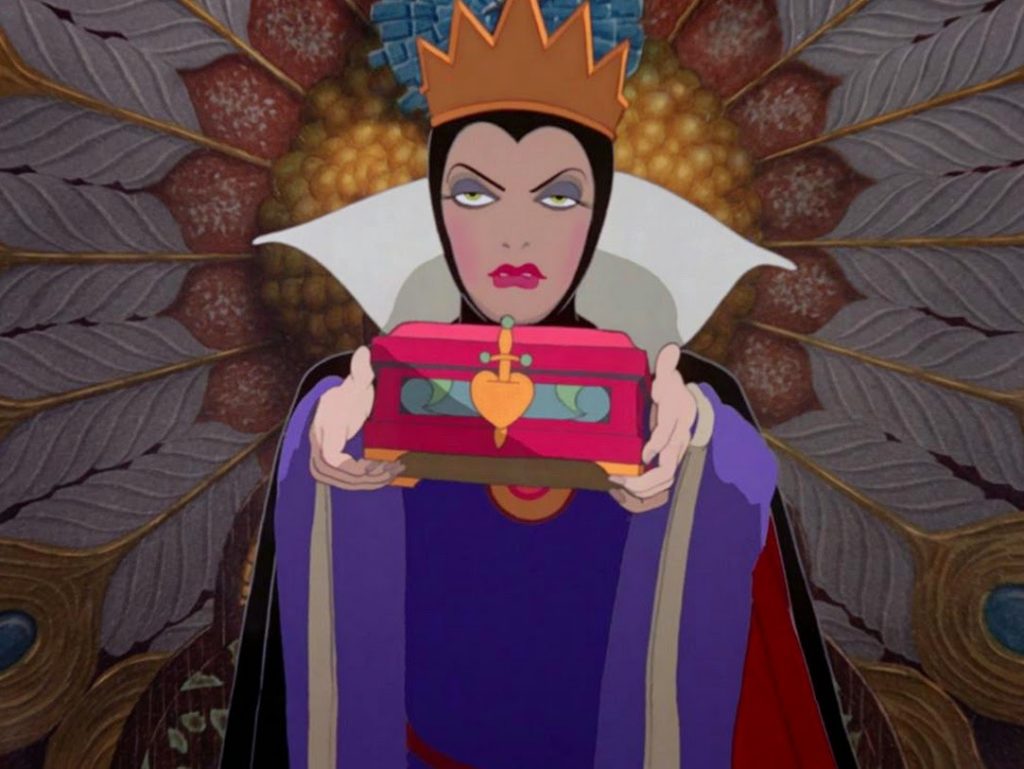
    In Walt Disney’s 1937 classic ‘Snow White’ the wicked Queen is the young princess’s step-mother.  Beautiful – in a glacial Hollywood Bitch sort of way – the Queen erupts into a jealous rage when her magic mirror tells her that she is no longer the fairest in the land.

    Raven-haired step-daughter Snow White has become the most beautiful in the land! Which can only be bad news for Snowy.

    The Wicked Queen charges her hapless huntsman with the job of taking Snow White into the woods and murdering her.  To prove that the job has been done, the Queen gives him an appropriately decorated box in which to bring back her heart!

    Of course, her evil plan is thwarted and the Queen has to do the job her self.  Using her totally EBIL magic powers she transforms herself into an cackling hag and uses the same skills to poison an apple.

    Using deception and preying on Snow White’s good nature, the Wicked Queen persuades the princess to bite the apple….

    The dwarves who have allowed the house-work-mad princess to live with them rush home from their work in the mines to discover their lovely Snow White ‘dead’ on the floor.  Incensed they chase after the Wicked Queen who eventually plummets to her death, thanks to a judicious bolt of lightning.

    -o0o-

    But here’s the thing! Which Court Card would you choose to represent The Wicked Queen?  I initially decided on the Queen of Cups reversed.

    This is because, according to my Ready Reckoner Guide to Villainy in the Courts, this crime would be committed by a member of the Cups family: After all, it is perpetrated on a family member (well, step-daughter) and caused by jealousy.

    However, there is a cold and calculating side to this Queen – cruel plans (is there any other kind? lol!), a contract killing, a demand for proof, deception (transforming into hag, poisoning the apple) which makes me think that the Queen of Swords reversed is perhaps closer to the truth.

    Add to this the skeletal remains in her dungeon and we see that she’s a heartless ruler.  And there is no sign of Snow White’s father either – so, for me, it’s looking weighted in favour of the Queen of Swords.

    What do you think?

  • Tarot in Art | Besancon Tarot

    Again I have been dusting in the vaults and stumbled upon this jewel lurking in a darkened corridor, the Besancon Tarot.  Reader, there should be a cedilla underneath that ‘c’, but my keyboard won’t let me insert one *ashamed of uncouth keyboard face*

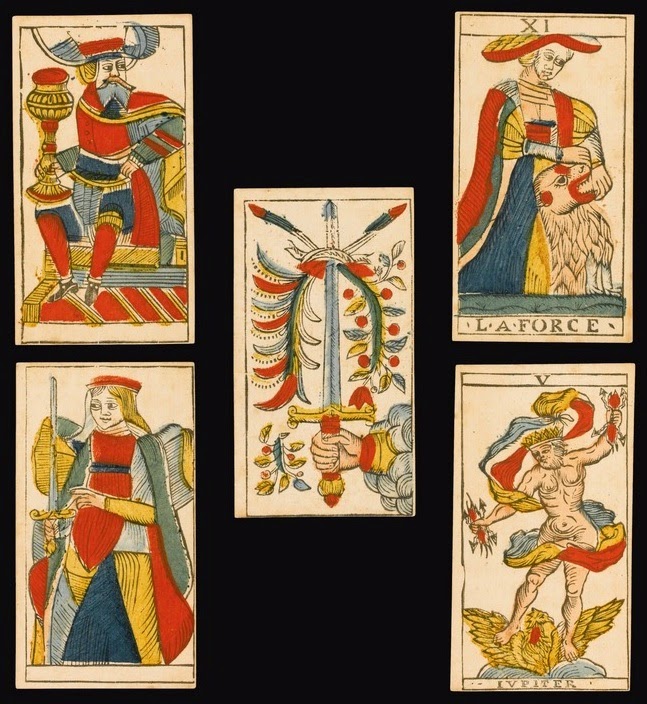
    This French Tarot by Guillaume Mann has some interesting omissions – from this image we can see that the King of Cups and Queen of Swords have had their titles removed and also their crowns, thus ensuring that this is a politically astute deck for Revolutionary France!  Better their crowns and titles swiped than their heads 😀

    Interesting to see that Major Arcana V is named  Jupiter and not The Pope.  This change wasn’t so much brought about by the Revolutionary attitude towards cutting links with the church as much as it was the church itself having been quite keen on getting rid of the figures of the Popess (Juno) and the Pope (Jupiter) from the deck – it’s not terribly dignified having the Pope as a trump in a card game that was no doubt played in inns and brothels all over Europe and goodness knows what the blessed cardinals thought of the mythical Pope Joan as the Popess!

    Created in 1795 in the town of Colmar in Alsace, this particular 78-card deck sold for £2,375.00 in November 2013.  The Besancon Tarot was a fore-runner for the IJJ Swiss

  • Meet the Family | Dame Fortune’s Tarot Wheel

    A while back I was enthusing about this Dame Fortune deck because it had a ready-made significator which absolves you of appropriating another Tarot card to use as the significator for your client.  At the time, I said that the Courts of the deck were worth a post on their own, so here they are.

    A year later.

    What can I say? I’m in a Pentacle-type sloooooooow state of mind 🙂

    I’ve written a post on the names associated with these Tarot cards, which you can read here.

    Dame Fortune’s Tarot Wheel was created by Paul Huson, the author of the excellent Tarot books, The Mystical Origins of The Tarot and The Devil’s Picturebook.


    Huson favours the tarot as it was, prior to the meddlings of those pesky kids from The Golden Dawn and draws his inspiration directly from Etteilla’s Tarot of the 1700s.

    Who was this Etteilla person and why are we interested in him?  well, that will be the subject of another post!

    Anyhoo, let’s meet the courts who have been waiting patiently for a year! Here’s my take on Dame Fortune’s courts 😀

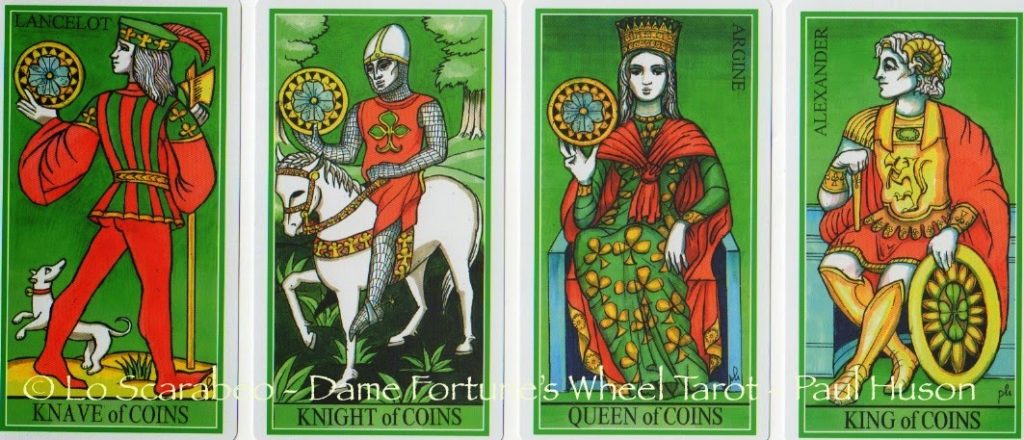
    The suit of Coins family are depicted in a verdant green with contrasts of red, which make them a most visually striking suit.  Like The Fool, the Knave has a playful dog at his heels as he focuses on his Coin (and not in the direction of where he walks!), his axe in hand.   He’s named Lancelot.
    The Knight’s tabard is decorated with a trefoil (associated with the suit of Clubs) and he rides slowly through a lush woodland setting.
    Hopefully you will have noticed that all the Courts bear a name.  These names derive from the Paris pattern (learn more about that here).  I would love to know whether you feel the stories of the various characters influence your thoughts about them as Court personalities.
    You’ll note that none of the Knights have a name.  This is because the fashion for naming the Court cards spilled over from playing cards.  And playing cards only have Kings, Queens and Knaves 🙂
    The Queen’s robes also sport the trefoil and this Queen is named Argine. I have searched all the dusty corners of the internet for a woman of importance called Argine, but nothing has turned up.  If you can tell me who Argine was – please let me know!  It may just be a bastardisation of Regina.  I know that ‘argine ‘ is also Italian for ’embankment’ or ‘dam’. 
    Alexander is the King of Pentacles. The King’s Coin has become his shield.  He carries no weapons.  I love his horns.  The King of Pentacles is associated with Taurus and I like to think of these as his bull’s horns.

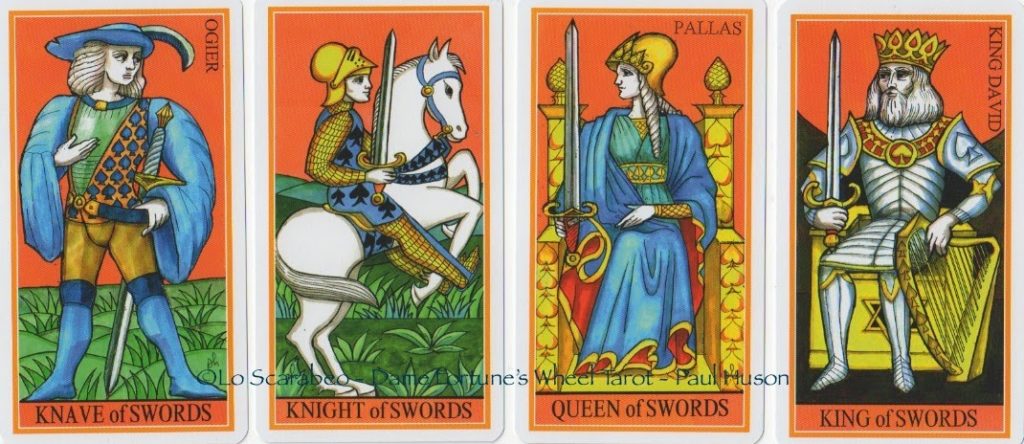
    The Swords family are largely in orange with a contrast of bright blue. They all sport spades on their regalia in some way or another, linking to their playing card suit.

    The Knave, Ogier, stands attentive while the nameless Knight’s white horse rears up – terribly chivalrous-looking, isn’t he?

    The Queen is clearly Pallas Athene – the Greek goddess of wisdom. I love the blood-like slashes of red inside her cloak – reminding us that this is a woman not to be messed with!  She looks directly towards the Knight – and he to her.  Looks quite an interesting relationship there…..

    I did read in Stuart Kaplan’s Tarot Encyclopedia that this name ‘Athene’ might actually refer to the martial Joan of Arc.

    Our elderly King of Swords is the Biblical hero, King David.  I love the Star of David on the throne and the inclusion of the harp, to remind us of the Psalms he wrote.  You can see the spade insignia on his armour and over his heart.

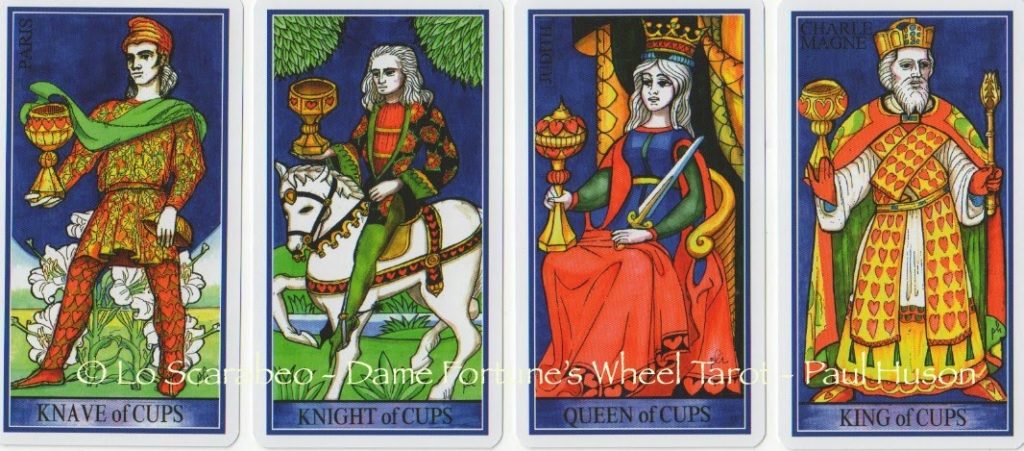
    The Cups are all in a deep watery blue, coupled with green and red.  The characters in this suit have no weapons nor armour (other than the Queen, Judith) Hearts are the playing card associations for this crowd and you can see this in all of the cards – La Hire’s leggings, the Knight’s jacket, in the robes of the King and the drapes that surround the Queen, as well as inscribed on each of their Cups.

    The Knave stands before a huge display of white lilies and his green scarf flows like water from his shoulder to his open Cup.  The nameless Knight is the least warlike of the four Knights – bare headed and weaponless; very much a character from a romantic tale.  Queen Judith’s cup has a lid on it – perhaps she keeps something of herself under wraps? It’s marvellous that she’s depicted with a sword (she decapitated the General, Holofernes, in the Bible tale).

    The King of Cups, Charlemagne, seems to be standing (the only King to be depicted thus) and is not depicted in armour – so he looks more like a priest than a King, don’t you think?

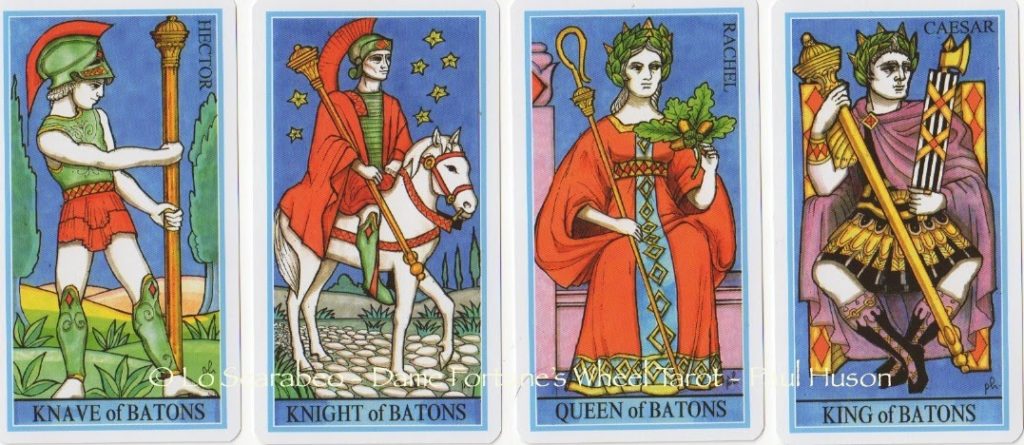
    The suit of Wands is depicted in blue and diamonds are their playing card symbol.

    The valiant Trojan Hector in his armour stands as Knave of Batons – his pose reminiscent of the RWS Page of Wands, I feel.  What does his baton remind you of? For me it is something quite playful, like a tent pole, rather than a weapon.

    The Knight rides forth down a cobbled path on his white horse looking much calmer than we would associate with a Golden Dawn Knight of Wands.

    The Queen is patient Rachel who waited 14 long years for Jacob to be able to wed her, her robe decorated with diamonds and clutching a spray of oak leaves and acorns (strength? endurance?). Her baton is a shepherd’s crook.  For when Jacob encounters her for the first time in their Bible story, Rachel is tending sheep. Caesar represents the King of Batons and has diamonds on his throne and carries the ‘fasces’ bundle that symbolises the power of the Roman senate.

    So what do you think of these courts? Do you like the names?  Do you like these characters – do their historical/mythical characters feed into your understanding of the cards as contemporary courts?

  • Full Moon | Taurus

    As we creep towards Yule, the nights here in Scotland are definitely chillier. I’ve unearthed my bed socks for another season and the central heating has been turned on*.  For us at Tarot Thrones, November heralds the full moon in Taurus.

    In Tarot, Taurus is represented by the King of Pentacles, so for 6 November, here’s how he will be influencing us all!

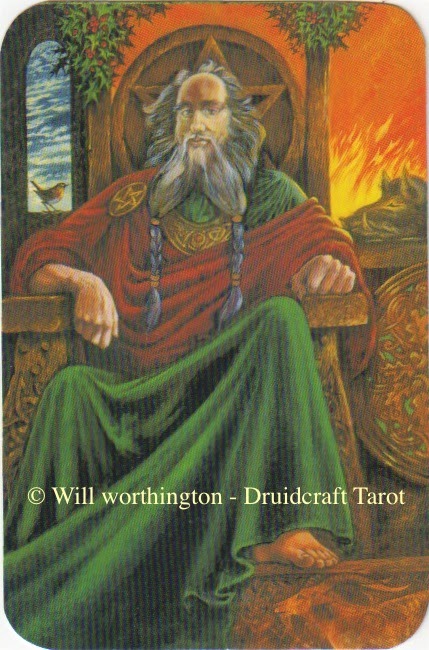
    In the Druidcraft Tarot, we see an older man who sits in his great hall in front of a roaring fire upon which a boar is roasting. I love how the carved points of the pentacle behind him look like horns!  Perched in the window is a little red-breasted robin.  The sky is darkening.  As the Stark family in that OTHER Game of Thrones might say… ‘Winter is coming!’

    Pentacles is the suit governed by the element of Earth and this, coupled with his Fiery Kingly energy tells us that the Full Moon in Taurus is a very productive time (think of how fire and elements from the earth come together to make pottery, ceramics, glass etc).

    This is a very sensuous character – he’s all about the experiencing (Pentacles/Earth) through the doing (Fire).

    He is very much at home with the finer things in life (just look at his fine robes and surroundings!) and while we may not all have the wealth that the King of Pentacles clearly enjoys, we can make the most of all the wonderful things that we DO have in our lives. Yeah, this is where I get all mushy and point out that even the dog lying snoring gently by your desk brings wealth of a sort to your life.

    Maybe not his in-sleep farting though.

    The King of Pentacles enjoys great wealth, but he is no risk-taking gambler.  His approach is steady and responsible and if you are in business, his influence shows sustainable progress.

    This full moon, he tells us:

    Be productive!
    Slow and steady wins the race!
    Enjoy life!
    Be generous!

    * How do you turn on your central heating system? Simple. You just say ‘hey baby, you are the sexiest heating system that I’ve ever seen.’  Old jokes.  Golden 😀

  • Heroes | Warriors |Worthies

    A long time ago,  I promised to show you the Court Cards from the Dame Fortune’s Tarot Wheel deck (by Paul Huson) because they are REALLY interesting: They are all named after well-known characters from classical literature and the Bible.

    I know.  CLASSICAL LITERATURE!!  THE BIBLE!!! Here on m’blog!!!!

    Before we meet those Court families, I thought that it made good sense to take a look at just why these cards bear the names that they do.

    *does the wobbly hands time thing*

    Back in the 1400s in France, it was the custom to pop names onto the face cards of the standard
    deck of playing cards. Two groups of names were common; one that
    became known as the Paris pattern and the other, the Rouen pattern.  These patterns, or lists of names,  have quite a bit of overlap and it is the Paris pattern that we are interested in today because this is the design that influenced early Tarot decks, such as Etteilla’s Tarot in the 1700s. And it is Etteilla’s deck that forms the basis for The Dame Fortune’s Tarot Wheel.
    The Paris Pattern

                       Hearts         Spades            Diamonds          Clubs
    Kings          Charles       David              Caesar                Alexander
    Queens       Judith         Pallas              Rachel                Argine
    Knaves       La Hire      Ogier               Hector          Judas
    Maccabeus *

                                                                                       Judah Maccabee

    Although we’re not talking about them today, here are the famous stars of the Rouen Pattern.

    The Rouen Pattern


                       Hearts          Spades    Diamonds    Clubs
    Kings         Alexander     David        Caesar          Charles
    Queens      Rachel           Pallas        Argine          Judith
    Knaves      La Hire          Hector      Ogier            Judah Maccabee **
                                                                                 Judas Maccabeus
                                                 

    Info from the International Playing Card Society website                                                                
    You will have noted, because I know that you are a clever and discriminating personage, that there is a Tarot rank missing – the Knights are not included in either the Paris or Rouen Patterns.  There’s nothing sinister about this, just that in ordinary playing card decks (where these patterns come from) there were only the three ranks of King, Queen and Knave.   We’ll be talking about this again when we get on to the Sola Busca Tarot in a week or so, because it’s contrary!  I know, it’s almost like I’ve PLANNED these posts.

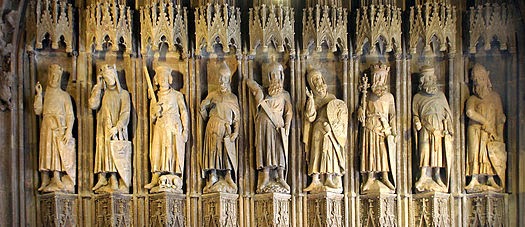
    13th century ‘Nine Good Heroes’
    (City Hall, Cologne)

    It was also suggested to me that the Nine Worthies (Neuf Preux) play a role in the names selected for the Paris and Rouen patterns.

    These Worthies were famed rulers of the Christian, Jewish and Pagan worlds and were first mentioned in a chanson de geste (a type of epic poem), ‘Voeux du Paon’  (‘The Vows of the Peacock’) by Jaques de Longuyon around 1312 – all about chivalry.

    It seems likely that similar chivalric tales (which were all the rage) influenced the naming of the cards in both the Paris and Rouen patterns.  

    The Nine Worthies 

    Pagan         Hector, Alexander and Caesar
    Jewish        Joshua, David, Judas Maccabeus
    Christian    King Arthur, Godfrey of Bouillon,  Charlemagne
    I’ve highlighted the overlapping names in the Paris Pattern with the Worthies in red.

    * Edit:  Paul Huson very kindly commented on this blog post and provided the following correction:  “Judas Maccabeus was one of the Nine Worthies but his name was never attached to the Knave of Clubs. From 1490 the Knave in both Rouen and Paris patterns bore the name “Lancelot” (of Camelot fame) although the name “Roland,” another name from French legend, was briefly tried but didn’t last”. 

    In the late 1300s,  Lists of 9 Lady Worthies were created, but only Judith seems to be an overlapping name. However, the Lady Worthies seem to change depending on who is creating the list!
    So while the Worthies must have influenced the naming of many of the male characters in the Paris system for playing cards,  the sources of the Lady Worthies just seem to be sourced from the Bible (Judith and Rachel), Argine isn’t a name that I’ve managed to find as a heroine anywhere (but it means ‘dam’ or ‘bank’ in Italian) and Pallas will be referring to the Greek goddess, Pallas Athene.
    King Arthur and Lancelot need no introductions from me but some of the others might need a Big Up:  La Hire was a French military commander during the 100 Years War and comrade of Joan of Arc and although Ogier (The Dane) was one of Charlemagne’s Knights, he became more widely known as a subject of European literature.
    Anyway, now that we’ve cleared all that up, I hope that you’re all geared up to meet Dame Fortune’s Families……in Monday’s post!