Tag: Arnell Ando

  • Pholarchos Tarot | Carmen Sorrenti | Arnell’s Art

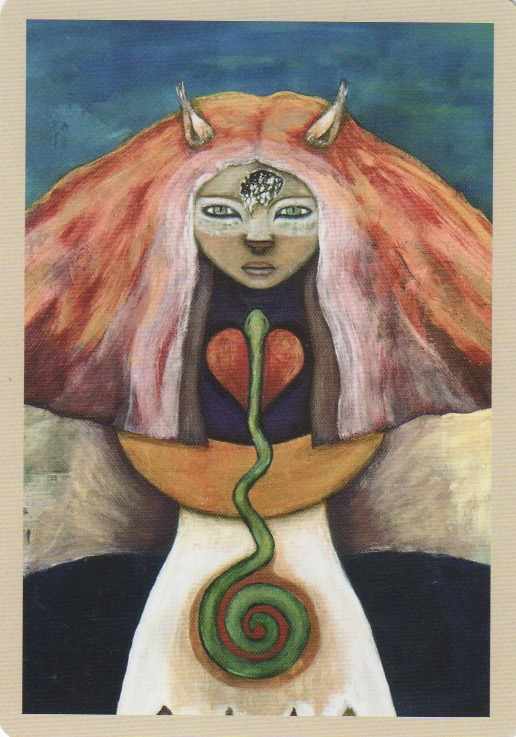
    Pholarchos Tarot: card back

    I was part of that fortunate band of tarot fans who took part in Arnell Ando’s last Tarot Art Tour to northern Italy back in 2015.  Amongst the many treats we experienced during the tour, one was undoubtedly the visit to the Tarot Museum in Riola.

    There in the garden of the museum, a young woman called Carmen Sorrenti propped some intriguing and beautiful paintings against the garden fence – the first paintings of the Pholarchos Tarot.

    Since then I have interviewed Carmen for Tarot Thrones (where she delves deeply into the deck’s inspirations) and followed the deck’s development via her facebook page and I was beyond thrilled when Arnell Ando (the publisher of the deck and the self-same organiser of that Italy tour!) asked me whether I would like an advance copy.

    By the time the Pholarchos Tarot arrived on my door mat, I could barely contain my excitement sufficiently to get into the package! Reader, I wasn’t disappointed!

    The box is sturdy, with a lift off top (illustrated with the deck’s High Priestess… a self-portrait I think) which reveals the accompanying book and the 78-card deck beneath.

    The 40-page book is full colour (but not fully illustrated) and provides Carmen’s insights for the use of the deck.  It’s not a ‘keyword’ type book, but prose poetry and the emotional flow of the card’s energies.  Here is the entry for 13 Death, by way of illustration:

    What you know turns inside out – you may not recognize this new place but it has great value. The pollen of a trillion flowers makes and unmakes you, this is the honeycomb of your bright existence.  Keep your wits about you as you harvest metamorphosis.”

    Deep and intriguing, right?

    So, let’s take a look!

    The deck measures 3.5″ by 5″ and the glossy finish to the card stock means that shuffling is a breeze (although if you have small hands, the width of the cards might mean some adjusting to your shuffle style)

    The Majors are traditionally named and numbered (Justice at 8, Strength at 11) using Arabic numerals, not Roman.  The positioning of the titles has been sensitively done, with everything placed so as not to detract from Carmen’s artwork.
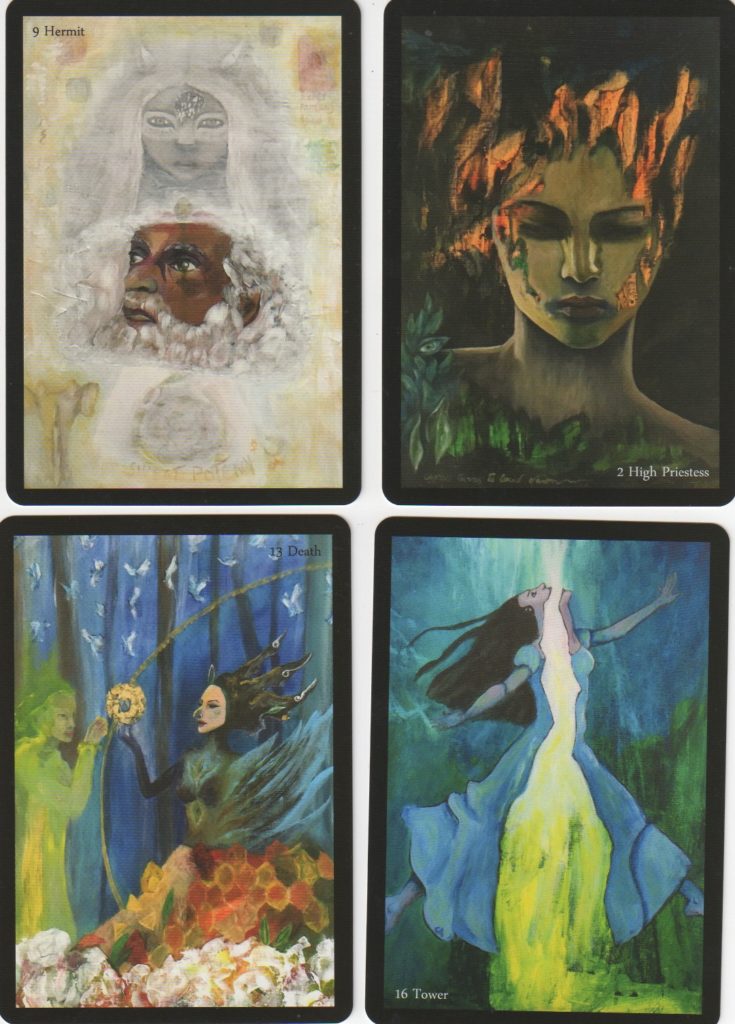
    Pholarchos Tarot – Major Arcana examples

    The deck is infused with alchemical symbolism and language, but in a magical way that is at once accessible, but also compels you to expand your concepts about the cards:  This is not a ‘The High Priestess means X and the Fool means Y’ sort of deck.

    My favourite Major is, I think,  16 Tower (bottom right card, above)  How often do you get to say that about a Tarot deck?!  The leaping figure is impaled by a divine lightning rod.  The book describes the moment as ‘an awakening’ as one is split asunder in order to refashion our connections.  I love it!

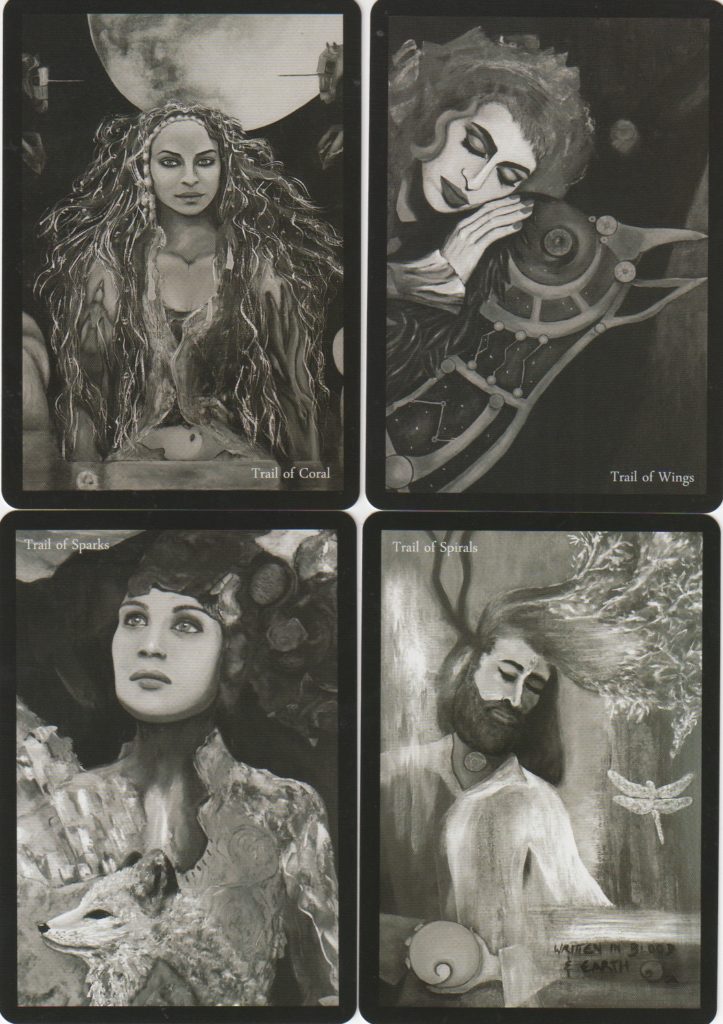
    The Minor Arcana is the area of greatest departure from the Rider Waite style decks.  We have four suits – Sparks, Coral, Spirals and Wings.  Very broadly speaking, these could equate to Wands, Cups, Pentacles and Swords.  But they are very much Carmen’s own creation.

    The images on the Minors feel as if they have been created at speed and have a dreamlike quality that demands you abandon what you THINK you know and just dive into the symbolism and immerse yourself in the qualities of THIS deck.  YOU become the Pholarchos.  You become the shaman in the cave who watches and listens, the dreamer who carries messages back to the world from beyond the mundane.

    Here are the 3s of the deck, to illustrate what I mean.
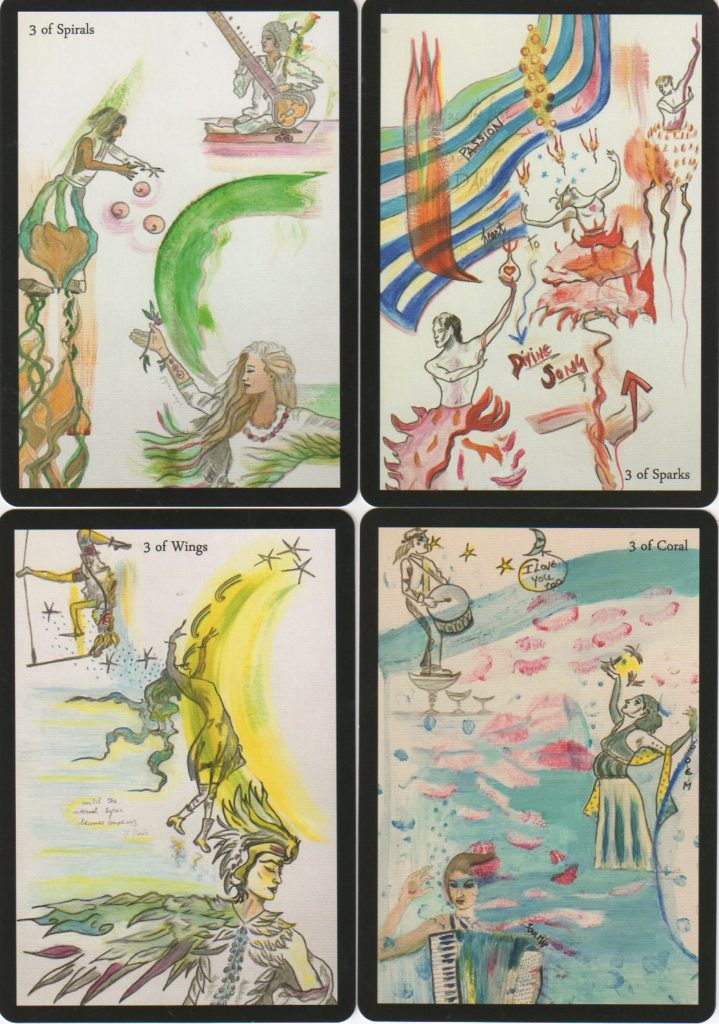
    Pholarchos Tarot – Minor Arcana examples

    And here is part of the entry for the 3 of Wings (loosely, 3 of Swords) from the accompanying book:

    “The first great cries, words turned to daggers, frenzy.  Balancing the act of becoming conscious, division creates what seems to be unbearable pain.” 

    The Minors have the same kind of feel, to me, of Rachel Pollack’s classic ‘Shining Tribe’ (thanks for the correction info, Caitlin!) AND the Motherpeace Tarot (Vogel & Nobel).

    Of course, my blog is concerned with the court cards and this is where we head now.

    There are four ranks: Dreamer, Trail, Queen and King.
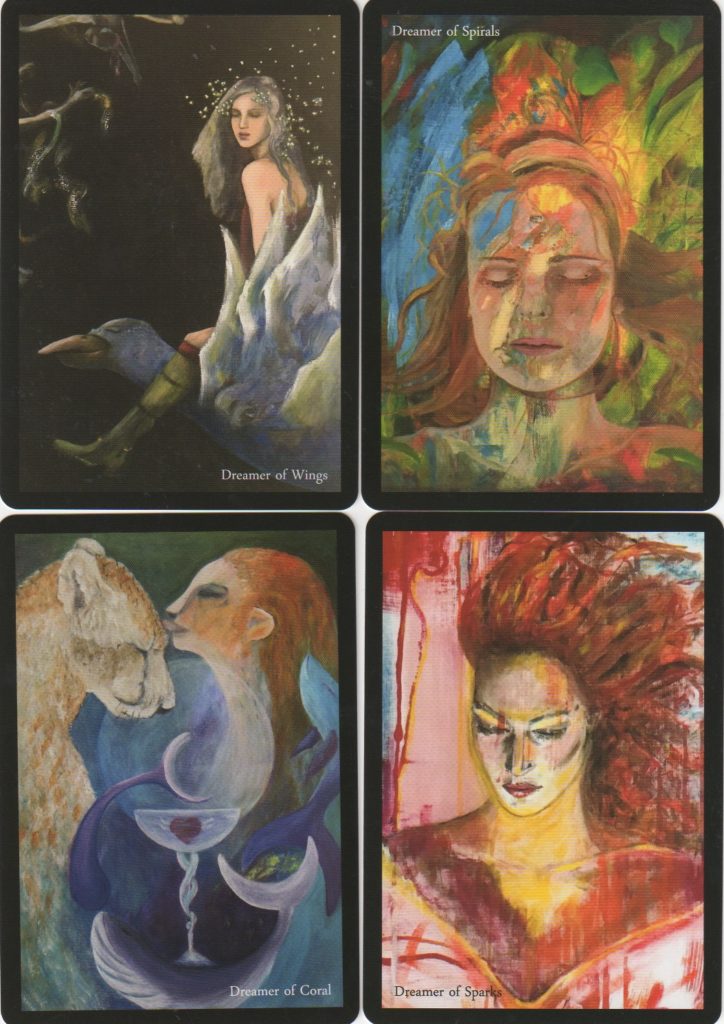
    The Dreamers of The Pholarchos Tarot
    The Trails of the Pholarchos Tarot

    Note that the Trails (who equate to the traditional Knights position) ARE in black and white (as are the Aces, in this deck). We follow the Trails every night as we fall asleep (our beds take the places of the ancient caves of the Pholarchos!). They are our psychopomps who guide us into another realm.
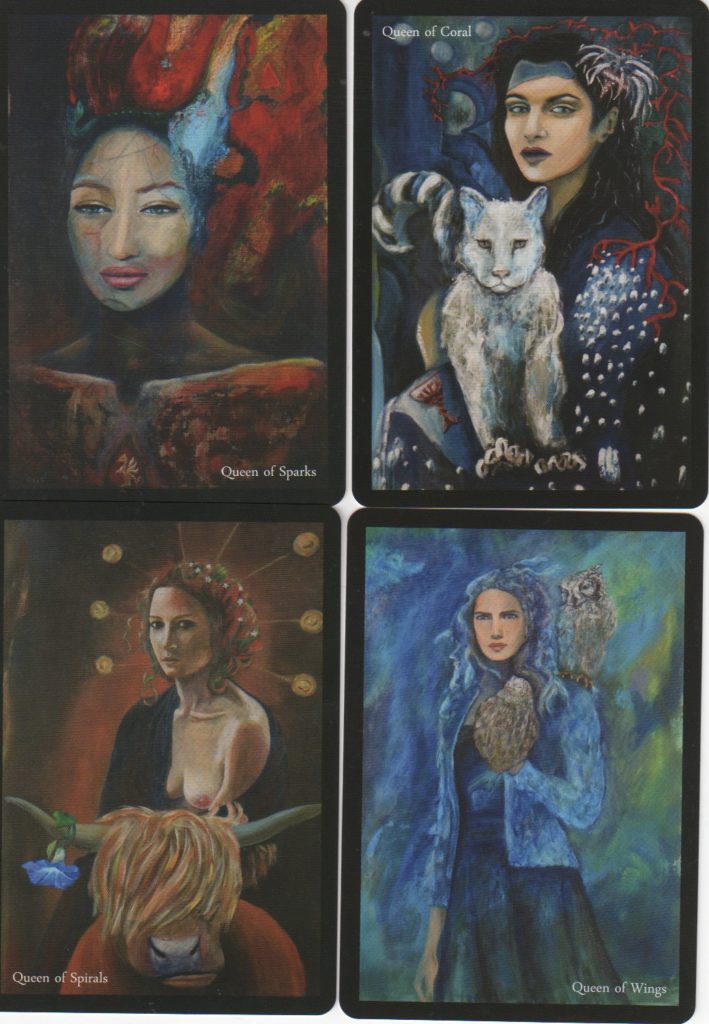
    The Queens of the Pholarchos Tarot

    I adore the images on the court cards – especially the Queens, perhaps because they feel like old friends to me now!
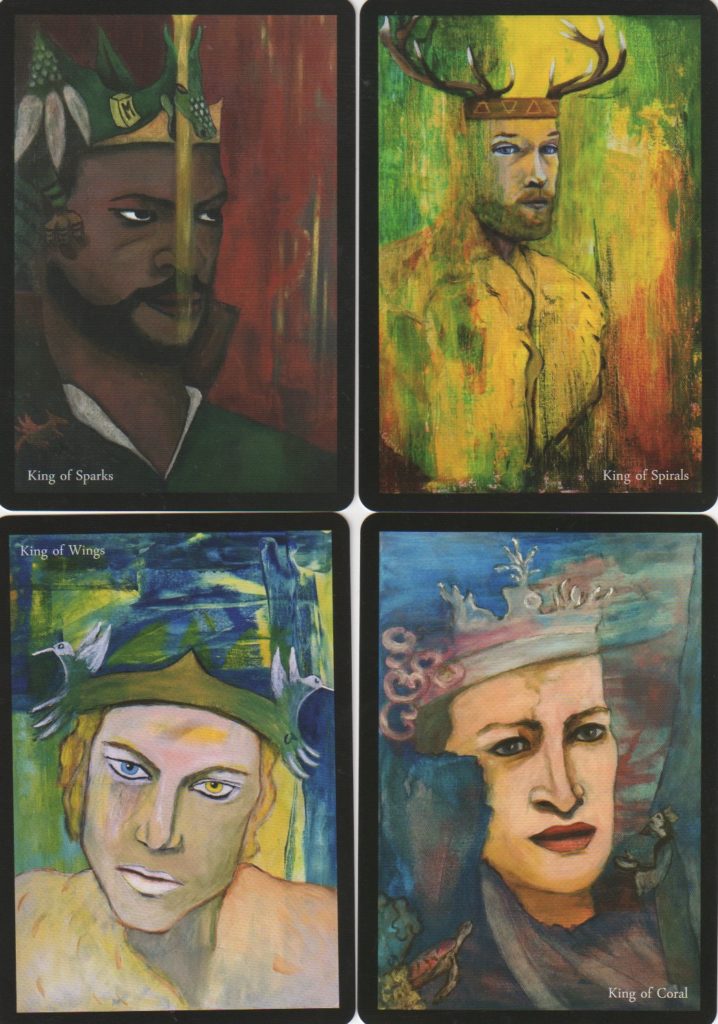
    The Kings of the Pholarchos Tarot

    This deck is perfect for someone who prefers to work with the tarot on a much more personal and intuitive level (or who wants to begin to work that way).  I would suggest that it is better suited to experienced readers because the jump from an RWS system to THIS system is not so vast that it can’t be made.  BUT if you start with THIS system and think that you can easily hop to an RWS system, I don’t feel that the leap will be so easy the other way! So, I wouldn’t recommend it as a deck for beginners.

    If you like working with the Motherpeace Tarot, Shining Tribe or the Margarete Petersen Tarot, then I think that the Pholachos would be right up your street.

    You can pre-order The Pholarchos Tarot here.

  • Tarot of The Crone | Ellen Lorenzi-Prince | Arnell’s Art

    Tarot of The Crone | Ellen Lorenzi-Prince | Arnell’s Art

    Every now and again a deck catches your eye and you just KNOW that its going to be a powerful tool to work with.  This is exactly the situation with Ellen Lorenzi-Prince’s Tarot of The Crone.  Ellen is an experienced deck creator and has two other decks under her belt (The Dark Goddess and the Minoan Tarot)

    (more…)

  • Holiday to Italy! The Tarot Pages

    I cannot believe that my long-anticipated holiday to Italy with Arnell Ando’s Tarot Tour will begin this weekend!

    It has been booked for about 8 months and suddenly IT IS HERE!

    On Saturday I will fly from Glasgow to Heathrow and spend the night at the Heathrow Thistle Hotel.  Not that I’ll be able to sleep much – too excited for that!

    Then on Sunday morning, I and Caitlín Matthews rendez-vous in Departures and fly out to Milan together!

    I hope she’s able to cope with my nervous excitement – I’ve not been abroad since 1997!!  Unless you could the Isle of Man a couple of years ago.  And I don’t!

    Once safely landed in Milan, we take the train to Milan central and hop over to our hotel (which is near to where the train station).

    We check in and hopefully meet up with some of the others.  Perhaps factor in a bit of exploring … maybe an ice-cream.  Well, it’s ITALY, isn’t it? And then we ALL get together for a pizza dinner at a nearby restaurant.

    And then what will we do?

    Gosh where to begin?! 14 days of Tarot-orientated history, surrounded by like-minded people, visiting the Sola Busca Tarot in the Brera… and tons more!

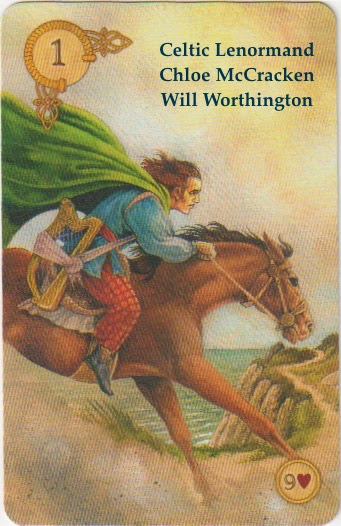
    I illustrate this post with the Rider card from the beautiful Celtic Lenormand by Chloe McCracken and Will Worthington to capture my excitement about the journey and the whole holiday shebang!

    In my heart I will be carrying the Tarot’s Pages – eager to travel, eager to learn, eager to make new friendships and eager for new experiences!

  • Comparative Tarot | The Prince of Cups

    The first time I encountered the comparative method of looking at cards was via Valerie Sim’s deck, the Comparative Tarot.  The cards in this cleverly designed deck have not one image, but four different images of the same card.   It was one of the first decks that I bought and I still regard it fondly.

    Not familiar with the Comparative Method? Here’s the skinny:  You don’t just interpret ONE card, you interpret the others on the card too – each one adding depth and colour to the over all ‘character’. 

    So I thought we’d try it here with The Prince of Cups – just comparing three images – but you can do it with as many cards as takes your fancy.  Or you can fit onto your table top.  Or bedroom floor.

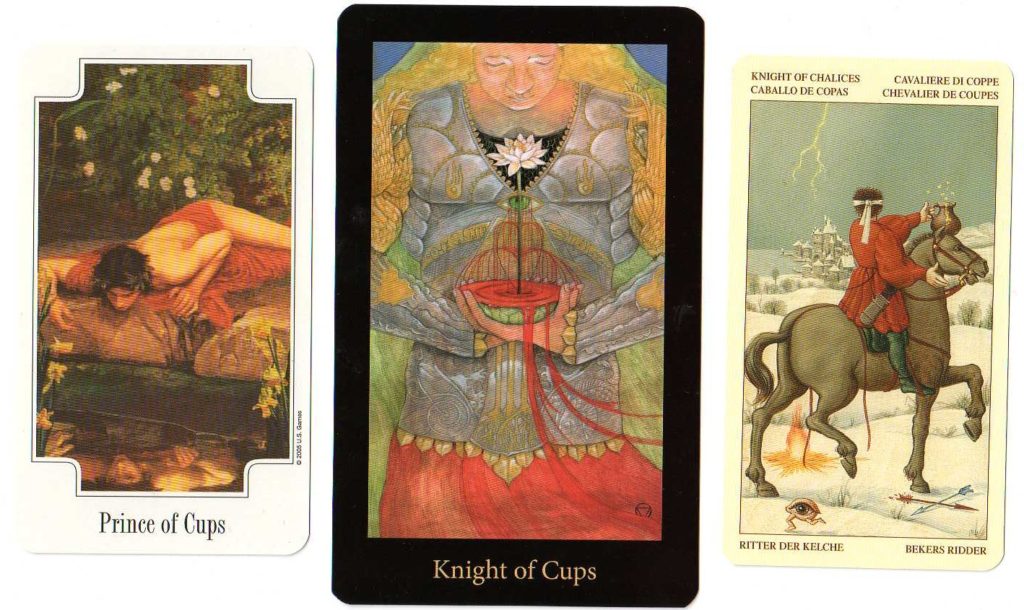
    I chose the Prince/Knight of Cups from the outrageously stunning Mary El deck by Marie White; the Prince of Cups from the Transformational Tarot by Arnell Ando and the Knight of Chalices from the Breugal Tarot by Guido Zibordi Marchesi.

    First of all, although one of these is a Prince, he DOES fill the Knight’s role in the deck.  He’s not a Thoth Knight

    click on image to enlarge.  I think.

    Arnell’s Prince (left hand card above) perfectly captures that romantic, self-absorbed feeling that comes with the Prince of Cups. It shows the youth Narcissus gazing ito his own reflection by the pool.  Poor old Narcissus was so wrapped up in himself that he drowned trying to embrace his own reflection.  I’ve had boyfriends like that.

    In the LWB Arnell explains that he represents the Artistic Idealist; someone who uses ‘creativity as a means to self-expression, but whose moods don’t always reflect his actions.’

    The Knight of the Mary El (central image) is also introspective, protectively clasping a grail that overflows with blood and from whose depths a lotus flower rises and blossoms.  This is the Grail Knight.  Marie White, creator of the Mary-El says: ‘Searching for matters of the heart; love, meaning in life. Compassion, experience and maturity is the key.’  If you don’t know the story of Percival, the Grail Knight here’s a 10 second summary:  In his naivity, Percival, a knight who is searching for the Holy Grail fails to recognise it the first time he encounters it and so he is compelled to set off on his quest again – older, wiser – and finds it.  And heals the Fisher King. The end.

    Our final Knight is the Breugal Knight (right hand image).  His horse steps confidently to the right of the card, but he is not looking in the same direction as his horse.  In fact, he looks as though he has a blindfold on.  Even with the blindfold, he is looking towards a distant village that lies beneath a fork of lightning.  He doesn’t hold a grail, but a tankard filled with flowers.

    Neither hand holds the horse’s reins. Either side of the horse we see a camp fire, crossed arrows and – bizzarely – an eye running to the left on a pair of little legs!

    We also have an eye in the armour of our Mary El Knight – in the centre of her chest.  And the Knight of the Transformational Tarot is gazing at his own reflection.  Sight is an important symbol of this card – one sees only himself, one sees only her Grail, one sees….nothing (with his eyes!)

    I think that the Breugal LWB perfectly encapsulates what’s going on here: ‘Where there is love, the eye follows’. 

    Using this Comparative Tarot method then, I would say that this Knight DOES have focus – but he doesn’t always focus it on what he SHOULD be focussed on, as far as the outside world is concerned.  As a result, he can seem dreamy and self-absorbed to other people and can display a level of cold-heartedness to that which is outwith his field of vision.

    For me he’s the guy who will spend weeks finely crafting you a love song, but never remembers to put the bins out at night.  Someone who will whisk you away for a romantic candle lit meal, but forget to organise his cash….or put fuel in the car 🙂

    What do YOU think of the Knight of Cups or the Comparative method?