Tag: Lenormand

  • Alexander Daniloff | Lenormand Oracle

    Alexander Daniloff | Lenormand Oracle

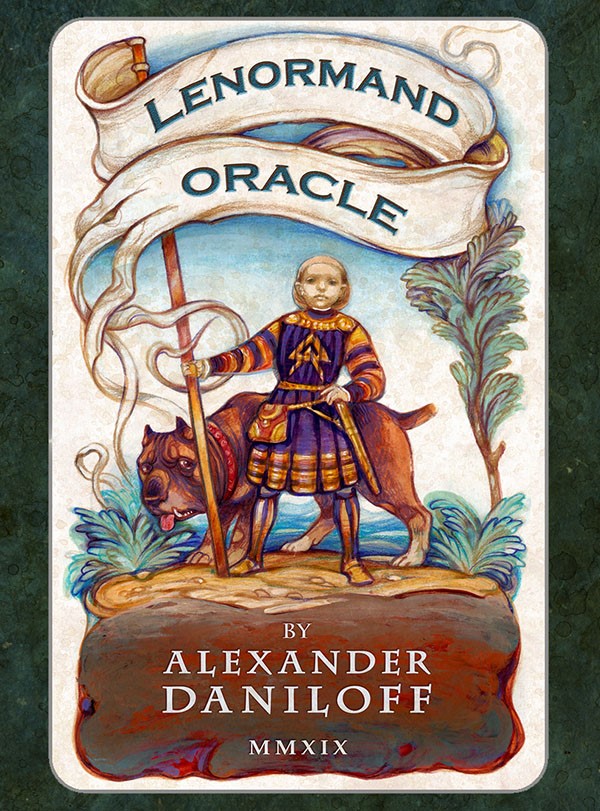
    I am a massive fan of Alexander Daniloff’s Tarot decks and I was super-excited when he contacted me a couple of weeks ago to let me know that he had completed a new deck – a Lenormand Oracle!

    What can I tell you about it?

    This first printing is limited to 500 copies and will be signed and numbered. Size-wise, this is a 2.25″ x 3.5″ deck – perfect for a Lenormand deck and for laying out the 36-card Grand Tableau spread.

    It’s a standard 36-card Lenormand with two additional cards to play with – an extra Lord and Lady. This will ensure that all types of relationships can be comfortably read, not just M/F.

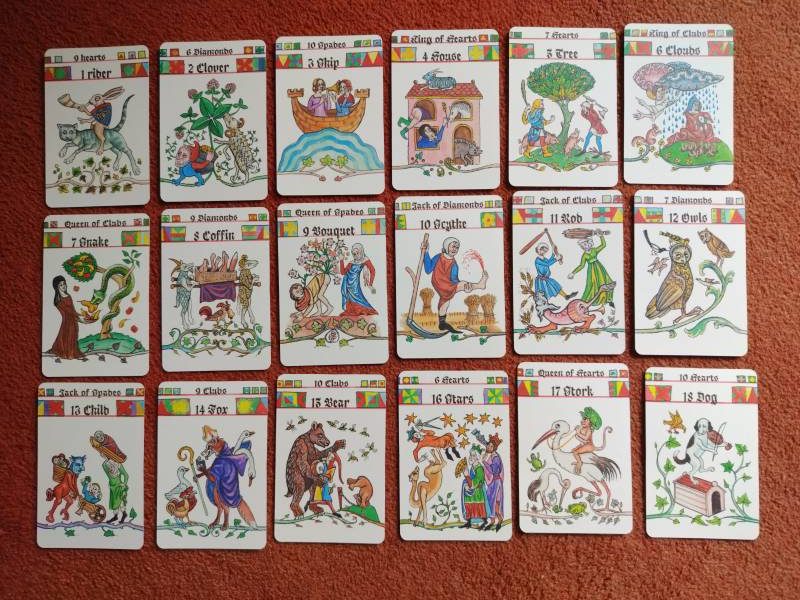
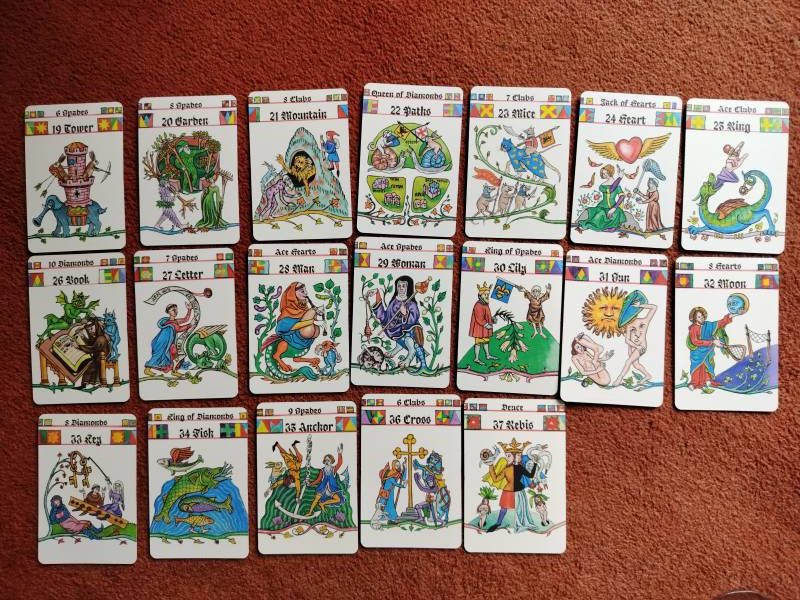
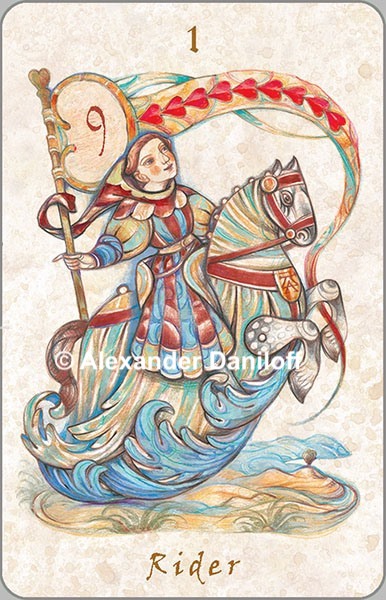
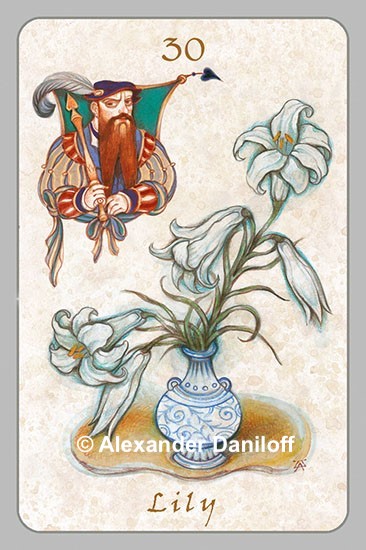
    As you can see, each card is numbered at the top and has its title, in English, at the foot of the card. Pip playing card associations are presented in a fluttering banderole that features the appropriate number of pips in the suit concerned.

    Those cards who have court card inserts have lovely character studies of Kings, Queens and Knaves.

    The imagery and colour-palette is exquisite (of course, I’m biased!) and I am very much looking forward to holding a set of these cards in my sweaty little paws!

    There will also be a downloadable pdf (written by me) available from Alexander’s website that will help you get started on your Lenormand journey, if it’s a new system to you. The final page of the document has links and suggestions for fab authors and content creators to take a deeper journey into the world of the Lenormand.

    This Lenormand is set to become a much-coveted item in your collection!

    The deck will be ready to order from Alexander’s website in December.

    To see all the images: http://www.daniloff-art.it/Tarocchi%20gallery/Lenormand%20Oracle.htm

  • Review | Lenormand de Marseilles | Edmund Zebrowski

    Lenormand de Marseilles (and Mini Me)

    *theme from Love Story plays in background*

    Like so many love stories for the social-networking age, I fell hook, line and sinker for the Lenormand de Marseilles when I saw her photo on Facebook.

    It really was luff at first sight.  But with none of that why-he-hasn’t-called-me-in-three-days nonsense.

    I bought the Illuminated version (limited and signed) and the mini version too, just as soon as a kind hearted fellow addict friend sent me a link to Edmund’s shop.  I don’t have a compulsion to buy decks.  I DON’T.

    *eyelid twitches*.

    Once you click through to Edmund’s shop, you’ll see the clutch of Lenormand decks that he has created – try not to give in to temptation and buy all of them.   *looks guilty face*


    As you may have guessed by the deck’s name, the imagery is inspired by the artwork of the Marseilles Tarot.

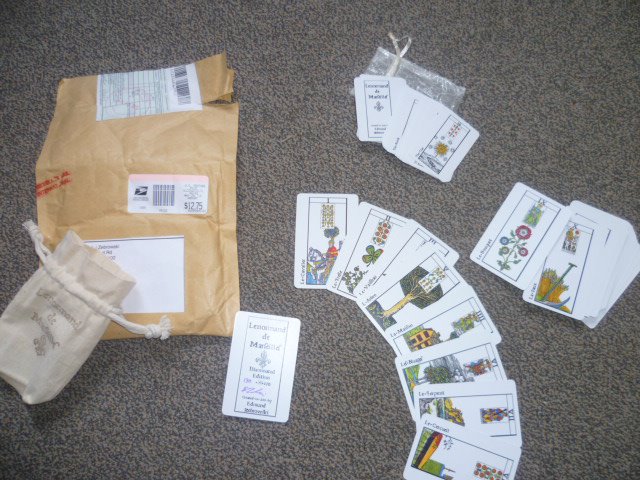
    The Illuminated version measures 3.5″ x 2.25″(9cm by 5.5cm for you new-fangled and modern types)  and is made from wonderful card stock that has a linen-effect surface.  The cards slide over each other wonderfully well, which is handy when you want to start shuffling as soon as you’ve slipped the cards from their smart little cotton draw-string bag!

    Happy Day! The arrival of the Lenormands!

    Card numbering is in Roman Numerals, paying tribute to the numbering method of the Marseilles Tarot itself.

    The card names are in French (again, homage to the Marseilles!) and I adore the antique font that Edmund has used – that has the old long ‘s’ that looks to our eyes like an ‘f’. The net result is that Les Poissons (Fish) looks as if it’s called Lef Poiffonf.  Thank goodness there isn’t a card called The Sucker *gives her reader a moment to work that one out*.

    Cards are unfussy white, providing a perfect foil for the images and punchy colours.  The card backs are decorated with tiny black and white pattern on rear.  Since one doesn’t use Lenormands in reversed positions (generally speaking!) it doesn’t have to be a mirroring image, and it’s not.

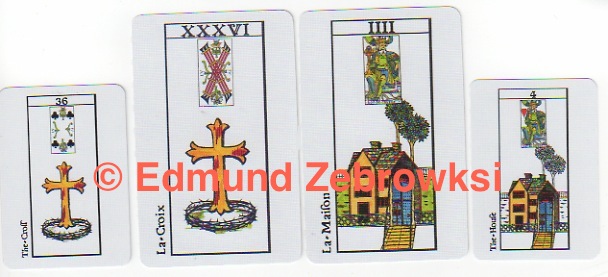
    The playing card inserts are also inspired by the Marseilles Tarot’s Minor Arcana – and the overall effect is classy and in keeping with the whole ethos of the Lenormand oracle.  Please note that card four is shown as IIII, not IV,  as you might expect.  That’s because in the Marseilles, the four is shown as IIII.

    There IS an error, and Edmund is now on the case to rectify it, but if you look closely at XXXVI above, you will see that the large card has 6 of Wands illustrating the playing card inset, but the tiny roman numerals at the side show ‘IV’.  The mini version of the same card also has an error, the 4 of Clubs is the insert, and it should be the 6 of Clubs.  Yes, these are errors, but I can honestly say that it doesn’t impinge on my use of these Lennies at all *whispers* because I’m not good enough to bring in the playing card inserts to my interpretations yet 😀

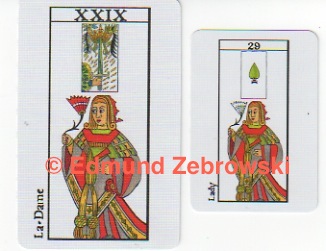
    Looking more closely at the Mini  (which also comes in its own teeny tiny bag).  It measures 2.5″ x 1.75″ (6cm x 4.5cm) we can see that the playing card inserts are standard, the titles are in English and the Roman numerals of the large illuminated version have been replaced by the more familiar Arabic numerals.

    So it’s been a week or so that we’ve been together and things are going well.  She’s just as beautiful in the flesh card than she was in the first picture that I saw of her.  And you can’t say THAT about many things on Facebook.  I think we’re going to be very happy together…..

    You can explore Edmund’s work here:

    http://delphischamber.bigcartel.com/

    What have Lenormand cards got to do with Court Cards?!  See earlier posts by Andybc and Helen Riding

  • Mary K Greer | Interview

    I thought I’d give you something really lovely that doesn’t put a single inch on your hips for Valentine’s Day.  And here it is – my Tarot Court interview with Mary Greer! I hope that you enjoy it:

    I asked top Tarot author Mary K Greer whether she would like to answer some Court Card questions for Tarot Thrones and, ever gracious, she agreed:

    Mary – thank you so much for agreeing
    to answer questions for my Court Card blog.

    I endeavour NOT to use your ideas and
    exercises on my own Court Card blog here, but, more often than not,
    when I re-read your book, Understanding the Tarot Court (UTTC) I realise that you got there YEARS before
    me! I apologise for inadvertently using your work – you really have
    created the Go-To book for working with the Tarot Court.   There
    doesn’t seem to be any aspect of working with the Courtly characters
    that you have left unexplored, how did that book come about?

    Great minds think
    alike! Tom Little and I were on a Tarot discussion group way back and
    the court cards came up quite frequently as problematic. Because Tom
    worked with Marseilles-style decks and I work more with the
    Rider-Waite, some different perspectives were produced that started
    expanding the possibilities for everyone. Tom started his own group
    to specifically explore the older French and Italian decks and Court
    Cards. We found that people told really intriguing stories about the
    “families” they saw in each suit’s court. So, I proposed we
    work together on a book that would work well for any deck.
    Why do you think that people struggle
    with Court Cards more than the other sections of the deck?
    A Court Card, by
    itself, doesn’t tell a story in the same way other cards do – at
    least in most modern decks. Its meanings don’t usually describe
    events. There’s no action except sitting, standing or riding. Nor
    are we familiar with the classical references made to European
    playing cards. Once people get that it is more about a style,
    attitude or “way” of doing things then it becomes easier to
    understand their role in a reading. That’s why most people enjoy
    the learning games. It’s not that difficult to know what cars the
    four Knights would be driving, instead of riding a horse. But, we
    still don’t know where they are going in their cars or why—unless
    we ask them [more about that later].
    The esoteric organisation, The Golden
    Dawn did a great deal of work with the Tarot Court – what’s your
    favourite contribution of theirs to the understanding of the Tarot
    Court today?
    I don’t often
    pay attention to their correspondence with the last 10° of one Sign
    and the subsequent 20° of the next Sign. Primarily I focus on what
    element they are most aligned with—all of the Wands Court are Fire,
    and all Queens are somewhat Watery—so that the Queen of Wands is
    the “Watery part of Fire”. I like the GD use of elementals and
    other esoteric insignia in the designs. Mostly, I found that the
    reconceptualization of the Courts as Knight – Queen –
    Prince/Emperor – Princess was liberating. Oh, and I also like that
    the only use for reversals was to determine what direction the Court
    Cards were looking or moving
    .


    Preference – RWS court or Thoth court?!
    I feel really
    comfortable with both as long as I am clear on which one I am using
    in a particular situation.
    What makes a ‘good’ Tarot Court in your
    opinion? And when I say good, I mean ‘readily accessible for
    readers’!
    A well-designed
    Court Card cannot be confused with either a Major Arcana or a pip
    card, plus the ranks are each distinct. I don’t want to mistake a
    Page for a Queen or King. I want to be able to tell each apart
    immediately. I also want them depicted so that, when described by a
    person, it naturally goes with adjectives that are characteristic of
    their suit, element and rank. A Cups Knight can be anything from
    romantic to wishy-washy and yet slightly “fired up” (in a
    Knightly sort of way)—if you use those conventions. A Pentacles
    Page should definitely be earthy but young. The William
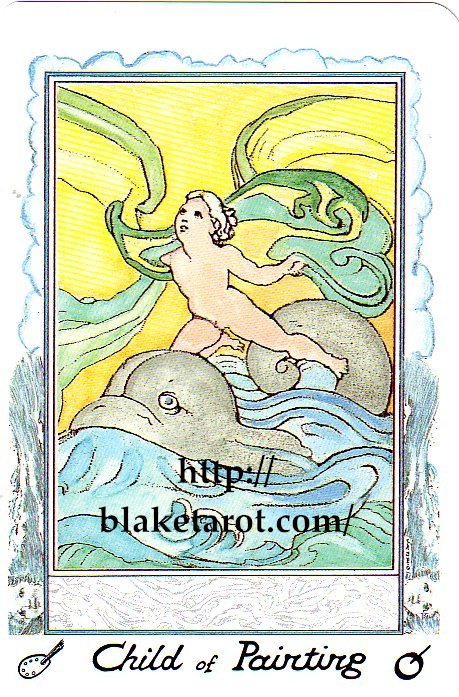
    Blake Tarot uses Angel, Man, Woman,
    and Child. Each can be clearly discerned, has distinct
    characteristics, and fits with its suit. Also, I generally don’t
    like them so personalized that they seem like real people as I can
    get too caught up in a specific personality. I prefer a “type”
    rather than an individual. The Gaian
    Tarot is an exception to this,
    although it was a hurdle I had to overcome.
    Tarot Thrones | William Blake Tarot - Ed Buryn
    William Blake Tarot:
    Trad: Page of Pentacles

    [Ali: Dear
    Reader, I promise to post about the Courts in the William Blake Tarot
    by Ed Buryn next week :-)]

    Given the huge swathe of decks you have
    come across in your career, which deck’s courts do you love best (and
    why!)
    That’s really
    hard to say. I have favorite individual Major Arcana cards from
    different decks, but not many Court Cards. When checking out a new
    deck, I often look at the Queen of Swords to see if the designers
    have conveyed her in a way I can appreciate. Maybe, Kat Black’s
    “Golden Tarot” comes closest to my favorite Court Cards, although
    the Thoth and RWS are so well known to me that they are like parts of
    myself.
    If you were to create the perfect Tarot
    court, what would it consist of? Would you choose the ranks and sexes
    of the RWS style deck, or a more 21st century
    representation of life?
    I’d probably
    stick fairly closely to the RWS. I really love the William
    Blake Tarot of the Creative Imagination with
    its Angel, Man, Woman, Child concept. It has, therefore, the higher
    self/superego/spirit messenger, the masculine, the feminine, and the
    inner-child. I like that.
    What’s your favourite deliberate use
    for a Court Card?
    For me, a Court
    Card always, always represents an aspect of myself—that I may or
    may not be giving away (projecting on) to someone else (having them
    play the role for me). I try to always “own” the role it is
    taking in a spread even if it is clearly also my mother coming to
    visit. In readings I often ask querents what each Court Card advises
    that they do (which helps them to see the projection). If the Court
    Card is in a past
    position, then I might say, “What would your father, if he was this
    card, have wanted you to do back then?”—given that we had
    perceived qualities of the father in that card. I might even ask a
    querent to dialog back-and-forth with a Court Card. A person doesn’t
    have to follow the advice, but they need to recognize the voice of
    that person (“the internalized father,” for instance) that they
    carry around in their own psyches and which may still be influencing
    them. The Court Cards are rather like a council of more or less
    helpful advisors and opinionated voices, arising from different parts
    of myself or externalized through individuals in my life. They urge
    us to take their perspective.

    Pages can indicate schooling or your receiving a message of some kind and Knights can indicate travel or represent rival lovers. A Queen can be your mother or friend and a King your father or boss. Try to not overlook the obvious.

    Which Courtly personality is your
    favourite, and why?
    The Queen of
    Swords. I like the contradiction of her being a Queen and therefore
    interpersonally-oriented, yet tending toward the rational and
    logical. She is deeply perceptive and clear about her boundaries and
    limits. She can be compassionate but without sentimentality. And she
    doesn’t take any nonsense from anyone.
    Amongst the array of exercises and
    approaches in your UTTC book you look at the Myers Briggs types and
    allocate them to the various Courtly personalities – do you think
    that there is more out there that contemporary Tarotists can take and
    ‘hang’ on the Courts?
    There probably
    is. Any system of 16 types might work, and even 12-type systems can
    work if one of the Courts can be assigned the “pure” type. The
    problem with the Myers-Briggs system is that a purely logical
    association of types to elements and ranks doesn’t perfectly match
    the characteristics of either. You end up having to skew a few types
    or cards to make them fit. Whenever you link correspondences this is
    always the case. For instance, Taurus and the Hierophant are not
    really a perfect match until you deliberately start making them look
    more and more like each other. As long as you don’t take them to be
    exactly equivalent (accepting that they are square pegs in round
    holes) you’re okay.
    At the moment you are deeply involved
    with the Lenormand Oracle, what are your thoughts about the
    personalities of ‘face cards’ as shown on the Lenormand and their
    relationship (with regard to interpretation, rather than historical
    links) with the Tarot court?
    In Lenormand I
    don’t attach much in the way of personality characteristics to the
    Court Cards except that the Queen of Clubs (Snake) is a rival, other
    woman, or wicked step-mother type, and occasionally a wise friend.
    The characteristics of other people, if I discern them in a Lenormand
    Court Card (rarely), are determined by the cards immediately around
    them. Their role as a specific person is usually secondary to the
    primary function of the card. For instance, the Child is most likely
    to be a child or something new, rather than a
    child-as-described-by-the-Jack of Spades. Bouquet is primarily a gift
    or invitation and only secondarily might have something to do with a
    female relative, but certainly it does not have any characteristics
    one would associate with the Queen of Spades. It needs to be
    remembered that the divinatory system associated with the original
    German suits is totally different than the English and French
    cartomantic meanings we usually associate with them. For example,
    Clubs is by far the worst suit and Spades, the best.

    Many thanks to Mary for answering my questions about the Tarot Court!  If you’d like to know more about Mary’s work:
    You can find Mary on Facebook here

    Mary’s blog is here:  http://marygreer.wordpress.com/
    Her latest book is:  Who Are You in the Tarot?  You can ‘like’ the page on Facebook here

    Her most complete work on
    reading techniques is found in 21 Ways to Read a Tarot Card.

    If you would like to know more about the William Blake Tarot, click here
  • About Face 2 | The Lenormand Oracle | Andybc

    Scythe: Lenormand (pub Konigs Furt)
    Earlier this week we looked at the Lenormand deck with expert guidance from Helen Riding. Today we look specifically at the face cards in the Lenormand deck, with the help of Andybc:

    Andy, How would we interpret the face cards in the Lenormand?


    Clubs:
    Queen (Snake)
    Sometimes older, highly intelligent, but aloof female, and can be used as a stepmother, if the relationship is cool or frosty. She has the habit of being the “other woman”, or an estranged or ex-partner when the separation was not easy. Not normally bad, however, unless after the Fox. With the Clouds a couple.
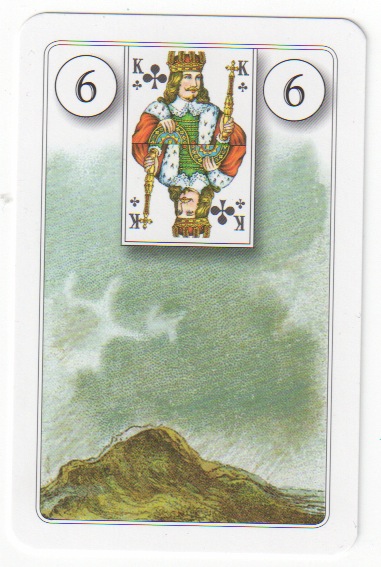
    King (Clouds)
    A difficult man you cannot ever really make out. Has an almost bipolar personality, exaggerated niceness or animosity. Card of the ex-partner (if a bad breakup, or one where you don’t see each other a lot), but can also be anyone you had an acrimonious connection with: stepfather, father, and colleague. Couple with the Snake.
    Knave (Rod)
    A younger person, often, but not always, male who is a very blunt speaker, eager, and occasionally prone to mood swings. Can be a teenager or sometimes a hyperactive and/or athletic person.
    Hearts:
    Queen (Storks):
    She’s normally the same age as the querent, and is often a friend, a sister, or good and friendly work colleague. The Storks would be an estranged or ex-partner, when the parting was friendly and mutual.
    King (House):
    This is often a male who is either older, or wiser, than the client having the reading. It can be a father, older sibling, stepfather, or occasionally a patron/sponsor (rather than a boss). Can also be a friendly ex – partner, someone you still like and see.
    Knave (Heart)
    Normally someone around the same age as the client, who is friendly, warm, and attractive: it tends to describe someone of the opposite gender of the client. Blonde or light brown hair.
    Spades:
    Queen (Bouquet):
    This is a woman who can be roughly the same age, but frequently is older. She’s a friendly and warm female; this would be querent’s mother, aunt or, stepmother or mother-in-law if the relationship is good. She’s typically someone who is charming.
    King (Lilies):
    Frequently, this is a man who is either older than the querent, OR it can be a male lover and therefore any age. If it’s not a lover, it does tend to be someone older. It’s someone you go to for advice, makes you feel safe and protected. A father, grandfather, or an uncle.
    Knave (Child):
    This is the most used Knave, and is simply a child or younger person (below 18) in the person’s life.
    Diamonds:
    Queen (Road):
    This is a woman who is younger, or the same age as the client. She is someone with some uncertainty around her, so for a man it can be on/off girlfriend, or, for a woman a love rival.
    King (Fish):
    Often this is the client’s boss, business partner, or an important male colleague, where there is a good relationship. They are normally the same age as the client, but can be a sibling who is younger.
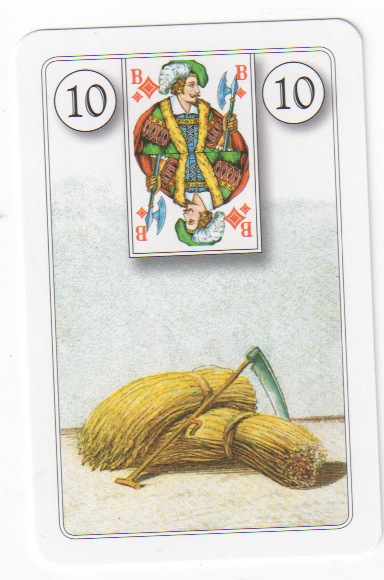
    Knave (Scythe):
    This is an aggressive and hurtful person, often a bully, who is the same age or a little younger than the client.
    Not Courts:
    Birds (7 of Diamonds)
    A couple, like grandparents, aunts and uncles, sisters, and rarely twins. Often, but not always, older than the querent.
    Bear (10 of Clubs)
    A mature, strong, nurturing woman. Often a mother, grandmother, or aunt; someone that holds a matriarch position in the client’s life.
    High Tower (6 of Spades)
    A mature, aloof and influential man who can be egotistical and cold. A patriarch figure, a father, grandfather, uncle in the client’s life.
    Mountain (8 of Clubs)
    A person in the client’s life, normally but not always male, who is an obstacle or enemy.
    Cavalier (9 of Hearts)
    A young or youthful looking man, very handsome and well dressed. With the Lilies and/or Heart can be a new lover or love interest.
    Dog (10 of Hearts)
    A man of any age, who is warm, friendly, and kind. A friend. Can also be a lover or the husband. 


    There are only 12 face cards in the Lenormand – Jack, Queen, King – just as you would find in a playing card deck.  So which ‘type’ is missing? Does the Jack equate to the Tarot’s Knight and thus the Pages are missing?
    Probably the knight is the one that is not represented in Lenormand; the system follows the French suit pattern, and they dropped the knights for a queen in the fifteenth century.
    The Lenormand’s knaves are not universally, or even continuously, used as people; they are androgynous in interpretation, much like the continental “valets” in tarot. However the comparison is loose due to the absence of the same structure seen in tarot, or regular playing card, fortune telling.
    Apart from the Child we do not use the Rod, Scythe, and Heart that much as people; this could be due to the usage of several non-face cards as people i.e. Cavalier, the Birds, the Bear, Dog, the High Tower, and Mountain.
    Do the Face cards equate to the remaining Tarot card personalities?  If not, what are those 12 personality types, as you would interpret them, Andy?
    No, there is no real similarity. Tarot, and most other playing card systems, has faces that are arraigned through suits and rank. The Lenormand, if stacked in suits, is clearly not randomly divided (look at the clubs), but we do not find the collective qualities needed for suit division evident in tarot, or piquet et cetera.  
    Lenormand faces are interpreted through the traits of their main meaning, not the suit. In the way I teach Lenormand, I get students to compile keyword meanings for each card that correspond nouns and adjectives.
    For the kings and queens, you do the same giving one or two nouns and adjectives that could describe a person i.e. king of spades would be lover, protector, and, attractive, wise.
    Another good example, is the Queen of Clubs (7 – Snake) very often appears as a woman who wears glasses. This is nothing to do with the suit of clubs, but the fact that snakes have poor eyesight.
    Our pool for characteristics is literally in what that card represents, normally, turned into characteristics. Full interpretation is however made by combinations formed by any card touching  (horizontally; vertically; diagonally) the face card. So, if the Queen of Clubs (Snake) had the Ship and Coffin either side of her, she could be a mature woman with dark hair, green eyes (Snake), olive skin or from abroad (Ship), and be musical or unwell (Coffin).
    Apart from the Child, it is not that common for readers to frequently use the knaves for people. However, the same rules apply: a Scythe (knave of diamonds) is a hurtful, spiteful, bully and a Rod (knave of clubs) is a blunt, talkative and hyper person.
    There are also several cards that are Lenormand people: the Cavalier, the Birds, the Bear, Dog, the High Tower, and Mountain. In Germany they tend to see the Bear as an official male, but in most Lenormand ‘schools’ she is a nurturing mother figure, the Mountain is a foreigner or an enemy, again drawing from the symbolism.

    About Andybc:
    I learnt to read palms through my maternal Romany family, and I’m now a professional palmist and cartomante; I also studied classical astrology extensively (horary and personal horoscopes). I authored the Cartomantes’ Cabinet: Lenormand Course, which was well received and have the second edition due out 1st October. I have one coming on fortune telling with tarot in Jan 2013.
    My blog is: http://www.andybctarot.wordpress.com (lots of Lenormand, including meanings and how to do the grand tableau), twitter @AndybCerru

  • About Face: I….the Lenormand | Helen Riding

    6 Clouds:  Lenormand (pub: Konigs Furt)

    To ring some changes, I thought we could explore the Face Cards in the Lenormand Oracle, to see whether they work like Court Cards in Tarot (and if not – how in the heck do you use them?!).  My search has led to two wonderful people – Helen Riding and Andy BC – both extremely talented and well-versed in the lore of the Lenormand Oracle.

    I first came across it a couple of years ago when I bought one that had been damaged from our TABI Conference stock.  Most widely used in mainland Europe, the Lenormand has not been as popular in the English-speaking world – UNTIL NOW!!!  The Lenormand is enjoying a massive surge in popularity and I thought I’d call upon this duo of Lennie Experts to talk about the deck and its history AND the use of face cards in some of the Lenormand decks.

    In this first post of two, Helen Riding very kindly agreed to help get us all up to speed with the deck:

    So – tell me first of all how you became interested in this deck, Helen

    I was drawn to the Lenormand section in the Aeclectic Tarot Forum where Sylvie Steinbach had set up a free study group in 2007, the year she published The Secrets of the Lenormand Oracle which is one of the few English language books on Lenormand currently available. Early in 2010 I bought her book and several others and got hooked. I later put Lenormand aside while studying the Elder Futhark runes and Ogham but got caught up in the latest Lenormand wave on Facebook this year. I was reading Mystical Origins of the Tarot by Paul Huson at the time which shed some light on the meaning of the Lenormand suits and got me more interested in the history of the Lenormand system.

    Tell me about the Lenormand deck (briefly – who was MMe Lenormand, what has she got to do with the decks available today?

    Mlle Lenormand was a famous French fortune-teller in the 18th century. Despite the Age of Enlightenment, laws prohibiting fortune-telling and religious opposition, fortune-telling games and cards were extremely popular in Europe and Lenormand was a highly illustrious figure. After Lenormand’s death in 1843, publishers took the liberty of using her name on several fortune-telling decks including a 36 card deck which it later transpired was published in Germany c1799 as part of a board game with a secondary use of fortune-telling. Various artistic interpretations of this “Lenormand” deck were subsequently sold in Germany where all sorts of games for learning and entertainment were extremely popular in the 19th century. The association with Lenormand no doubt boosted the popularity of the deck and ensured its survival long after many other historical cartomancy decks have been forgotten. Even today many people still cling to the romantic notion that these were the exact cards Lenormand used, and while this deck may have been one of her many fortune-telling tools we just don’t have any evidence for it. We now know the deck was designed by Johann Kaspar Hechtel from Nuremberg and I hope more people acknowledge his role in the future (I am busy creating a Wikipedia page for Hechtel, so there will be no excuse not to know about him).

    The cards sometimes include playing card images – why did that happen – were they always in this oracle or a later addition?

    Hechtel’s board game Das Spiel der Hoffnung (The Game of Hope) may have been structurally based on or inspired by a 6×6 picture lottery board with 36 squares and combined with a stripped playing card deck of 36 cards traditionally used in Germany. The original illustrated cards preserved in the British Museum include both German and French playing card insets. The German playing card insets disappeared in the new so-called “Lenormand” decks published later and some publishers also replaced or supplemented the French playing card insets with text explaining the individual card meanings. These days many Lenormand cards have neither playing card insets nor explanatory text. I prefer the ones with playing card insets only as the playing cards can add a secondary layer of meaning to the cards and I find the canned text distracting although it can be useful to aid understanding of the traditional meanings of the cards.

    Do different Lenormand ‘Schools’ favour different types of decks (eg – do the Germans, for example, make better use of the playing card elements?)

    I would say most traditional schools prefer cards with playing card insets although most Lenormand authors disregard them except for the secondary layer of meaning of the face cards. Unfortunately when the German playing card insets were removed from the deck the original cartomantic meanings of the suits were mostly lost as they differ from the cartomantic meanings of the French suits standard today (although there appears to be an intended theme per suit, clubs and not spades is the trouble suit in Lenormand).

    These are my personal Lenormand playing card suit associations:

    ♥ hearts: water element, love, relationships and family
    ♠ spades/leaves: air element, society, government and travel
    ♦ diamonds/bells: fire element, enterprise, fortune and misfortune
    ♣ clubs/acorns:earth element, survival, hardship and trouble]

    There are face cards included in the playing card references in the Lenormand – which face cards are included (and if they are not all included, why are those that are not included left out?)

    All the face cards (jack, queen and king) are included. The Lenormand deck is based on a traditional German deck with 36 cards equivalent to a standard French deck stripped of the 16 pip cards numbered 2, 3, 4 and 5. Anyone can easily modify a regular playing card deck and use it as a Lenormand deck.

    I should point out here that the primary significator cards in the Lenormand system are not face cards. When the Lenormand deck was designed, aces were ranked highest in each suit and often given a similar treatment to face cards in illustrated decks. (As a matter of interest, the German equivalent to the French ace is actually the deuce as the aces were removed from German playing card decks early on.) This could explain why two of the aces are used as the primary significator cards. Man (A♥) represents a male querent and Woman (A♠) represents a female querent, with the other primary significator representing the querent’s significant other. Some modern decks include additional male and female significators to facilitate readings for people in same-sex relationships.

    Apart from the face cards and primary significators, other cards that can represent people include Dog (10♥) which can represent a friend, known person or third party, Rider (9♥) which can represent a newcomer, messenger or visitor and Birds (7♦) which can represent a couple or siblings.

    How does one interpret those face cards in the Lenormand (You can just provide a list if you want)

    The face cards have primary meanings based on their main symbols:

    ♥ hearts: Heart (J♥), Storks (Q♥), House (K♥)
    ♠ spades/leaves: Child (J♠), Bouquet (Q♠), Lily (K♠)
    ♦ diamonds/bells: Scythe (J♦), Crossroad (Q♦), Fish (K♦)
    ♣ clubs/acorns: Whip (J♣), Snake (Q♣), Clouds (K♣)

    Some readers interpret the face cards as various types of people as alternatives to their primary meanings, and some readers use either face cards or other people cards to represent same-sex partners in the absence of specific cards for this purpose. Personally I find too many cards that can represent people in addition to their primary meanings confusing and generally (never say never) prefer to work with the main symbols on the face cards which do however have an obvious relationship to the face cards.

    In the hearts suit, Heart (J♥) can represent affection, Storks (Q♥) motherhood and House (K♥) family. In the spades suit, Child (J♠) can represent a child, Bouquet (Q♠) beauty and pleasure and Lily (K♠) maturity and experience. In the diamonds suit, Scythe (J♦) can represent danger, Crossroad (Q♦) alternatives or diversification and Fish (K♦) entrepreneurship. In the clubs suit, Whip (J♣) can represent aggression, Snake (Q♣) deception and Clouds (K♣) confusion.

    You can find out more about Helen and The Lenormand at Helen’s blog
    http://www.mywingsofdesireblog.blogspot.com

    Facebook groups:
    Lenormand Cards Study Group
    Lenormand Cards Reading Exchange