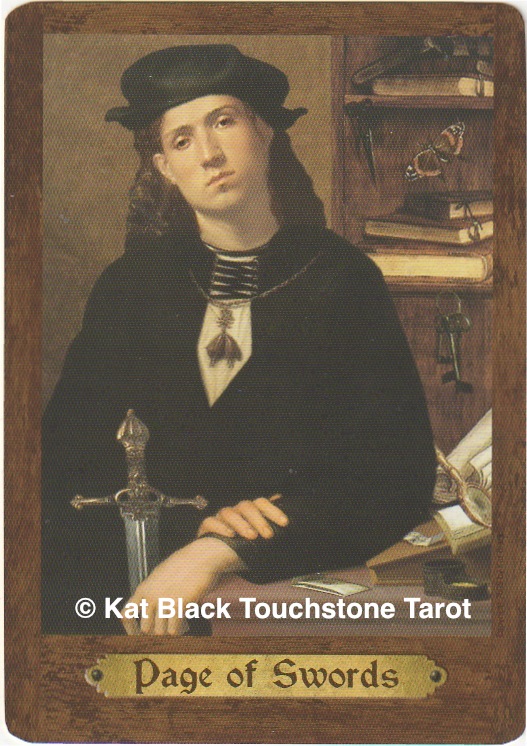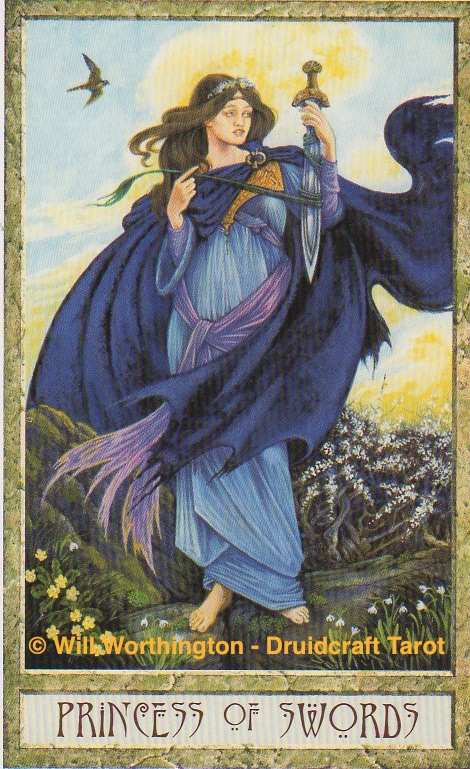
Tag: Page of Swords

  • Page of Swords | The Tarot of Mr Punch | Doug Thornsjo

    Sometimes you see a project and it’s just such a perfect storm that you wonder why it was never done before! That’s how I felt when Doug Thornsjo (Tarot of the Zirkus Magis, Tarot Lombardi Dannegiatto etc) began sharing images from his Tarot of Mr Punch: The rambunctious personality of Mr Punch will make a great ‘no punches pulled’ *groan – sorry, that was awful!* tarot deck.


    I asked Doug if he could answer some questions about his new deck and woohoo!!!! HE SAID YES!!

    Me: So, tell me how you got interested in creating Tarot decks?
    Doug: This is going to sound like a flip answer, but I don’t mean it that way: it’s just human nature that you’re going to want to do whatever it is you like. If you like reading books, you’re going to want to write a novel. If you like watching sports (although personally I can’t imagine a worse waste of a person’s life), you’re going to want to play. Tarot is one of the things that I’ve always liked, so from the beginning I always wanted to make my own. The cosmic axis simply did not come into alignment for this to happen until a couple of years ago.

    Me: You’ve created a few decks so far, The Tarot of Mr Punch is the deck that we are looking at specifically today.  

    I am intrigued to learn that the roots of Mr Punch stretch back to the 16th century Italian Commedia del Arte figures – Pulcinella. 

    Doug: Yes, Mister Punch and the Tarot go back a long way together! I’m just lucky no one thought of the connection before!

    Me: This Pulcinella figure was a comic figure who could say quite outrageous things – like the court jester …. but by the time the puppet shows that we are more familiar with came along, he had morphed into a modern day Homer Simpson character – a bit of a buffoon who can do quite violent things?
    Doug: I wouldn’t compare him to Homer Simpson (who is a dolt) and I wouldn’t call him a buffoon. Mister Punch is very, very smart. Not a nice man, it must be said, but smart. Smarter than you or me or anyone. The court jester can get away with telling the truth because he’s clever about it. Mister Punch out-smarts everyone: the police, the judges, the hangman, even Death and The Devil themselves. He always wins — always — because he is the smartest one in the room. He’s also Quite a Mean Old Bastard, who makes no distinction between hitting you with a club (or wand!) and hitting you with words.
    *** just as an aside – why does Mr Punch always look the same – hooked nose and chin? ***
    Doug: Also a hump back. Don’t forget that! He’s a very well-established character and when something works you don’t mess with it. When Punch appears on the stage he needs to be instantly recognisable. Again, it sounds like a flip answer, but if you changed his appearance he simply wouldn’t be Punch. 
    Maybe this has something to do with it and maybe this has nothing to do with it, but in profile, his head and face look exactly like a lobster’s claw. It’s a great design for a mean old bastard, because it’s harsh and pinchy and bitey. 
    Me: What was it about Mr Punch that made you think – this would make a great Tarot deck?
    Doug: See above: they both go way back, have similar origins, and have evolved together over the years. More than that, both Punch & Judy shows and the Tarot deal with the Big Issues of life in a compressed and even detached form. Relationships, family, legal issues, emotions, Life and even Death itself. All the Big Issues of Life that we struggle with, he’s been there and done that. The fact that, as we know him now, he is essentially a Victorian figure — that didn’t hurt, either. His age gives him weight and authority and style, too. 
    The creator/editors of PUNCH magazine realized that he would make a good mascot because a) he’s a snarky little fellow and b) he’s seen and done it all, and is capable of giving any kind of authority figure a damn good spanking. And that includes Supernatural Beings and Deities of all sorts.
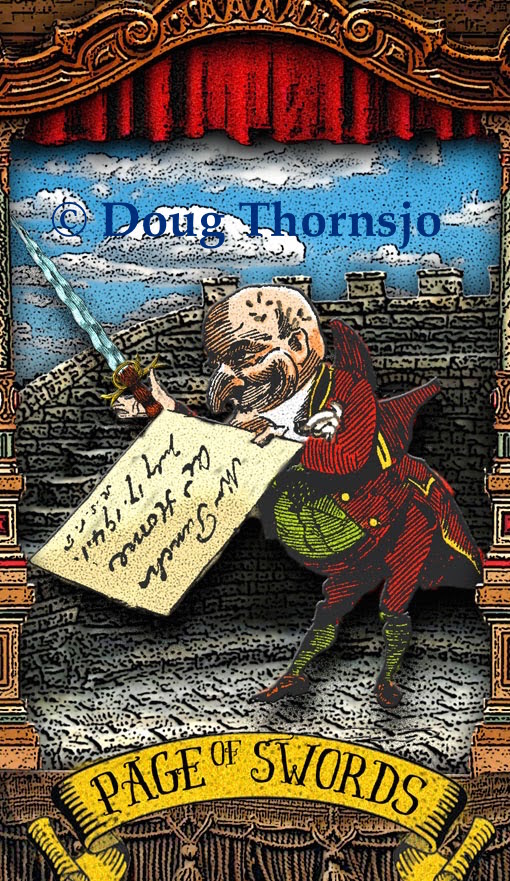
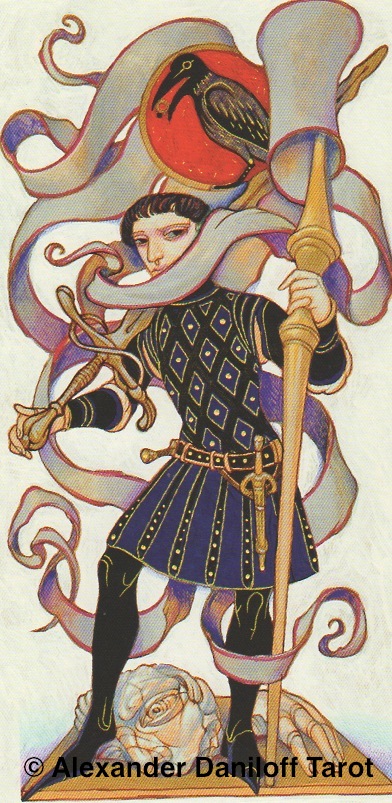
    Me:  The Page of Swords is the card that we are taking a look at specifically today. Tell me about the image – what was your source material, how did you transform it into the Tarot card?
    Doug: The figure is taken from what they call a “spot illustration” — not a full cartoon — from the pages of PUNCH magazine, circa 1880s-90s. I coloured him, put an especially twisty sword into his hand, and then because the suit of swords needs air and clouds, I set him on the battlements of a model castle that I “artified.” The first version I did had him inside a castle setting, and that didn’t work for me. With swords you have to have air, sky and clouds. 
    Me: Tell me about the structure of the deck itself – are we talking RWSy, Thothy, Marseille-y influences?
    Doug: Not so much Thoth this time, except for maybe two or three cards. I will say that with any deck I work on, I do not confine myself to one (or any) particular school of symbolism. This appears to annoy some people who want their decks to be ALL RWS or ALL Thoth or Marseilles. I may start with a certain school of symbolism, but I like to mix it up and I’m always working towards doing things my own way. I haven’t completely succeeded at that with any tarot deck I’ve done so far. The closest I’ve come to succeeding is with my Marvelous Oracle of Oz.
    Me: Are there any surprises in your Majors? Anything renamed?
    Doug: Not really. I do have “Art” in place of Temperance, with symbolism that’s neither particularly Thoth or RWS, and I do have “The Aeon” in place of Judgement Day, featuring a cartoon from Punch magazine that just practically reeks of Thoth symbolism. I probably will never create a Tarot deck with a conventional Judgement Day card in it, since it’s a specific kind of Christian symbol that I don’t agree with and can’t abide. No, Ladies and Gentlemen, when you die you are NOT going to grow wings and fly up and sit in the clouds with the angels, thank you very much.
    Me: In the Minors, is the structure traditional – Ace to 10 and four courts? 
    Doug: Yes; although personally, I tend to stack the Court Cards all together, separate from all the pips. I stack all my decks up with the courts following the majors King to Page in each suit, and then the pips one to ten in each suit, so that the ten of pentacles is always the last card in the deck. That’s the way the deck comes packaged. I think — although I won’t swear to it — that this reflects a Thoth bias. 
    Me: That’s interesting – Why do you put them there? Do you see the Courts as filters or an interface for all that Major Arcana energy by putting them between the Majors (archetypal energy) and the Minors (individual effort)?

    Doug: I’m smiling as I type this, but I don’t see all those Kings and Queens and Princesses and Knights and Princes consorting with the peasantry or the riff-raff. They want to hang out with their own kind. 
    And I do see them as being separate — they’re read differently than either the majors or minors. They do act as a filter between the two. When I bought my Thoth deck, it came stacked up like this, and I thought “if it’s good enough for crazy Uncle Aleister, it’s good enough for me…” In TAROT FOR YOURSELF, Mary Smith (if I remember correctly), stacks them separately but puts them at the end. 

    What are your Court card ranks in the deck?
    King, Queen, Knight, Page.
    Me:  For those who are not very familiar with the Thoth deck, In the Thoth, the Court Cards are Princess, Prince, Queen and Knight … with the Princess associated with traditional Page energies, The Prince with Knightly energies, The Queen with, erm, the Queen and the dashing Knight replacing the old King.   So the Knight in the Thoth is the Young King.  

    Doug: Ally’s Knights are more virile aspects of the King, it seems. This raises another issue for me: why is the pagan female deity represented at all stages of her development (maiden, maturity and crone), but the pagan male god is ONLY ever represented as being young and virile and full of himself? Mister Horney God. I personally can’t respect that image and wonder why he’s never presented as being older and wiser and someone who thinks with the head on his shoulders, not the one between his legs. But I digress… 🙂

    Me: How do you see your Knights’ role in the Tarot of Mr Punch – is he more Kingly (like in the Thoth) or is he the young explorer of the RWS? 

    So, yeah, my court cards are more RWS than Thoth. My Kings are accomplished, older men and the Knights are dashing young squires. In the Punch deck the Knight of Wands is so young that he’s riding on a wooden hobby-horse!
    Me: What are your suits in the deck? 
    Doug: Wands, Cups, Swords, Pentacles — although the latter are represented visually as coins.
    Me: Are the pips fully-illustrated or pips? 
    Doug:  Now, this is interesting! When I started out, this was just going to be a Marseilles-style deck with plain ol’ pip cards. As I got into it, I found for several reasons that I wanted and needed to create illustrated minors. I did the Cups first, in my first mind-set, and so they are the most pip-ish cards in the deck. But I kept sticking Punch into them in ways that were illustrative. So by the time I started the next suit, which was wands, it suddenly turned into full-on illustrated minors. So the end result is a little bit schizophrenic.
    Me: Which is the last card in the deck, for you?  10 Pentacles? 

    Doug: Yes, the ten. It makes sense to me that Legacy, Fulfillment, Promise for the future should be the last card, and as most decks arrange their ten coins in a Tree of Life pattern, that’s a perfect symbol to end on. From a writer’s point of view, if there’s a single card in the deck that says “The End,” it’s the ten of pents.

    Me: Which card in the deck was the most fun to make?
    Doug: I can’t really think of any one card that stands out: a LOT of them were fun to make — but the thing that makes a design fun is when everything — your ideas and your base materials and the execution — just all slide together and dovetail as if the final design was simply meant to be. There were a number of cards in the deck like that, and it’s always a delight when you get that pleasant surprise of everything coming together just naturally and perfectly.
    Me: Which card did you struggle most with to get just perfect?
    Doug: In the Majors — “The Lovers” was Quite a Bastard. In the Minors, the two of Pentacles went out of its way to annoy me. As a rule, though, the hardest part is finding the right base image, the one that says what you want it to say the way it ought to be said. That was easily the most time-consuming part of this deck’s process. 
    Me: Are there any particular colour themes in your suits – are your Wands particularly orange or red, for example? 
    Doug:  Nnnnnn-ot really. The wands are more woody than fiery. The swords are appropriately airy. But the cards all have a puppet-theatre proscenium surrounding them, so colour-wise they’re really more brown than anything else. That ought to make them popular with the Steampunk crowd….
    Me: Have you incorporated any other system into your deck – for example, astrology?


    Doug: Astrology and numerology are beyond me. However


    … if the language of theatre is a system, then yes: the whole conceit behind the deck is theatrical. There’s a precedent for this, Marcus Katz and Tali Goodwin have their book out now exploring theatrical connections in Pamela Colman Smith’s work, and I think he’s got another project coming that takes another step in that direction, stemming from Pamela’s personal use of toy theatres. 

    Being specifically derived from puppet plays, this deck takes several steps in that direction, and I have another project in mind that will push it still further. So — The Language of Theatre: not abstract symbology but staged Drama, “All the World’s a Play” — Enter The Devil Stage Right. The Emperor comes downstage and speaks sotto voce directly to the audience, breaking through the Fourth Wall. I’m deeply steeped in theatre myself, my first novel Persephone’s Torch has a theatrical setting and is itself theatrical in structure. if encouraging people to think outside of themselves and objectify their lives and issues (and the cards) as players on a stage… if that can be considered a system, than that’s the system I used….
    If you would like to see a bit more of The Tarot of Mr Punch or buy a copy please visit Doug’s site for the deck.

    See Doug Thornjo’s entire creative oeuvre  at www.ducksoup.me
    You can also find Doug on facebook:  

  • The Poet’s Tarot | Annette Spaulding-Convy & Kelli Russell-Agodon

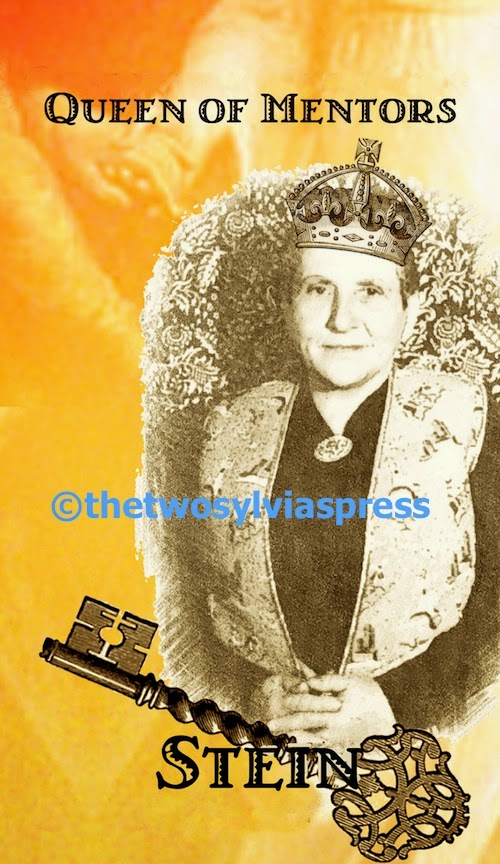
    Queen of Mentors – Poets’ Tarot
    Time to delve into a new Tarot deck via its Page of Swords! Except for The Poets’ Tarot, it’s the Queen of Mentors that we’re looking at.  Worry not, all will become clear 😀 

    The Two Sylvias Press ran a successful Kickstarter campaign to fund The Poets’ Tarot.  The two women behind the deck, Annette Spaulding-Convy (ASC) and Kelli Russell-Agodon (KRA) very kindly agreed to talk about their newly launched baby!
    Me: OK
    – first of all tell me about the Two Sylvias Press – what or who is
    it?!   


    KRA: Two Sylvias Press is an independent press Annette Spaulding-Convy and I began in 2010 in a sort of accidental way.

    We each had eReaders and one night on a ferry ride home from a poetry reading, we were talking about how there weren’t any eBook anthologies of women poets and how we wished there were more poetry collections available for Nook and Kindle. We continued to talk about how this concerned us and by the end of the ferry ride, we had decided to create an eBook anthology of contemporary women’s poetry ourselves—this is how Fire On Her Tongue: An eBook Anthology of Contemporary Women’s Poetry was born. Creating Fire On Her Tongue led us to cofounding our own press, Two Sylvias Press, as we realized we’d like to do more creative projects and that we had ideas for books we’d like to see in the world.

    Since that evening on the ferry, we’ve turned the Fire On Her Tongue anthology into a corresponding print book as well as published a book of poetry writing prompts (The Daily Poet: Day-By-Day Prompts For Your Writing Practice), three eBooks of poetry, one print book of poetry, and one eBook memoir. We publish in both print and/or eBook works we’d like to read ourselves. We want useful, creative, innovative books and more art in the world. We believe in the “passion” project, following our instincts, and doing what we love; this is how the tarot deck came to be.

    Me: Amen to having more art in the world! So, tell me about your Tarot background?

    KRA: I was introduced tarot cards about fifteen years ago by a good friend and was instantly intrigued by them. I have several decks of tarot cards which I use when I need guidance or inspiration in my life. One of the first decks I remember being introduced to was the Renaissance Tarot Deck. In creating The Poet Tarot, Annette and I wanted the artwork on the cards to have a vintage, retro, Victorian, and almost Steampunk feel.

    For The Poet Tarot, I did all the graphic design as overall, I am probably less knowledgeable in the history, tradition, and specific meanings of the cards, but I have always been interested in the art of each deck. Now, I keep The Poet Tarot on my desk to reach for as I write.

    ASC: I was first introduced to Tarot when I was in college. A good friend of mine had the Aquarian Tarot deck and she not only read the cards for me, but also taught me several layouts as well as both traditional and esoteric meanings for the cards. What most impressed me was her intuitive sense when she gave a reading. She consulted her various books, but sometimes she would depart from the card’s meaning and she would share her own interpretation, which in the end, was often fairly accurate in terms of the querent’s life or situation.

    I have always owned several decks of cards—Tarot based on fairytales, mythology, and of course, the traditional Rider-Waite deck. I’ve occasionally given readings for other people, but mostly I have used the cards as a private psychological and spiritual tool to give me creative insight. I don’t at all consider myself adept with the Tarot, but have always been fascinated by its archetypal symbols.

    Me: Why have you created a Tarot based on poets?

    KRA: I have always appreciated the opportunity to slip poets and poetry into our lives in unique ways, and for me, the Poet Tarot was a way to do that. I feel the cards offer beauty and art into the world, but are also something that encourages others with their own creative projects. I like that along with being a larger art project itself, The Poet Tarot also helps inspire and support other writers and artists with their own work.

    ASC: The Poet Tarot really came seemingly from a dream and a few creative visualisation exercises. I simply awoke one morning and thought—wouldn’t it be amazing if there were a tarot deck made up completely of poets. As I thought more about it, suddenly the suit cards became symbols of the creative process—the way a creative idea (poem, story, painting, song, etc…) moves from inspiration to realisation to revision to completion. As Kelli and I talked about the idea, we began to see the deck as a potential tool for artists and we were excited about showcasing some of our favourite deceased poets. Kelli took on the visual art and graphic design aspect of the cards while I worked on the guidebook and further hammered out the cards’ meanings. We wanted the deck to align with the traditional tarot, but with some differences, so it wouldn’t be just another Tarot “knock off.”

    Me: Tell me about the deck – I know that it was a successful Kickstarter project, but I need the details!!

    ASC: The deck follows the major arcana with 22 poets representing the traditional cards. We chose poets to represent each card based on the poet’s personality, life, and the thematic elements of his/her poetry. Edna St. Vincent Millay is a great representation of the Wheel of Fortune (X) because of the almost cyclical nature of her artistic career. She began with much immediate success (a Pulitzer Prize) and due to both her own personal issues and certain circumstances, within ten years she was barely writing and on the fringe of the poetry world. E. E. Cummings makes a wonderful Fool (0), not so much because of his personal life, but because of his poetic experimentations (simple subjects, use of lowercase, lack of punctuation), which led to many critics brutally ridiculing him. But, Cummings is now considered one of the most innovative poets of the twentieth century. We had fun matching poets with the traditional major arcana cards and we were careful to include some historic individuals as well as many twentieth century writers. It was also important to us to have an equal number of women and men represented.

    In terms of the minor arcana, the traditional suits were changed to symbolise the various stages of the creative process—Cups turned to Muses (inspiration), Wands became Quills (creation), Swords morphed to Mentors (revision), and Pentacles/Coins changed to Letterpresses (completion). For instance, the Seven of Quills is concerned with how a writer or artist deals with competition. It’s no surprise that we end up competing against fellow writers and artists when it comes to chapbook prizes or gallery space. This card explores how we handle competition in a healthy way without it impacting our creative wellbeing. As in a traditional Tarot deck, our major arcana is more in-depth and philosophical, while our minor arcana deals much more with the nitty-gritty and practicalities of the creative life.

    We are thrilled that our Kickstarter campaign to raise funds for the production of The Poet Tarot has been so successful. We nearly received twice the amount of our original goal and our supporters have been so generous in terms of Tweeting and Facebooking about the project. Although Kickstarter is over, The Poet Tarot is available for sale on our Two Sylvias Press website: www.twosylviaspress.com

    Me: Tell me about your Court Card structure – there are fewer Courts than in most other decks, am I right?

    ASC: For the court cards, we decided to simply have a Queen and a King reign over each suit. We carefully chose two poets (one woman and one man) who best embody a given stage of the creative process. Perhaps if we do a future revision of the deck, we might include the Page and Knight, but for now, we’re happy with our powerhouse Kings and Queens! Two of my favourite pairings are the King and Queen of Letterpresses (the traditional Pentacles suit)—Walt Whitman and Queen Elizabeth I. Queen Elizabeth I was highly educated and wrote verse, and of course, was an amazing patron of the arts. Always inventive and resourceful, Walt Whitman, ended up printing Leaves of Grass himself at the local print shop when no one else would publish it. He also started his own solo newspaper and took on every production role from reporter to printer to delivery man. They are both powerful examples of the “completion” stage of the creative process.

    Me: The meme here on Tarot Thrones usually focuses on artists talking specifically about their Page of Swords, but you don’t have one! Instead we are talking about your Queen of Mentors – Gertrude Stein. Tell me all about this card! Why did you select her to represent this Queen? What does she represent in a reading?

    ASC: Certainly most people are familiar with the great Gertrude Stein (a rose is a rose is a rose) and if you ever had to study some of her poetry, well, you might have become a little frustrated! I chucked her book of poems out of my dorm window in college and then had to retrieve her from a puddle of rainwater.

    Gertrude Stein is the perfect woman to represent the Queen of Mentors (which is traditionally Swords). In The Poet Tarot, the Mentors suit deals with all aspects of revision in the creative process. Few of us ever get a poem or painting completely right in its initial form, but we usually rethink, reevaluate, and make changes before we feel it is a complete and true representation of our initial idea. Sometimes we revise in isolation, but many times as artists we are part of a creative community, and so we often seek feedback on our writing or art piece. We must then decide whether to use that critique to change our work or we may choose to dismiss the feedback. And sometimes we are in the position of critiquing someone else’s art or writing, and therefore, we have an obligation to evaluate carefully with honesty and objectivity.

    Following the first World War, Gertrude Stein’s famous house in Paris was a haven for experimental and groundbreaking visual artists and writers. She generously critiqued their work and she was trusted because she had a keen eye and an amazing amount of insight and objectivity. She helped launch the careers of Hemingway and Fitzgerald, as well as Picasso and Matisse. If you draw the Queen of Mentors in a reading, you are being encouraged to work on your skills as an insightful critic—putting away emotionalism and sentimentality in favor of logic and objectivity. Stein could be overly harsh, so there is a warning about delivering feedback by balancing creative support with honest assessment. This card also encourages you to seek out exciting groups of artistic individuals, to maybe host a Gertrude Stein style “salon” in your home or studio, where artists bring their artwork and discuss it, where writers bring their poems and stories and read them aloud. The Queen of Mentors encourages you to be generous and thoughtful as you help fellow artists realize their full potential.

    Me: I’m not familiar with all the poets on your cards, do Tarotists need to know about the poets in order to use the deck?

    KRA: No, you don’t need to be familiar with the poets to use the deck at all. Annette did an incredible job writing the guidebook to create a description for each card that introduces you to a bit of the background of each poet before moving on to explain the card’s meaning. I created the cards based on what they represented and the background of the poet. For example, I included a “bell jar” on Sylvia Plath’s card, as that was the title of one of her books; however the image still enhances the card and can be something to meditate on if you choose.

    I also think that not knowing a poet can offer you more in a reading as you come to the card with “Beginner’s Mind”—that place where you are open, curious, and ready to learn. I guess my hope is that people who aren’t poets or writers and who use the deck may find a poet mentor or a new poem that will inspire them, or maybe they will connect with a poet they hadn’t even known existed before they bought the deck. I think more art and poetry in everyone’s lives only makes the world a better place.

    Me: I’m very curious about the creative process for Tarot artists – how do you both work? Does one come up with the concept and the other executes it?

    KRA: In our case, while Annette initially came up with the concept, we both participated in creation of the deck and guidebook. I have always been interested and played around in graphic design. Annette has a much stronger understanding of the individual cards, meanings, and history.

    We each worked separately, but also together. We created a list of poets, then determined which poet would best represent each traditional card. For example, Emily Dickinson as the Hermit was a quick and easy choice; choosing Anne Sexton as the Empress was a little harder. Once we had all the poets chosen, Annette sent me a list with what each card meant, including the suit cards.

    As a poet, I see the world in metaphor, so converting my interpretation of each card’s meaning to a visual image was actually not too difficult and I found that I enjoyed the process. These cards were a delight to create and I loved having the opportunity to “bring these poets back to life” with each image I created. It fulfilled me as both an artist and a poet.


    Me: Thank you so much for your time!  The Poets’ Tarot is such an interesting and unusual concept – I wish you tuns of luck with it!

    If you’d like your own copy of The Poets’ Tarot, you can order it here:

  • Lammas Blog Hop | From my table to the community

    Welcome to the Lammas blog, where the theme set by our Wrangler, Arwen, is: “What can I share from my table to enrich my community?”  If you’re hopping forward, you’ve come from the lovely Ania Marczyk’s blog and if you are hopping backwards (you TOTAL rebel, you!) you’ve come from the equally lovely Joanne Sprott’s blog. And if your cat has randomly strolled across your computer keyboard and the Tarot Thrones blog has popped up on your screen…. well, just be grateful that I’m not a porn site 😀

    So what can I share from my table to enrich the Tarot community?
    Since Tarot Thrones is a blog all about the Court Cards of the Tarot, I got into a huddle with my 16 courtly colleagues to thrash out a few ideas.  Reader, it got very heated.  The Queens wanted me to teach something, the Kings wanted me to DO something, the Knights wanted me to be daring and bold and the Pages? Well, the Pages just went outside to play.
    Then I had an idea.  I made my suggestion and the Kings and Queens murmured their agreement and happily headed off down the pub to give me peace and quiet to write.  So here’s my Lammas Blog Hop gift to you:
    When you are buying a new Tarot deck, how do you choose it?  Do you have a few favourite cards that you inspect? Do you run your hands expertly over The Star’s fetlocks to see if she shapes up to your perfect Star? Do you inspect the teeth of The Devil to make sure he’s someone that you can work with or do you take The Lovers for a quick canter around the paddock?
    Well, here’s a suggestion from ME to YOU:  Why not take a look at the Court Cards to see whether you can work with THEM?  After all, they tend to be the section of the Tarot that readers tend to frown  around – why not make sure that the Courts are guys that you are comfortable with?
    Radical, eh?
    So here are my Top 7 bits of advice for expertly checking out the Tarot Court in a new deck:

    1  The most important thing in the Courts, for me, is symbolism – what is there for you to work with? Plenty of symbols will give you plenty of pegs on which to pin your ideas about the Court Card and lots of things to talk about in your reading.  Check also for consistency – do all the Knights have some kind of steed, for example.  If not – why not? Can you see why the Knight of Pentacles might be left to labour along on foot….or does it show a lack of thought about what the Courts represent?  Are all the Queens wearing shoes, except one? Why might the Queen of Cups go barefoot and the Queen of Swords wear shoes that are tightly laced? Does it make sense to you?
    Tons of symbolism, nice setting, expressive character and suit colour-themed
    2  The next most important thing is Setting – are the Courts active in some kind of scene?  For me this is important because it helps with the story-telling aspect of your reading.  What direction are they heading? What are they DOING?  What are they looking at/turning their back on?

    It seems to me that people struggle with the courts because they seem to punch holes in the flow of your story-telling much more so than the Majors or Minors, so any setting that allows you to incorporate the Courts into your story is a Good Thing.

    3  Character – this covers a lot of ground – if the characters are expressive, clearly delineating a personality type by their expression or pose, then this helps you work with them.  Someone bent over and tired-looking has easily got a completely different message from a sprightly young Page. 
    4  Sex – is there an equal balance of male and female characters? Are they all women? All men? Are they animals/birds? Is that what you want?
    5  Rank – how are the Courts ranked?  Straightforward Page (Princess)/Knight/Queen/King ares traditional and, for me, easier to work with than an entirely new combination like Lightbringer/Demon/Sprite and Soul where it’s not clear which rank trumps the others and how progress is made – you have got some additional learning to do.  And does that learning conflict or support what you already know about Ranks in your other decks?

    A Princess to replace the Page, nice setting, symbolism, suit attributes 
    6  Colour – this could form part of symbolism – do the suits have colours? Are those colours pulled through into the Courts? If they are, it might make it easier for you to incorporate suit traits into your story?  Do those colours represent the elemental associations that you’d expect?  If not, will that affect your use of elements in this deck?
    7  Astrological information etc – some decks have information from other systems built in to their Courts which makes it a danged sight  easier to talk about, for example, astrological traits instead of having to memorise the associations!
    The black-clad Ninja with his sneaky expression and his heuuuuge hidden sword
    The other Courts have astrological associations clearly illustrated – result!
    Of course, this isn’t a complete list, and they don’t ALL have to be present in every deck’s court, but these are just some of the main prompts that will help you find easy to work with Courts.  
    Now, if you’ll excuse me,  I’m off to run my hands expertly over the haunches of the Knight of Wands ;-D
  • Page of Swords | Sola-Busca Tarot | Giordano Berti

    The Page of Swords – Sola-Busca Tarot
    If you have a passion for classical Tarot decks, you will know that the Wolfgang Mayer version of the 15th century Sola-Busca Tarot is enjoying a resurgence in popularity.  


    Giordano Berti, Tarot author and scholar, is the man behind this work and he has very kindly agreed to answer some questions about the deck, and, more specifically, the Court Cards.


    First of all, Giordano, tell me how you came to reprint the
    Sola-Busca Tarot?


    The version of
    the Sola-Busca Tarot
     I’m promoting is not my
    work. As you know I’m writer, not Tarot producer. 
    This is the deck realised by
    Wolfgang Mayer in 1998 in Germany, faithfully reprinted from the
    original deck of 1491.

    Mayer made an edition limited to 700
    copies.  Each of these decks has a Warranty card numbered and
    hand-signed by Mayer.

    In 2012 the Mayer family decided to
    sell the warehouse stocks, the printer having died, and I have bought
    about 300 decks.
    What is your involvement with the
    artwork – has it been edited or recoloured?

    Mayer’s version is really
    extraordinary because it respects both the measurements and the original
    colours of the fifteenth century deck.

    Since the decks that I bought from
    the family Mayer had no packaging, I asked an Italian craftsman to
    manufacture two types of box. A book-shaped box, with marbled paper
    in Florentine style (DeLuxe box), and a box with sturdy golden
    cardstock (Golden box).

    Then, I added the
    deck’s 8-page booklet where I summarise the story of this deck.  
    I also give the meanings of  the 78 cards taken from the book Sola-Busca
    Tarot’
    by Sofia Di Vincenzo (US Games
    Systems, Stamford, 1998) and a simple method to use these cards.
    Is is quite a large
    format deck?

    Each cards measure exactly 150 x 82
    mm, i.e. 5.9 x 3.2 inches.  
    Wolfgang Mayer used a cardstock
    slightly larger so you can see exactly the boundaries of the paper in
    its original size.
    The Sola Busca is the first Tarot to
    show fully illustrated Minor Arcana cards, is that correct?
    We must remember
    that
    the Sola-Busca is the only Tarot deck
    that came up to our day complete with all 78 cards. But this deck is
    very important historically because is the first fully-illustrated deck.
    It was necessary to wait for the
    Rider-Waite-Smith Tarot, printed in 1909, to find a new deck
    illustrated in the Minor Arcana.
    In fact,
    some of the Sola-Busca served as inspiration for the Arthur Edward
    Waite and Pamela Colman Smith.
    This is, of course, not your first
    Tarot deck – which other decks have you been involved with, Giordano?

    I started to study the Tarot around
    1974 and afterwards I studied at the University the relationship
    between art and esotericism … but the Tarot are my first love and I
    have devoted a lot of effort both in the historical study and the
    design of new decks.

    I have created many
    h
    istorical exhibits about Tarot in
    important places such as the Castello Estense in Ferrara (1987), the
    Archaeological Museum of Bologna (1983) and the Museum of Castel
    Sant’Angelo in Rome (1985).

    On Tarot I also wrote several books
    and exhibition catalogues, but one of my biggest satisfaction has
    been the design of new Tarot decks.

    Since 1994 I have
    created eleven new decks, all illustrated by great artists.
    The
    complete list can be found on the website Tarotpedia, at the page dedicated to Giordano Berti.

    I couldn’t say which of these is
    most important, because each deck requires a great effort and
    each one almost becomes a child to you.
    • Celtic
      Tarot
       (Lo
      Scarabeo, 1994), 78 illustrations by Giacinto Gaudenzi and Saverio
      Tenuta.
    • Tarot
      of Druids
       (Lo
      Scarabeo, 1994), with Bepi Vigna, 78 illustrations by Antonio
      Lupatelli and Severino Baraldi.
    • Enchanted
      Tarot
       (Lo
      Scarabeo, 1995), 78 illustrations by Giacinto Gaudenzi.
    • Dante’s
      Tarot
       (Lo
      Scarabeo, 2001), 78 illustrations by Andrea Serio
       Dante_Tarot.
    • Ramses.
      Tarot of Eternity
       (Lo
      Scarabeo, 2003), 78 illustrations by Severino Baraldi.
    • Golden
      Tarot of Renaissance – Estensi Tarot
       (Lo
      Scarabeo, 2003), 78 illustrations by Jo Dworkin.
    • Bacchus
      Tarot
       (Dal
      Negro, 2005), 78 illustrations by Luigi Scapini.
    • Venice
      Tarot
       (Dal
      Negro, 2007), 78 illustrations by
       Davide
      Tonato
       ([8]).
    • Angels
      Tarot
       (Lo
      Scarabeo, 2007), 78 illustrations by Arturo Picca.
    • Universal
      Wirth Tarot
       (Lo
      Scarabeo, 2007), 78 illustrations by Stefano Palumbo.
    • Initiatory
      Tarot of the Golden Dawn
       (Lo
      Scarabeo, 2008), 78 illustrations by Patrizio Evangelisti.
    I think that the
    artwork is beautiful and I have been looking at the Court Card
    images.
    Why are the Pages the only
    rank who do not have names?

    I suppose
    the inventor of these cards have not given a name to the Pages
    because there are few references to famous servants in ancient
    literature.
    What significance
    are the names of the remaining Court members?
    Are
    they characters from classical literature?

    Some
    famous Knights, Queens and Kings are included in the Sola-Busca Tarot with the
    clear intent to put them in relation with the life of the Alexander
    the Great, represented in the King of Swords.
    Tell me about the Major
    Arcana of this Tarot, how is it different to other Tarots?

    The Major
    Arcana of the Sola-Busca Tarot portray characters from Greek and Roman history,
    except for
    Nenbroto
    (Trump XX) and
    Nabuchodenasor
    (Trump XXI), who are Biblical characters, and the
    Fool
    (Trump 0), which has no name.

    I suppose the
    intent of the inventor was not to create a gallery of ancient
    celebrities, because many of the names of the
    Major
    Arcana are not famous for anything. Probably there is a profound
    mystery in choosing these characters: they could refer to friends of
    the author of the deck, who shared philosophical interests with him.

    In any case, the
    iconography of the
    Major Arcana in
    the Sola-Busca Tarot is very different from the traditional one. In many figures
    there are torches and altars with fires: a detail that, according to
    Sofia Di Vincenzo, alludes to the practice of Alchemy.

    Apparently the
    supposed inventor of the
    Sola-BuscaT, the
    painter Nicola di Maestro Antonio, was a friend of alchemists.
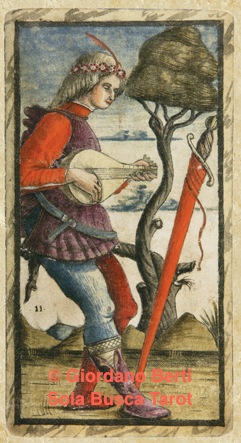
    The Page of
    Swords is a wonderful image – he seems to be strumming a tune on his
    lute to the sword in front of him!
    Tell me about his
    character and how he is interpreted in the Sola Busca Tarot.

    This image, in my opinion, show in
    allegorical way the ambiguity of feelings that animate the immature
    people, not just those who are young. The contrast is given by the lute,
    an instrument of peace and poetry, near the sword, instrument of war
    and death.

    The proximity of the sword means
    that at any moment the Page could take it in his hand with menacing
    intent, both defensively and offensively.
    How is your Sola Busca edition
    different to other issues of the deck?

    I am convinced, along with Sofia Di
    Vincenzo, that the Sola-Busca Tarot is the first deck to be designed
    with non-gaming purposes, but this is purely speculative.  It is evident in
    many cards references to Alchemic tradition, which must be
    interpreted not as a way to make gold but as practice for improving
    the individual.

    I hope to
    publish
    , before the end of 2013, a
    book I’m working on, entitled
    Sola-Busca
    Tarot. Secret Code of Alchemy.


    If you would like to buy the Sola-Busca Tarot,  write to: giordano.berti@gmail.com

    Many thanks to Giordano Berti for taking the time to answer my questions about the Sola-Busca Tarot.  You can explore the deck here.

    Giordano provided his answers in English, which I edited in one or two places to read more smoothly.  Any translated errors are, therefore, entirely of my own making 🙂

    ‘like’ the Sola-Busca Facebook page!

    Visit Giordano’s website to explore the deck in greater depth.  Read other articles about the Sola Busca Tarot here 

  • Page of Swords | Gratitude Tarot | Teresa Deek

    The Page of Awareness
    AKA Page of Swords

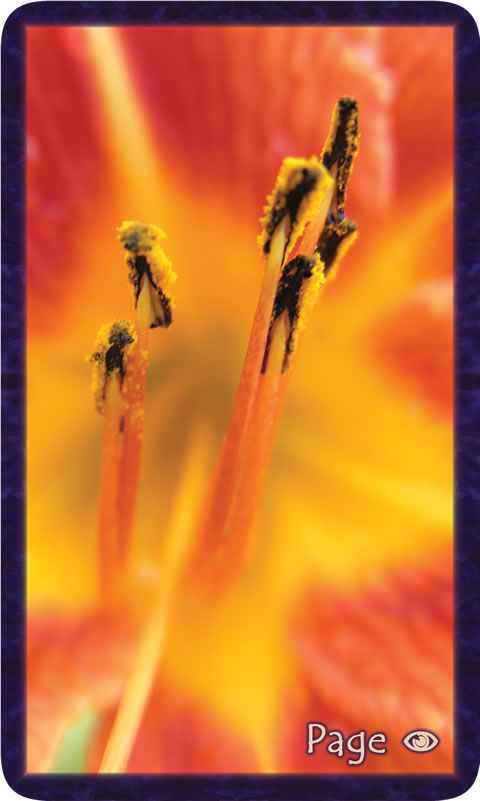
    Now here’s something a little bit different for you to peruse – the Page of Awareness from Teresa Deek’s Gratitude Tarot.

    I first came across Teresa’s deck in the Tarot Blog Hop and thought that it was a lovely idea, well-executed.

    The macro photo of pollen-dusted stamen of a lily represents this Page – tiny, upright and potent – it feels quite Wandsy to me because I associate the creative/fiery/summer with the hot Wands with cool Swords being more airy and Springlike.

    Teresa’s web page for this card features the following poem (I’ve retained the original formatting):


    Page of Awareness

    children we are
    if we let ourselves be
    declaring ourselves

    bright stars arisen

    pushed up from our smoldering essence
    will you dance with me
    on the head of this pin?

    will you set your troubles adrift

    out to sea
    to see
    their lessons melt
    into our bounteous river
    the meaning to one
    becoming

    the meaning for all

    in the wake of their expulsion
    the grand widening of space

    radiates joy

    into the hearts of soul-family
    flowing as one through our connections

    Well,  that’s a bit different from the norm, isn’t it?  

    Teresa’s site then goes on to provide an interpretation of the card: ‘Youthful passion explodes into your life. See how vital your individual nature is. Rise up in your own fire.’ I say! That sounds positively WANDSY!

    Time to ask some questions about this lovely deck!

    I read from your website that you were inspired to blend the tradition of the Tarot with the elements of gratitude to come up with this beautiful hybrid!

    “Yes!”

    Do you associate any elements/colours/seasons etc with the suits as you have reimagined them, Teresa?

    “I’ve not yet put a lot of thought into that, although my discovery of the elements happened in the order of Thankfulness then Awareness then Community then Kindness. which I could see may follow the seasons from spring through summer to fall and winter.”

    Since we will be talking about the Page of Awareness – what element to you associate with that suit?

    “Awareness is that time in the journey when I began to see that there is Beauty in everything, that the light of the Mystery lights every moment, every item, whether it seems beautiful at first or not.”

    In trad decks – Swords = the element of Air, does that also apply to your deck or is it a set of associations that aren’t applicable for the Gratitude Tarot?

    “Though I don’t focus on the elements a lot when I work with my cards, I’m happy for others to! And so, yes, air would apply to Swords.

    “Pages feel like they are all about movement, action, newness….”

    So the fiery bit for the Page of Swords is not related to any kind of elemental association? It’s just an expression of his movmennt, action and newness?

    “I love that interpretation, yes!  Though I seem to have used more fire imagery in my Awareness (Swords) since I let my heart guide its creation, it is kind of hard to describe the reasons behind my choices and word.”

    The Gratitude meanings to the cards are quite different to what someone might be used to working with in a Tarot. How did you decide which meaning to ascribe to which card?

    “I did work with keywords at the beginning, nudges towards the traditional meanings. Once I got into the detail of writing the short meanings and then the poems, I let intuition take over.”

    So would you recommend that people who use your deck let their intuition guide them or are they best to stick with what you intend for the cards?

    “I always feel it’s best that people let their intuition guide them when working with a deck! We really are tapping into a deeper knowing within ourselves and whichever meanings come up when we use the cards is the one we are meant to see.”

    The images are very beautiful – did you take the pix yourself?

    “Yes – thank you – all of the photos are taken by me, and none of them are photoshopped (except in order to fit them to the card and add the border and title).


    “Photography has been the central part of my journey to Gratitude. It is through taking my photos that I discovered the four elements, and it was my desire to share the enlightening experience of taking the photos, of touching Gratitude so closely, that led me to want to share them as a Tarot deck.”


    Tell me allllll about your Page of Awareness – why you chose that image, how you decided that THIS was the message you wanted him to convey

    “Goodness! It was like the image asked to be included, as so many of them did, tapping my heart as if to say “I have what it takes”. And in the image I saw a reaching forward, upward, into the unknown. I saw the energy of youth, stars rising through the air. This card seeks, longs to be higher…

    …. and thank you for asking about my deck.”

    You can find our more about Teresa’s deck at her website: http://handsongratitude.com/buy-gratitude-tarot/

  • Hello Kitty! Welcome to the Pointy Page

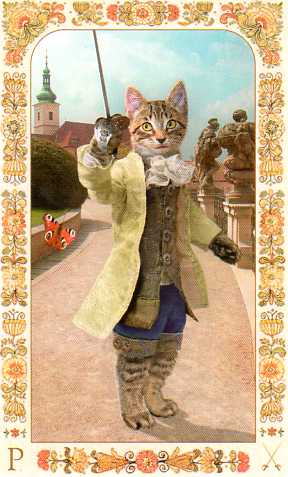
    Yesterday afternoon, the moon entered its New phase, so I drew a card to see whose qualities I should be embracing from now to the Full Moon on the 6th of April. I drew the Page of Swords from the Baroque Bohemian Cats Tarot by Karen Mahoney and Alex Ukolov at Magic Realist Press.  I seem to be interacting a LOT with the Page of Swords on this blog lol!

    The Page stands alert on the pathway in what looks to be a grand garden.  Poised for a duel, he holds his sword aloft. 

    But he’s not duelling with us, the viewer – there’s a Red Admiral butterfly that looks like it will be on the receiving end of the Page’s blade – so this Page is quick witted if he can fence a butterfly!

    Maybe he doesn’t intend to hurt the butterfly at all – you can’t see the tip of his blade in the image – for me that signifies that he’s not going to hurt anyone – but he can go through the motions and probably be quite a pain in the neck (or wings!) for the poor creature.  The Page of Swords can be an irritant – bit whiny, a bit of a clype as we say in Scotland!  OK – I’ll be trying to avoid THOSE particular traits lol!

    Cats like to tease and toy with their ‘catch’ and that’s perfectly suited to the Page of Swords!

    Pages often stand for messages – possibly from your inner child or a part of you that feels stultified in some way.  For me the Page of Swords is appearing here as a timely reminder to let my head have a bit of fun.

    Swords like fair play and justice – and so do I – and this sometimes means that I wade in and try to help other people with their issues.  Maybe it’s time to step back, not take things too seriously, have a bit of fun – like my clever and quick-witted little companion here!

    Have an excellent weekend – and if you have a couple of minutes, why not tell me what the Page of Swords mean to you?