Tag: A E Waite

  • A E Waite | Happy Birthday!

    A E Waite | Happy Birthday!

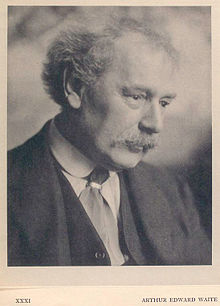
    On this day, 163 years ago, in Brooklyn Arthur Edward Waite entered the world. For the first time? Who knows!

    His father died when he was very young, so his mother returned to her homeland, England, taking the young Arthur with her.

    It was the death of his sister in 1874 that triggered what would become a life-long interest in the occult and he soon found his way to the esoteric sections of the British Library. And aren’t we grateful that he did?!

    I was today years old when I found out that for the nine years prior to the Rider Waite Smith Tarot being released into the world, Waite worked for Horlicks!

    He joined the ranks of The Golden Dawn in 1891. This esoteric group was popular with creatives in the 1890s and unfortunately, there were a lot of very large personalities in its membership (including Aleister Crowley) and it pulled itself apart (put itself back together and pulled itself apart again!)

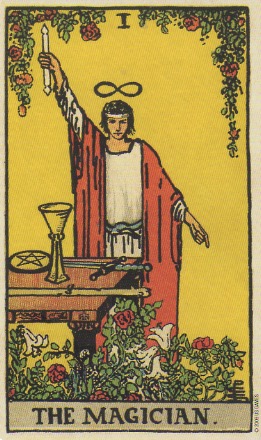
    It was 1909 when he hit the big time (in the Tarot world!) when the tarot deck he’d designed along with fellow Golden Dawn member Pamela Colman Smith was published by Rider. Initially known as the Rider Waite Tarot, over more recent years the enormous contribution of Pixie Smith has been better recognised and it is more often referred to as the Rider Waite Smith Tarot.

    It is the best-selling Tarot deck in the world – ranked no 1 for Cartomancy and New Age Mysicism and no 2 for Tarot, today on Amazon. Not bad going for a deck that is well over 100 years old!

    Tonight I’ll have a Horlicks in your honour, Arthur!

  • The Tarot Court | The Bridge card

    If I were to ask you to lay out the your favourite tarot deck in order, how would you do it?

    Would you lay out the Major Arcana from The Fool to The World and then dive into the Minor Arcana via an Ace from one of the suits? And work up to the 10 and then head over to the Page and end at the King before beginning at the next suit’s Ace?

    I reckon I’d begin with The Fool and work through them until I culminated with the King of Pentacles as the 78th card.

    But that’s not how A E Waite saw it.


    I’ve been revisiting Waite’s The Pictorial Key To The Tarot, one of the Tarot books that you can freely enjoy on www.sacred-texts.com or buy on Amazon for a couple of shekels.

    Admittedly, Waite’s style of writing is convoluted and a bit disdainful of anyone who isn’t himself (like many of his ilk). Frankly, if he was any more up himself, would be able to see the back of his own teeth.  BUT, on the other hand, he did give us The Rider Waite Smith Tarot deck that we all know and love, so I figure that he is worth another look.

    Waite says:

    “In respect of their usual presentation, the bridge between the Greater and Lesser Arcana is supplied by the court cards ..”

    He then goes on to say that there is no special idea connected on the surface with the ordinary court cards, that they are merely ‘a bridge of conventions’ that lead to the ‘simple pretexts’ of the Minor Arcana.

    He concludes, no doubt from a melancholic slump on his red velvet divan:  ‘We seem to have passed away utterly from the region of higher meanings illustrated by living pictures.’

    Waite’s occult snobbery about the value of the Minor Arcana aside, what he’s saying is that the COURT CARDS are the link between the Majors and the Minors.

    But which one, Mr Waite? Who’s the lucky guy/gal?

    *clears throat and stands up to relay the important news*

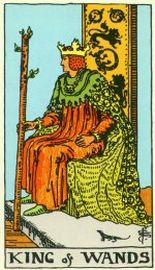
    The reclining court card that reaches upwards, Adam-like, from the earthly Minor Arcana to brush fingertips with the celestial glories of the Majors is……. *pauses to build tension*….  THE KING OF WANDS.

    For me, the King of Wands is magnetically attractive, potentially dangerous and, just like the Fire he represents, can be all-devouring. However, in addition to the traits that we would normally bestow upon him, it is time to add one other.  For it would seem that The King of Wands is a spiritual lighthouse.

    Yes, yes, this is all well and good, I hear you thinking, but SO WHAT?

    Well, what it could mean is that when The King of Wands arises in your work, we readers can be aware that THIS court card – more than any other – has a link with the archetypal energies of the Majors.

    Not only can we interpret the King of Wands as perhaps a person (the querent or someone known to the querant) or reflecting the energies around the situation being discussed, he may also act as a signal that some BIG Archetypal Type Changes are a-coming because HE is the Bifrost.

    Yes, the King of Wands can be the flaming rainbow bridge that links the world of the archetypes with our own humble abode.

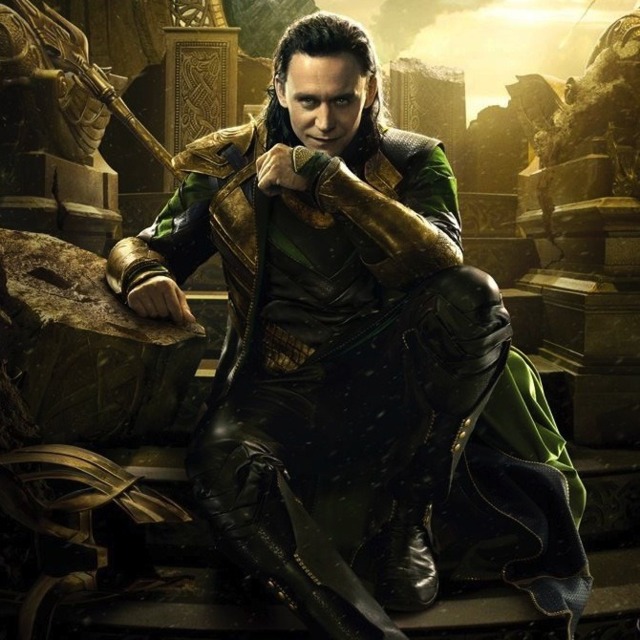
    That makes me think of Thor.  And by default, Loki.  I know that you’re not really surprised to see this:

    … and sorry, this post has nothing whatsoever to do with the Danish TV series and Saga Noren either.  NOTHING.

    Or Simon and Garfunkle.

    Or dental work.

    So, do you think that the King of Wands is a very special sort of a guy, being The Bridge?

  • The King of Wands | The Power of Tarot’s Bridge Card

    Last week I wrote about the King of Wands and how A E Waite saw this card as the stepping stone from the glory of the Major Arcana to the mundanity of the Minor Arcana.  
    Today I thought I’d expand on this and show you how I am using The King of Wands card as a result of reading Waite’s insight.
    Let’s see how powerful he really is!
    First, procure your
    deck’s King of Wands card.

    Split your deck into
    two bundles – one for the Major Arcana and the other for the Minor
    Arcana and shuffle each bundle well.
    Ask your King of Wands
    card to guide you to the most significant Major that you need in
    order to make progress (in your issue, towards your goal, whatever it
    is that you are looking for help with).
    Place your King in the
    Major Arcana bundle and shuffle, all the while keeping your question
    for him at the forefront of your mind. 
    When you are content to stop
    shuffling, take your Major Arcana bundle, face down, and lay down
    each card in turn, as if you were playing snap or something. When
    you turn the King of Wands, you are paying attention to the NEXT card
    that you turn over – this is the Major that will help you.
    Do the same with the
    Minor bundle and your King of Wands card. Again, you are looking for
    the card that follows the King of Wands as you turn over each card in
    the bundle.
    You now have two cards
    – a Major and a Minor. These have been linked by the King of
    Wands.
    How can reading these
    two cards together help you with your issue?
    Here’s a worked
    example:
    The question concerns a
    stale relationship and a need for break-through:
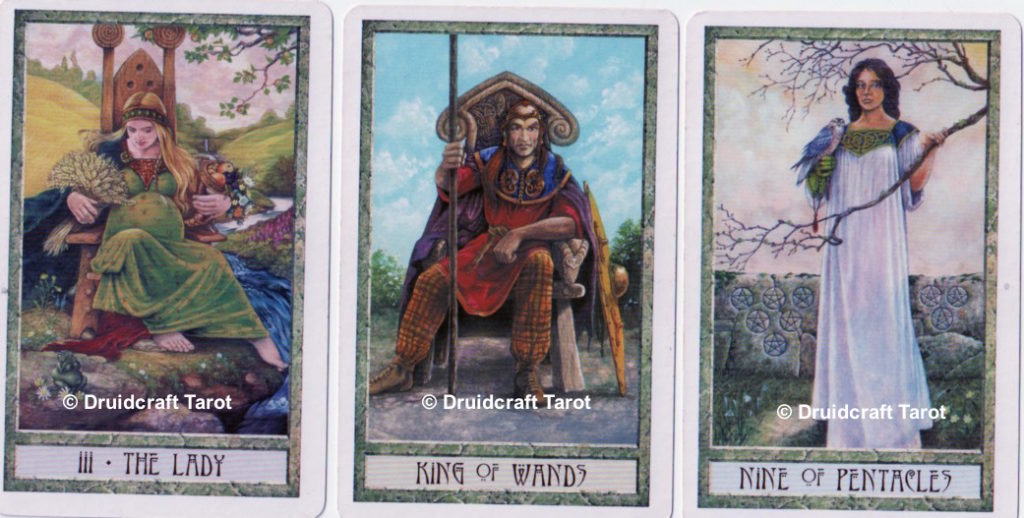
    The Lady (Empress equivalent) and the 9 of Pentacles.
    I am struck by how sad
    The Lady looks, despite being surrounded by such luxury and
    fecundity. The harvest necessitates the cutting of the wheat, the picking of the fruit; the
    arrival of the baby heralds the end of her pregnancy. She is brooding
    the losses that come with creation.
    The 9 of Pentacles
    woman wears the same pensive expression and she too looks materially
    comfortable. Her hawk is held on the glove. In order for it to fly
    free, she has to let it go.
    The two cards that the
    King of Wands has chosen to act as a bridge tell me that in order to
    effect a break through, the sitter has to work on two things to make
    the necessary break through.
    • If comfort is
      paramount, then the sitter must be prepared to accept the necessary losses and
      restrictions in order to keep comfortable.
    • If, however, the sitter
      wishes the bird to fly freely, then some discomfort and uncertainty
      must be endured in order to create something new and better.  

  • Comparative Tarot | Page of Wands

    We began this Comparative Tarot session with a look at the Page of Swords, over three decks.  Today we look at the Page of Wands, trying to find common ground and extend our perceptions as to what he might mean in the decks that we use ourselves.

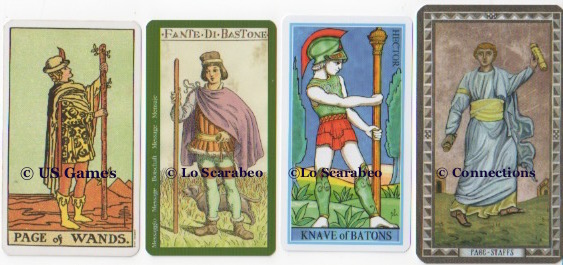
    On the left we have the RWS Page of Wands, then the Fante Di Bastone from the Tarot of The Master (ToTM), the Knave of Batons from Dame Fortune’s Tarot Wheel and finally the Page of Staffs from The Byzantine Tarot.

    In the RWS we have a cloaked-up young man standing in an arid landscape.  He must be roasting hot in his hat and cloak! He gazes intently at his sprouting Wand.  Pyramids line the horizon to the right of the card.


    The Fante stands dressed in his travelling clothes, his Wand held like a walking stick, his cloak pulled around him and his little dog companion on a leash behind him.

    The Knave of Batons is named Hector in the Dame Fortune deck.  He looks martial with his helmet, breast plate and shin protectors. Yet he has no sword or shield. He too stands in a landscape, focussed on the Wand.

    The Byzantine Page is out of his office and hurries over the grass, bearing scrolls in his hands.

    We know that Pages stand for smallness, messages and newness …  but what do the Pages creators say about them?

    In A E Waite’s ‘Pictorial Key To The Tarot’ he writes of the Page of Wands:  “Dark young man, faithful, a lover, an envoy, a postman….He may signify family intelligence”.  Clearly missing in the Donald Trump family, I think.

    The ToTM Fante is marked with the keyword ‘Message’ and the Little White Book (LWB) that accompanies the deck adds little to what we can see, stating only that the rural aspect of the Wands is clearly seen in the Fante.

    Hector’s LWB entry states: “A stranger.  Hector, prince of Troy. An unknown person, something extraordinary, admirable.  A messenger for a powerful man.”

    The Byzantine’s Page information comes from a good-sized accompanying book that comes with the deck.  The key words are: “A Prodigy, A Stranger, an Emissary, Surprise, Naivety, Faithfulness, Tidings – good and bad”.

    The common elements seem to be faithfulness, foreignness and a messenger of some sort (either delivery or ambassadorial)

    How can we link all this together?

    The RWS Page is clearly wearing the wrong clothes for his environment, so he’s HERE from somewhere else? And if you are visiting, you are a stranger and a foreigner … and you could be acting on someone’s behalf or delivering a message?

    The Fante is dressed for travel, with his cloak slung around his shoulders and his sturdy boots on.  Again – travel, foreignness … maybe he is waiting for the letter he must deliver.  We also clearly see this idea of faithfulness in the shape of his dog.  Dogs are often associated with fidelity.

    Hector was, according to Homer a thoughtful, heroic chap – so we can see the ‘admirable’ qualities that his LWB talks about.  Interestingly, on Wiki I read that author James Redfield describes him as a ‘martyr to loyalties..’ Also, according to Wiki, his name, Hector could mean ‘hold fast’ so here we have two ways that he is associated with loyalty and fidelity.

    Although I don’t think he was noted for being a messenger (please let me know if this is a wrong assumption on my part!) he is dressed in armour, but not in a battle. So, like the RWS he is here from somewhere else – so a foreigner and stranger 🙂

    The Byzantine Page of Staffs is clearly delivering messages.  More usually found in the confines of the office, this Page is outside his usual enviroment, just as much as the RWS Page and Hector – so again we can infer foreignness and being a stranger.

    So there we have it – by looking at four Pages of Wands we can see that they are messengers, strangers abroad, faithful and admirable.

    How do YOU interpret the Page of Wands?

    Like the look of these cards? ….

    Amazon.co.uk Widgets

  • Comparative Tarot | Page of Swords

    I’m running a workshop for the Glasgow Tarot Meetup Group at the beginning of April on using the comparative method of working with the Tarot.  I first heard about this method from Valerie Sim and the Comparative Tarot deck that she created specially for it.

    I though that it would prove an interesting exercise to do with the court cards, here on m’blog.

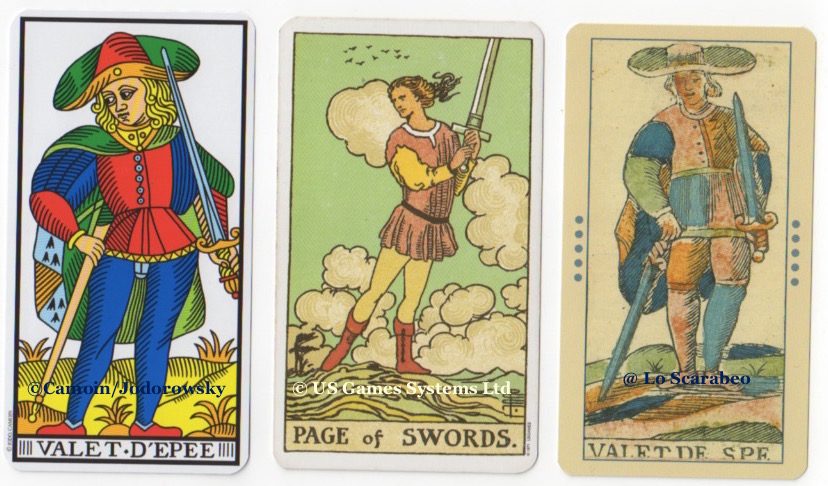
    From the left we have the Valet d’Epee from the Camoin/Jodorowsky Marseille deck, then the Page of Swords from the Rider Waite Smith in the centre and the Valet De Spe from the Ancient Tarot of Bologna on the right.

    They all have different names, but henceforth I shall refer to them all as the Page of Swords, for ease of reference.

    What do the books say about them?

    Ancient Tarot of Bologna (Lo Scarabeo) says that the Valet is a researcher, investigator, revelations, search for truth, surveillance

    In A E Waite’s Pictorial Key to the Tarot, the Page of Swords is described as: Authority, overseeing, secret service, vigilance, spying, examination, and the qualities thereto

    Tarot de Marseille Jodorowsky/Camoin – The deck’s LWB is silent on entire Minor Arcana.  But in his book The Way of The Tarot, Jodorowsky uses the words: ‘foundation of intelligence’, ‘student or young seeker’ ‘caution’.

    So our Pages are most definitely associated with intelligence, a Swords’ suit trait.  But also perhaps with secret intelligence too – spying, secret service, surveillance, investigator etc.

    What can we actually see in these cards?

    They are each looking to the left, which I associate with the past. Perhaps they are each looking over their shoulder.  We look over our shoulder when we are being wary.

    They each hold a sword in their left hand.  The left has always had slightly sinister (did you see what I did there?!) overtones.  Our little valets could, in theory, shake your hand (traditionally the right hand is proffered …unless I’m shaking hands with you and then, being a leftie m’self, I extend my left hand!) and stab you in the arris with a cunningly concealed left-handed stroke!

    Two of them have empty scabbards, so we could say that they have drawn their swords and are alert to attack.

    They each have their feet pointing in different directions, the Page on the right is on a path and, for me, this means that he is not certain which way to go.    This lack of clear direction is most obvious in the RWS Page whose body language is clearly carrying him forward, but his gaze is behind him.

    They all stand on uneven ground.  In the RWS I associate that rolling landscape underfoot with a lack of confidence or experience.  That could also apply to the other youthful Pages too.

    The RWS Page is quite different in many respects – without a hat, cloak or scabbard.  He seems altogether more theatrical than the two Marseille Pages.  He does, of course, come from a period much later than the two Marseille decks (being printed in 1910).  The Camoin deck original dates from 1760, with the Bologna version from the 1780s).

    Perhaps Pamela Colman Smith decided:  NO CAPES! *in the manner of Edna from The Incredibles*

    Amazon.co.uk Widgets