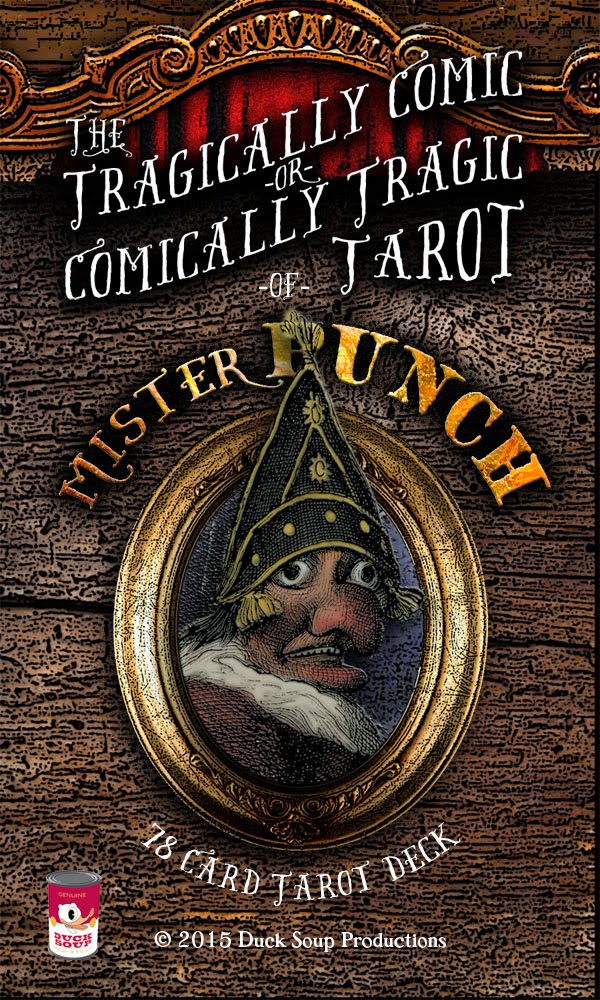
Sometimes you see a project and it’s just such a perfect storm that you wonder why it was never done before! That’s how I felt when Doug Thornsjo (Tarot of the Zirkus Magis, Tarot Lombardi Dannegiatto etc) began sharing images from his Tarot of Mr Punch: The rambunctious personality of Mr Punch will make a great ‘no punches pulled’ *groan – sorry, that was awful!* tarot deck.
I asked Doug if he could answer some questions about his new deck and woohoo!!!! HE SAID YES!!
Me: So, tell me how you got interested in creating Tarot decks?
Me: So, tell me how you got interested in creating Tarot decks?
Doug: This is going to sound like a flip answer, but I don’t mean it that way: it’s just human nature that you’re going to want to do whatever it is you like. If you like reading books, you’re going to want to write a novel. If you like watching sports (although personally I can’t imagine a worse waste of a person’s life), you’re going to want to play. Tarot is one of the things that I’ve always liked, so from the beginning I always wanted to make my own. The cosmic axis simply did not come into alignment for this to happen until a couple of years ago.
Me: You’ve created a few decks so far, The Tarot of Mr Punch is the deck that we are looking at specifically today.
I am intrigued to learn that the roots of Mr Punch stretch back to the 16th century Italian Commedia del Arte figures – Pulcinella.
Doug: Yes, Mister Punch and the Tarot go back a long way together! I’m just lucky no one thought of the connection before!
Me: This Pulcinella figure was a comic figure who could say quite outrageous things – like the court jester …. but by the time the puppet shows that we are more familiar with came along, he had morphed into a modern day Homer Simpson character – a bit of a buffoon who can do quite violent things?
Doug: I wouldn’t compare him to Homer Simpson (who is a dolt) and I wouldn’t call him a buffoon. Mister Punch is very, very smart. Not a nice man, it must be said, but smart. Smarter than you or me or anyone. The court jester can get away with telling the truth because he’s clever about it. Mister Punch out-smarts everyone: the police, the judges, the hangman, even Death and The Devil themselves. He always wins — always — because he is the smartest one in the room. He’s also Quite a Mean Old Bastard, who makes no distinction between hitting you with a club (or wand!) and hitting you with words.
*** just as an aside – why does Mr Punch always look the same – hooked nose and chin? ***
Doug: Also a hump back. Don’t forget that! He’s a very well-established character and when something works you don’t mess with it. When Punch appears on the stage he needs to be instantly recognisable. Again, it sounds like a flip answer, but if you changed his appearance he simply wouldn’t be Punch.
Maybe this has something to do with it and maybe this has nothing to do with it, but in profile, his head and face look exactly like a lobster’s claw. It’s a great design for a mean old bastard, because it’s harsh and pinchy and bitey.
Me: What was it about Mr Punch that made you think – this would make a great Tarot deck?
Doug: See above: they both go way back, have similar origins, and have evolved together over the years. More than that, both Punch & Judy shows and the Tarot deal with the Big Issues of life in a compressed and even detached form. Relationships, family, legal issues, emotions, Life and even Death itself. All the Big Issues of Life that we struggle with, he’s been there and done that. The fact that, as we know him now, he is essentially a Victorian figure — that didn’t hurt, either. His age gives him weight and authority and style, too.
The creator/editors of PUNCH magazine realized that he would make a good mascot because a) he’s a snarky little fellow and b) he’s seen and done it all, and is capable of giving any kind of authority figure a damn good spanking. And that includes Supernatural Beings and Deities of all sorts.
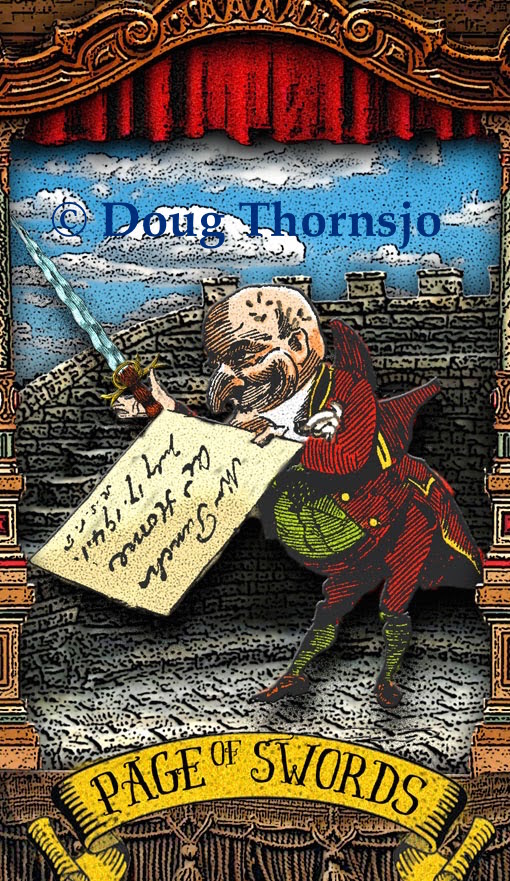
Me: The Page of Swords is the card that we are taking a look at specifically today. Tell me about the image – what was your source material, how did you transform it into the Tarot card?
Doug: The figure is taken from what they call a “spot illustration” — not a full cartoon — from the pages of PUNCH magazine, circa 1880s-90s. I coloured him, put an especially twisty sword into his hand, and then because the suit of swords needs air and clouds, I set him on the battlements of a model castle that I “artified.” The first version I did had him inside a castle setting, and that didn’t work for me. With swords you have to have air, sky and clouds.
Me: Tell me about the structure of the deck itself – are we talking RWSy, Thothy, Marseille-y influences?
Doug: Not so much Thoth this time, except for maybe two or three cards. I will say that with any deck I work on, I do not confine myself to one (or any) particular school of symbolism. This appears to annoy some people who want their decks to be ALL RWS or ALL Thoth or Marseilles. I may start with a certain school of symbolism, but I like to mix it up and I’m always working towards doing things my own way. I haven’t completely succeeded at that with any tarot deck I’ve done so far. The closest I’ve come to succeeding is with my Marvelous Oracle of Oz.
Me: Are there any surprises in your Majors? Anything renamed?
Doug: Not really. I do have “Art” in place of Temperance, with symbolism that’s neither particularly Thoth or RWS, and I do have “The Aeon” in place of Judgement Day, featuring a cartoon from Punch magazine that just practically reeks of Thoth symbolism. I probably will never create a Tarot deck with a conventional Judgement Day card in it, since it’s a specific kind of Christian symbol that I don’t agree with and can’t abide. No, Ladies and Gentlemen, when you die you are NOT going to grow wings and fly up and sit in the clouds with the angels, thank you very much.
Me: In the Minors, is the structure traditional – Ace to 10 and four courts?
Doug: Yes; although personally, I tend to stack the Court Cards all together, separate from all the pips. I stack all my decks up with the courts following the majors King to Page in each suit, and then the pips one to ten in each suit, so that the ten of pentacles is always the last card in the deck. That’s the way the deck comes packaged. I think — although I won’t swear to it — that this reflects a Thoth bias.
Me: That’s interesting – Why do you put them there? Do you see the Courts as filters or an interface for all that Major Arcana energy by putting them between the Majors (archetypal energy) and the Minors (individual effort)?
Doug: I’m smiling as I type this, but I don’t see all those Kings and Queens and Princesses and Knights and Princes consorting with the peasantry or the riff-raff. They want to hang out with their own kind.
And I do see them as being separate — they’re read differently than either the majors or minors. They do act as a filter between the two. When I bought my Thoth deck, it came stacked up like this, and I thought “if it’s good enough for crazy Uncle Aleister, it’s good enough for me…” In TAROT FOR YOURSELF, Mary Smith (if I remember correctly), stacks them separately but puts them at the end.
What are your Court card ranks in the deck?
King, Queen, Knight, Page.
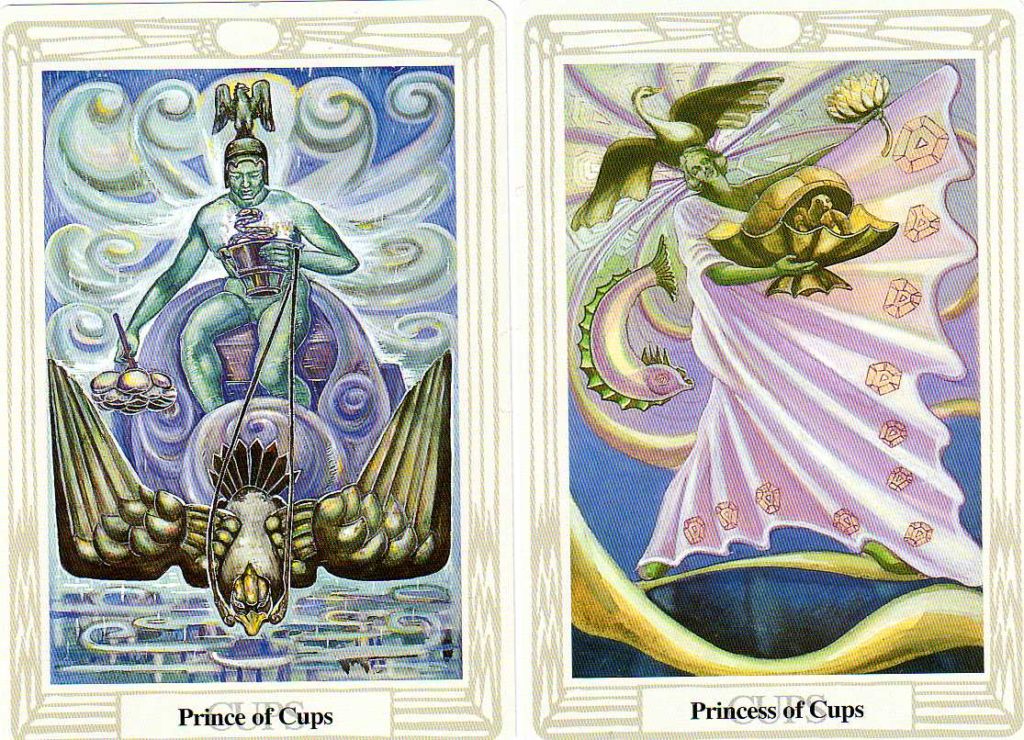
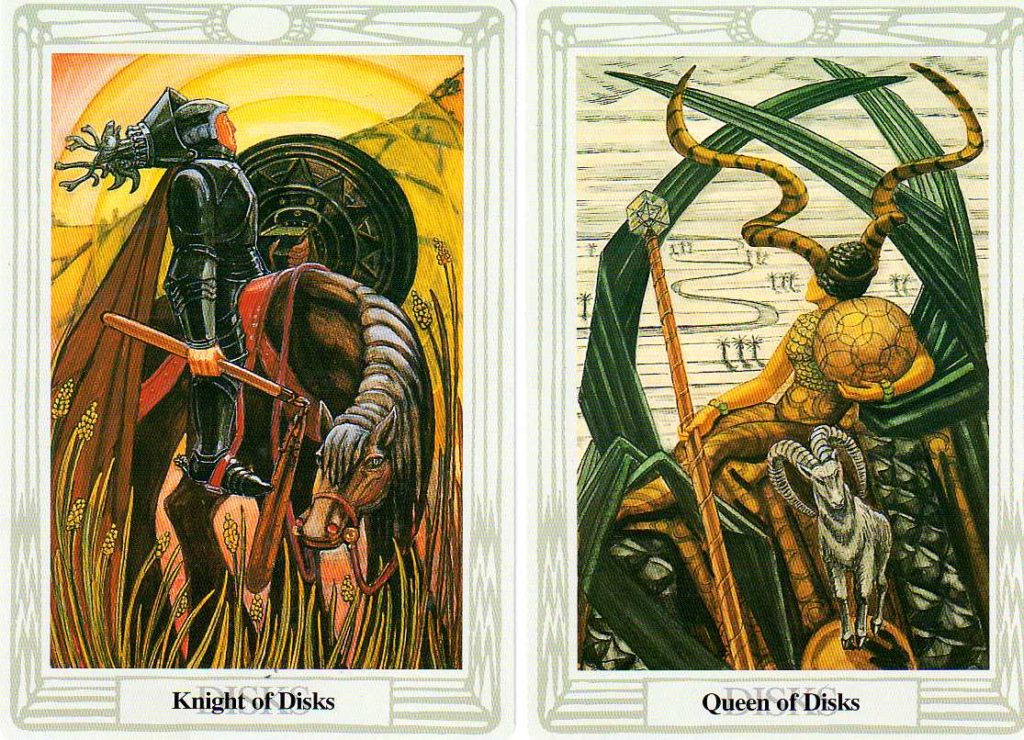
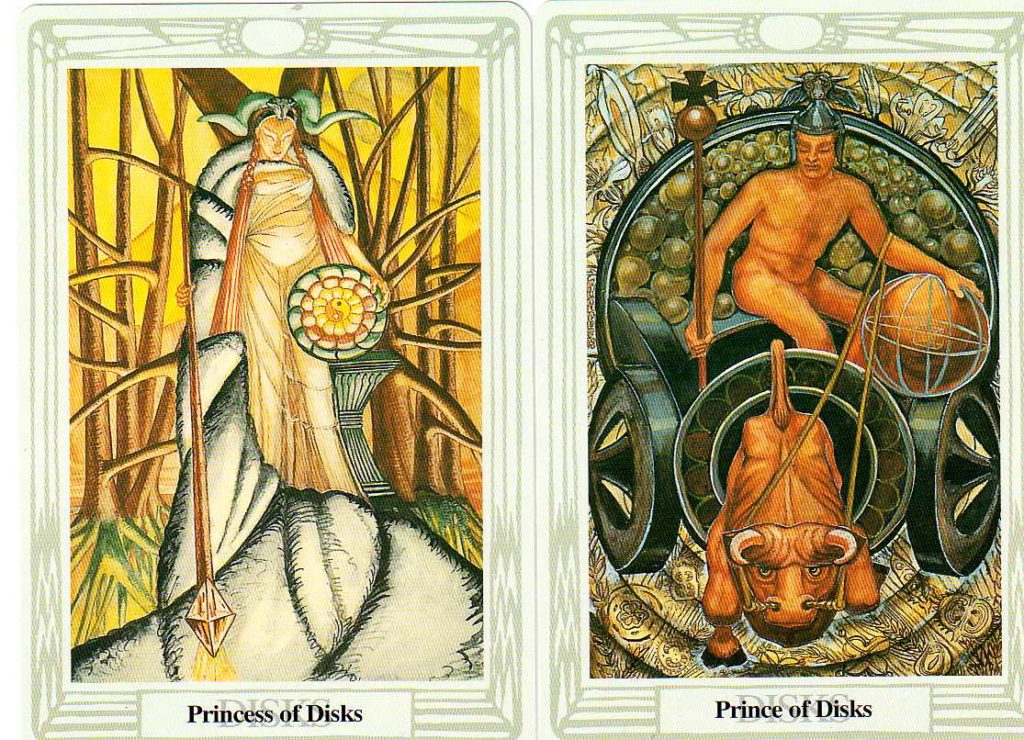
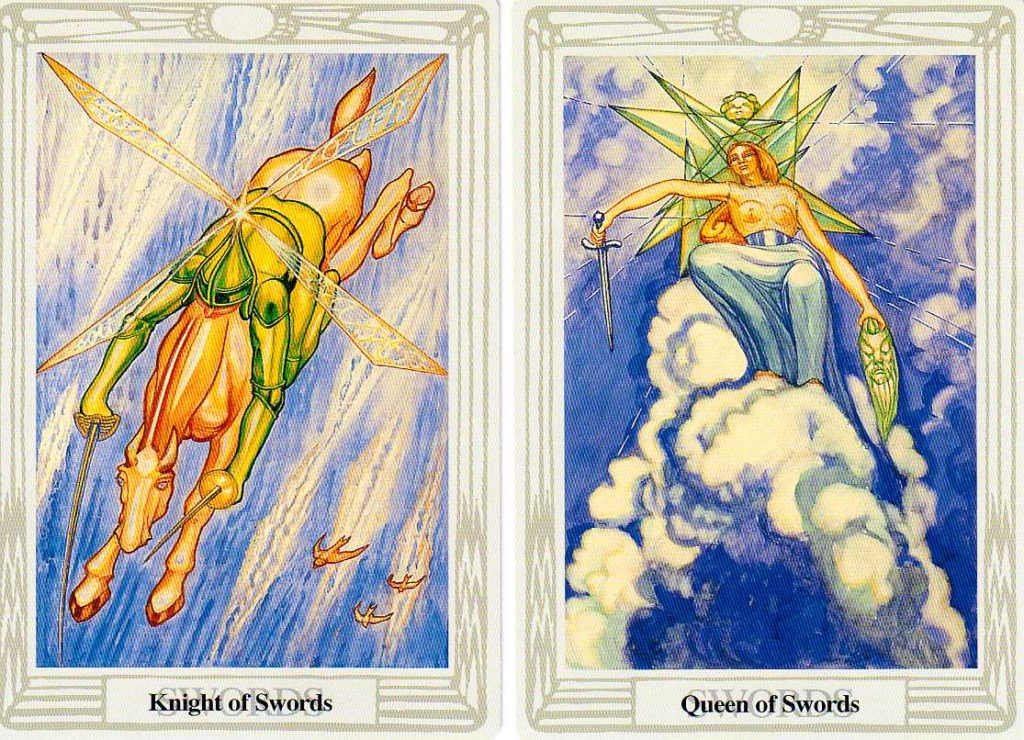
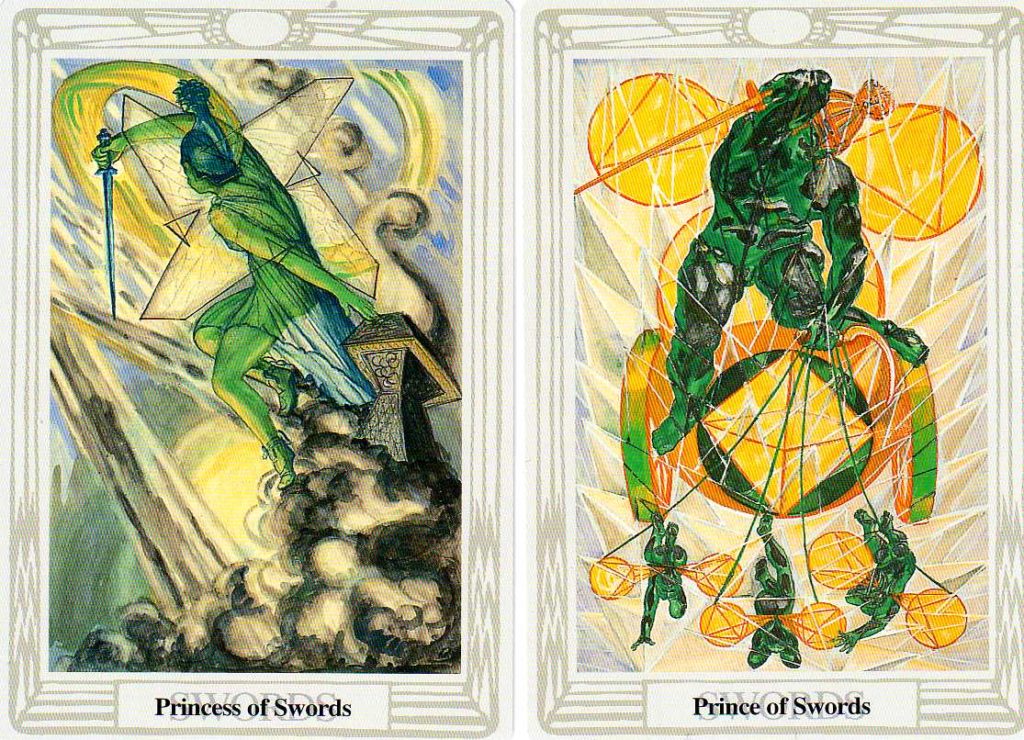
Me: For those who are not very familiar with the Thoth deck, In the Thoth, the Court Cards are Princess, Prince, Queen and Knight … with the Princess associated with traditional Page energies, The Prince with Knightly energies, The Queen with, erm, the Queen and the dashing Knight replacing the old King. So the Knight in the Thoth is the Young King.
Doug: Ally’s Knights are more virile aspects of the King, it seems. This raises another issue for me: why is the pagan female deity represented at all stages of her development (maiden, maturity and crone), but the pagan male god is ONLY ever represented as being young and virile and full of himself? Mister Horney God. I personally can’t respect that image and wonder why he’s never presented as being older and wiser and someone who thinks with the head on his shoulders, not the one between his legs. But I digress… 🙂
Me: How do you see your Knights’ role in the Tarot of Mr Punch – is he more Kingly (like in the Thoth) or is he the young explorer of the RWS?
So, yeah, my court cards are more RWS than Thoth. My Kings are accomplished, older men and the Knights are dashing young squires. In the Punch deck the Knight of Wands is so young that he’s riding on a wooden hobby-horse!
Me: What are your suits in the deck?
Doug: Wands, Cups, Swords, Pentacles — although the latter are represented visually as coins.
Me: Are the pips fully-illustrated or pips?
Doug: Now, this is interesting! When I started out, this was just going to be a Marseilles-style deck with plain ol’ pip cards. As I got into it, I found for several reasons that I wanted and needed to create illustrated minors. I did the Cups first, in my first mind-set, and so they are the most pip-ish cards in the deck. But I kept sticking Punch into them in ways that were illustrative. So by the time I started the next suit, which was wands, it suddenly turned into full-on illustrated minors. So the end result is a little bit schizophrenic.
Me: Which is the last card in the deck, for you? 10 Pentacles?
Doug: Yes, the ten. It makes sense to me that Legacy, Fulfillment, Promise for the future should be the last card, and as most decks arrange their ten coins in a Tree of Life pattern, that’s a perfect symbol to end on. From a writer’s point of view, if there’s a single card in the deck that says “The End,” it’s the ten of pents.
Me: Which card in the deck was the most fun to make?
Doug: I can’t really think of any one card that stands out: a LOT of them were fun to make — but the thing that makes a design fun is when everything — your ideas and your base materials and the execution — just all slide together and dovetail as if the final design was simply meant to be. There were a number of cards in the deck like that, and it’s always a delight when you get that pleasant surprise of everything coming together just naturally and perfectly.
Me: Which card did you struggle most with to get just perfect?
Doug: In the Majors — “The Lovers” was Quite a Bastard. In the Minors, the two of Pentacles went out of its way to annoy me. As a rule, though, the hardest part is finding the right base image, the one that says what you want it to say the way it ought to be said. That was easily the most time-consuming part of this deck’s process.
Me: Are there any particular colour themes in your suits – are your Wands particularly orange or red, for example?
Doug: Nnnnnn-ot really. The wands are more woody than fiery. The swords are appropriately airy. But the cards all have a puppet-theatre proscenium surrounding them, so colour-wise they’re really more brown than anything else. That ought to make them popular with the Steampunk crowd….
Me: Have you incorporated any other system into your deck – for example, astrology?
Doug: Astrology and numerology are beyond me. However…
… if the language of theatre is a system, then yes: the whole conceit behind the deck is theatrical. There’s a precedent for this, Marcus Katz and Tali Goodwin have their book out now exploring theatrical connections in Pamela Colman Smith’s work, and I think he’s got another project coming that takes another step in that direction, stemming from Pamela’s personal use of toy theatres.
Being specifically derived from puppet plays, this deck takes several steps in that direction, and I have another project in mind that will push it still further. So — The Language of Theatre: not abstract symbology but staged Drama, “All the World’s a Play” — Enter The Devil Stage Right. The Emperor comes downstage and speaks sotto voce directly to the audience, breaking through the Fourth Wall. I’m deeply steeped in theatre myself, my first novel Persephone’s Torch has a theatrical setting and is itself theatrical in structure. if encouraging people to think outside of themselves and objectify their lives and issues (and the cards) as players on a stage… if that can be considered a system, than that’s the system I used….
 If you would like to see a bit more of The Tarot of Mr Punch or buy a copy please visit Doug’s site for the deck.
See Doug Thornjo’s entire creative oeuvre at www.ducksoup.me
You can also find Doug on facebook:

Stop being confused by court cards! Start being excited by the possibilities! Become a court card adventurer along with me 🙂 The Tarot’s Court Cards are my specialist area. They talk to me. Not LITERALLY though ….