Year: 2012

  • Amplifiers | The Rabbit Tarot

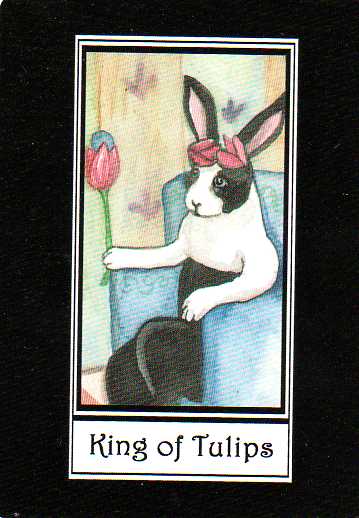
    King of Tulips – sweeeeeet!

    Each of us has our own ideas about what kind of character a particular court card represents – whether it’s Pages representing tentative beginnings or whether they urge us to develop a lighter and more playful approach…well, it’s up to you.

    And sometimes, no matter how deft our character studies are, no matter that you explain that the Queen of Wands is really Jolene (as sung by Dolly P), your sitter cannot not acknowledge or recognise the person or those traits within themselves.

    Something that you can do that can jolt the matter into a different orbit is introduce a card from an Oracle to act as an amplifier for your Court Card.

    This week we are looking at Animal Courts and here we have the King of Tulips from the Rabbit Tarot by Nakisha VanderHoeven (Tulips equating to the suit of Cups in this deck).  While I love the artwork in Nakisha’s deck, it is not really terribly heavy on the symbolism to help us with this King’s characteristics.

    I really need to dig in to what I know about the King of Cups in other decks here – so the King of Tulips is someone who understands someone’s emotional make up, but he himself is not driven by his emotions – so he’s diplomatic. An unhealthy King of Tulips (ie in reversed position) may possibly even manipulate people’s emotions to get what he wants. 

    Of course, what you say in your actual reading will be affected by the surrounding cards.

    Now, if your Client hasn’t recognised the King of Tulips as being significant to the question under consideration, and everyone’s a little stumped as to what in the heck he’s doing in the reading, you can pull on your Big Girl Pants and add an amplifier card from another deck. I know, it’s risky!

    But when you’re at this point in a reading, with a client shaking their head in confusion, you have nothing to lose and simply surrender, giving yourself over to the cards and what they say. 

    One of my favourite non-Tarots for using as an amplifier card is the Dreaming in Colour deck by Mindy Summers – a luminous deck where the lush fractal images vibrate with colour.  Each card is allocated an concept – from Aggression through Family and Passion to Temptation and Withdrawal.

    By adding one of these cards to your Court Card in question, you can add an additional interpretative layer to your work.
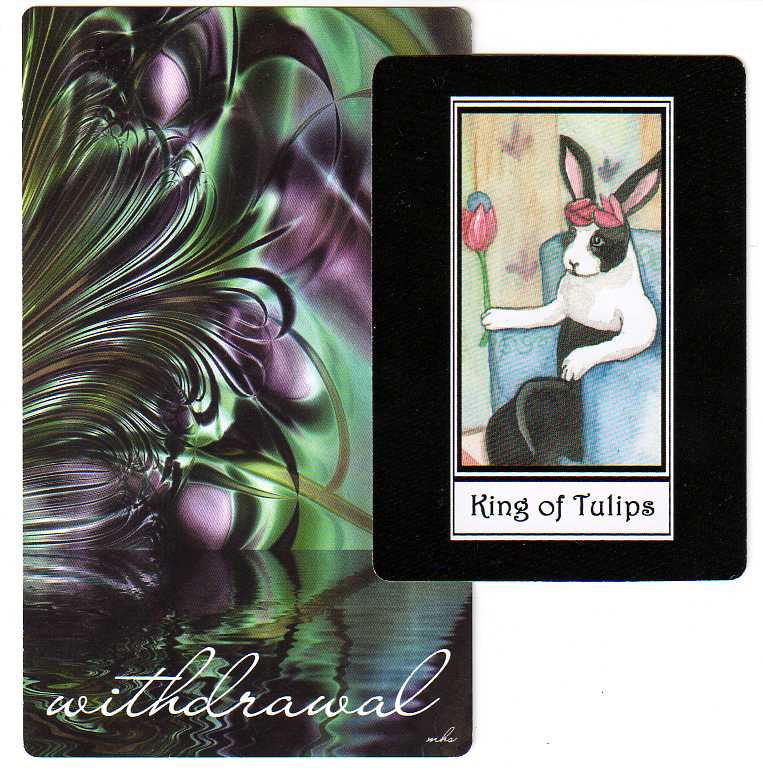
    As you can see, the card drawn to act as amplifier for the King of Tulips is Withdrawal.

    To me it looks as if the image is sinking into the sea, like a sunset….

    Have failures in diplomacy led to this character trying to take a back seat.  Has it all become too much for him to handle? Whomever he is, he is withdrawing either into himself, or from the situation, or from the client. Maybe that’s why your client doesn’t recognise these energies? The King has pulled back or disengaged in some way?

    When I select an Oracle to work in this way, I’m looking at the qualities of both cards and figuring how they would interact with what I already know about the Court Card in question.  Is it typical behaviour? Is it unusual behaviour? What else is the amplifier adding to what I know?

    We know that the King of Tulips does have a significant emotional component, but is able to over-ride his watery Cuppy influences for the sake of being a successful (and fiery) King.  Is he withdrawing either his Cups energies (his caring, altruistic side) to allow his more dynamic Kingly energies to suffuse the situation to help move things along – or vice versa?

    And what of the idea of sunset – we know that the sun will rise again tomorrow, will the King of Tulips try again? Probably 😉

    Y’see – it brings another set of qualities to the table and stops Court Card interpretation from becoming stale and one-dimensional.

    Have you used an Oracle card as an amplifier? What do you think of the idea? What Oracles do you recommend for this approach?

  • Say hello to…..The Page of Pentacles | Ferret Tarot

    So the moon has just gone dark which is my regular cue to pick a Court Card that will represent the incoming energies, or energies that I would do well to embrace, until the moon becomes full in June.

    This week I’m devoting my blog to Court Cards that feature animals (I’ve already had a Page of Swords from the Baroque Bohemian Cats Tarot published by Magic Realist Press) and there are lots of lovely animal-orientated decks out there!

    The card drawn for the coming period is taken from the Ferret Tarot by Elaine Moertl (they do a Majors only Chat Du Marseille Tarot too.  Features cats.  Obviously.  I don’t have one *sigh* <- hint)

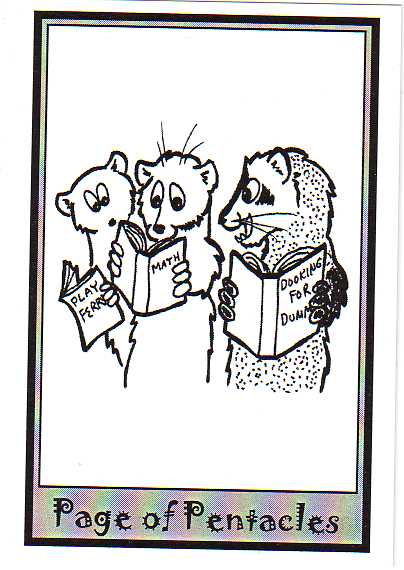
    Here we’ve got the Page of Pentacles.

    He stands with his text book open, looking quite pleased with himself.  Unlike the other two who wear the same panicked expression as myself myself on the day of the  Standard Arithmetic exam back in the day.  I thought that the exam was on the Monday, it turns out it was ALSO on the Friday before.  Oh yeah, sitting an exam without finishing your prep.  Scary stuff!

    The little ferret that is the Page of Pentacles has no such fears.  The cheat sheet that comes with this little self-published deck says: ‘ I studied for this, did you? I know a lot.’

    So this Page is a cocky little guy, thinks that he’s got all the answers.  I could do with a little of his chutzpah rubbing off on me for sure!

    I’m not greedy, I would settle for knowing just SOME of the answers!

    Generally though, I associated this Page with learning (that’s his Paginess) but in a more hands-on way (the practicality of Pentacles) so rather than having all the answers because he’s studied from a book, I would hope that he’s getting the answers because he’s getting some practical experience.

    Book learning would be more a Page of Swords thang, I think.

    He is also urging us to have a bit of fun – and I could do with a bit of that – physical fun!  Not the quippy wordplay that Facebook encourages…. but horse-play, practical jokes, having a LAFF.

    Oh yes, bring it on little Page, bring it ON!

  • Comparative Tarot | The Prince of Cups

    The first time I encountered the comparative method of looking at cards was via Valerie Sim’s deck, the Comparative Tarot.  The cards in this cleverly designed deck have not one image, but four different images of the same card.   It was one of the first decks that I bought and I still regard it fondly.

    Not familiar with the Comparative Method? Here’s the skinny:  You don’t just interpret ONE card, you interpret the others on the card too – each one adding depth and colour to the over all ‘character’. 

    So I thought we’d try it here with The Prince of Cups – just comparing three images – but you can do it with as many cards as takes your fancy.  Or you can fit onto your table top.  Or bedroom floor.

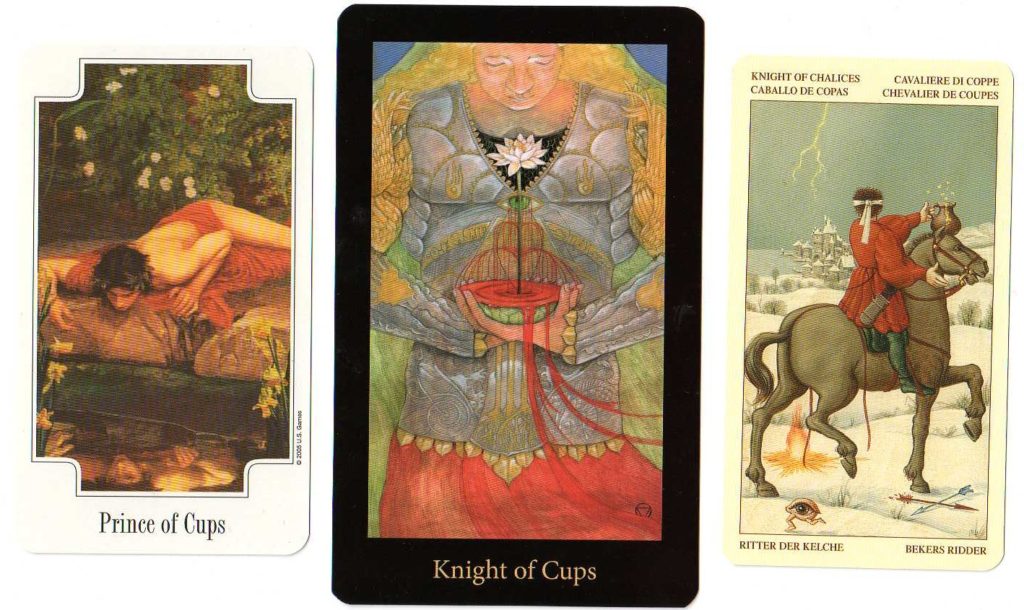
    I chose the Prince/Knight of Cups from the outrageously stunning Mary El deck by Marie White; the Prince of Cups from the Transformational Tarot by Arnell Ando and the Knight of Chalices from the Breugal Tarot by Guido Zibordi Marchesi.

    First of all, although one of these is a Prince, he DOES fill the Knight’s role in the deck.  He’s not a Thoth Knight

    click on image to enlarge.  I think.

    Arnell’s Prince (left hand card above) perfectly captures that romantic, self-absorbed feeling that comes with the Prince of Cups. It shows the youth Narcissus gazing ito his own reflection by the pool.  Poor old Narcissus was so wrapped up in himself that he drowned trying to embrace his own reflection.  I’ve had boyfriends like that.

    In the LWB Arnell explains that he represents the Artistic Idealist; someone who uses ‘creativity as a means to self-expression, but whose moods don’t always reflect his actions.’

    The Knight of the Mary El (central image) is also introspective, protectively clasping a grail that overflows with blood and from whose depths a lotus flower rises and blossoms.  This is the Grail Knight.  Marie White, creator of the Mary-El says: ‘Searching for matters of the heart; love, meaning in life. Compassion, experience and maturity is the key.’  If you don’t know the story of Percival, the Grail Knight here’s a 10 second summary:  In his naivity, Percival, a knight who is searching for the Holy Grail fails to recognise it the first time he encounters it and so he is compelled to set off on his quest again – older, wiser – and finds it.  And heals the Fisher King. The end.

    Our final Knight is the Breugal Knight (right hand image).  His horse steps confidently to the right of the card, but he is not looking in the same direction as his horse.  In fact, he looks as though he has a blindfold on.  Even with the blindfold, he is looking towards a distant village that lies beneath a fork of lightning.  He doesn’t hold a grail, but a tankard filled with flowers.

    Neither hand holds the horse’s reins. Either side of the horse we see a camp fire, crossed arrows and – bizzarely – an eye running to the left on a pair of little legs!

    We also have an eye in the armour of our Mary El Knight – in the centre of her chest.  And the Knight of the Transformational Tarot is gazing at his own reflection.  Sight is an important symbol of this card – one sees only himself, one sees only her Grail, one sees….nothing (with his eyes!)

    I think that the Breugal LWB perfectly encapsulates what’s going on here: ‘Where there is love, the eye follows’. 

    Using this Comparative Tarot method then, I would say that this Knight DOES have focus – but he doesn’t always focus it on what he SHOULD be focussed on, as far as the outside world is concerned.  As a result, he can seem dreamy and self-absorbed to other people and can display a level of cold-heartedness to that which is outwith his field of vision.

    For me he’s the guy who will spend weeks finely crafting you a love song, but never remembers to put the bins out at night.  Someone who will whisk you away for a romantic candle lit meal, but forget to organise his cash….or put fuel in the car 🙂

    What do YOU think of the Knight of Cups or the Comparative method?

  • Significators | Where to stick them!

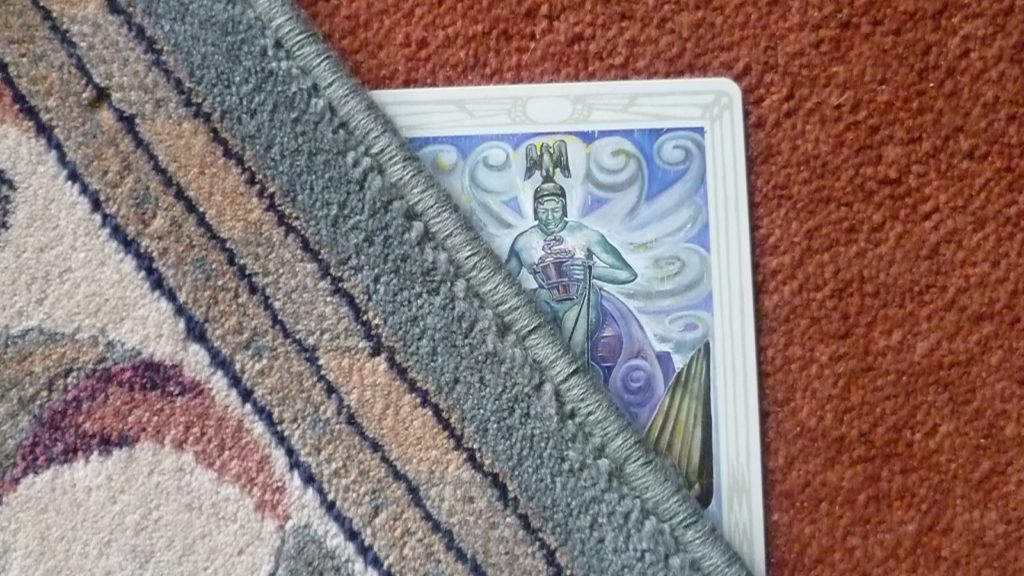
    Don’t sweep me under the carpet!

    Back in April, I ran a little poll asking YOU whether you’d consider using a significator in a reading. As I expected the majority of you said that you never used it in a reading, but an encouraging 20% said that you might consider using one now.

    I may run the poll again at a later date and see whether that percentage goes up.  I promise that I won’t cry if it doesn’t 🙂


    Thanks to everyone who took the time to vote – I appreciate it 🙂

    Anyyyyywaaaay – so far we’ve looked at lots of ways one might choose a significator – some complicated and others very simple.

    But what to DO with the damned thing once you’ve got it?!

    Traditionally with the Celtic Cross reading, it would be slipped beneath the first two cards of your spread, hitherto never to be referred to again!  Well, what’s the point of THAT?!

    How could we make better use of this card?

    Why not try keeping the significator off to one side, somewhere where it can be kept in view throughout the reading, and then see how that card ‘relates’ to the other cards in the spread?

    In a circular-shaped spread – eg a Wheel of The Year type lay out – you could sit the significator in the centre.  Literally placing your querent at the heart of the reading – and see how the card reacts to the others  in the spread?

    You might want to consider the following: –

    Is the Significator and the card you want to talk about from the same suit?
    Or are they from suits where the elements are opposed (eg Wands and Cups, Swords and Pentacles)?
    Is your significator looking towards the card under discussion?
    Is the character in the OTHER card looking towards or away from the significator card?
    Is your significator looking to the left or right? Straight out?
    Does the significator mirror any aspect of the card under discussion?
    Are there any symbols common to both the Significator and the other card?

    What do you think? 

  • Court Couples | King and Queen of Swords

    Court Couples | King and Queen of Swords

    The Fey Tarot published by Lo Scarabeo is one of my favourites, even though it’s jam-packed with fairies, I confess.  I find that it’s a great deck to read with, especially if you’re a RWS devotee.

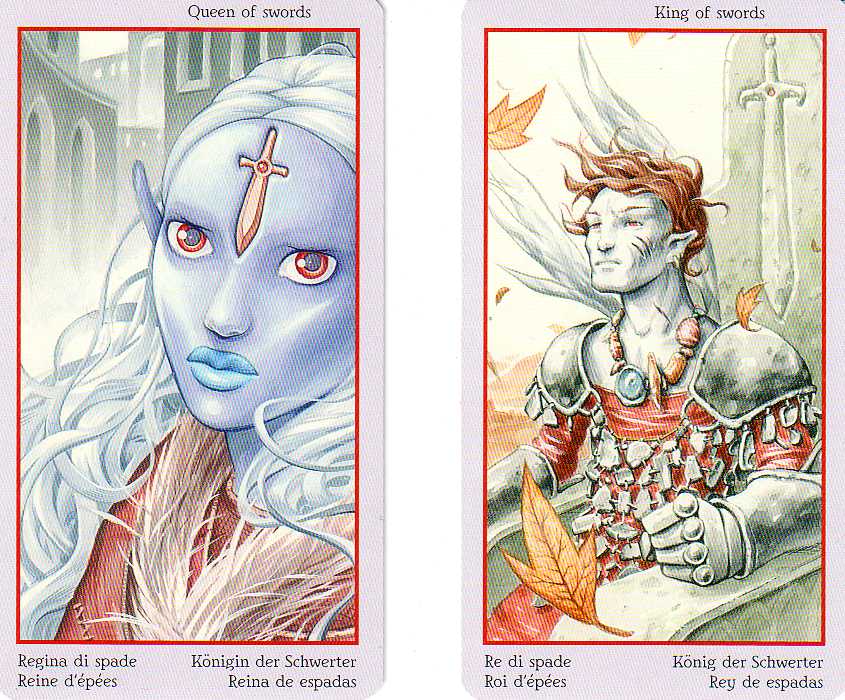
    Today I’m presenting the King and Queen of Swords to you *sweeps a long, low bow*…..

    I’m a little bit in love with this King of Swords, if I’m honest.

    Even though the wind buffets him relentlessly, blowing the autumnal leaves hither and thither, he remains at his post.  The scars of battle (life? love?) have marked him and even on his throne he is clad for conflict.

    His hands are encased in armour- even his finger tips – can he no longer feel anything (emotionally? physically?)  Does he need to remember that you don’t need your armour at all times, that sometimes it’s safe to let yourself be exposed? Even if it leads to more wounds?

    His consort is the Queen of Swords.  Her hair tumbles around her face and shoulders like water and she gazes out at us with a serious demeanor.  Unlike the king who is in some desolate wilderness, she is in a built-up area – civilisation.   And indeed this Queen is erudite, witty, clever and – I suspect – an excellent dancer and chess player.

    If the eyes are windows to the soul, what are the windows in this card? The eyes of the soul?  Although she is beautiful, her blue lips and skin tone make her chilly-looking – ‘Noli Mi Tangere

    Does she look like the sort of woman that the King needs to cuddle up to?!

    Maybe her sword, emblazoned onto her third eye, cuts her off from the King.  Introspective and thoughtful, I can imagine the verbal traps that she could set for him (‘what do you mean my bum doesn’t look big in THIS? Are you saying that it looks big in other things?’)

    Even when you switch the King and Queen around, there’s not much change in the tension between them, is there?

    The Fey Tarot has colours allocated to the suits and Swords are allocated red – something that I associate more with Wands, to be honest.  The passion of red doesn’t really suit the cerebral approach of the Swords family – but here, I think it works on these two cards.  I think their love of order and of duty – doing The Right Thing, just because it IS the right thing – doesn’t mean that they don’t have strong passions – far from it.  And the red border reminds me that they are passionate people.

    But I wonder where that leaves them?

    Perhaps if I got into full Queen of Wands mode, I could persuade him to come down from that throne and step out of his armour?!

    The Fey Tarot is published by Lo Scarabeo,  accompanying book by Riccardo Minetti, artwork by Maria Agham.

    King | Queen | Swords | Fey Tarot | Tarot Thrones
  • Meet the Thoths!

    Got that tiger by the tail?

    I’m sorry, but in my head the theme from the Flinstones started playing as I typed that blog title! And it is deeply inappropriate because the elegant Thoth Courts are about as far away from Barney and Betty Rubble as you can get!

    The Thoth deck, created by Aleister Crowley (rhymes with Holy) and Frieda, Lady Harris*, is one of the most beautiful and well thought-through decks in the Tarot universe.  Crowley was a Golden Dawner – and one of its most colourful characters.  Once referred to by the press as ‘the wickedest man in the world’ he was, I think, just 50 years ahead of his time.  Today he would be hanging out with Lady Gaga and regularly papped for all the Celebrity pages in newspapers.

    Prince of Wands
    F1 Champion

    But for all his over-the-top antics (chiselling off a discrete fig leaf from Oscar Wilde’s tombstone, for example), he was utterly sincere in his Great Work.  Cajoled (and paid) into creating a Tarot by Lady Harris the two of them hammered out this magnificent deck.  If you get a chance to read their correspondece, please do.

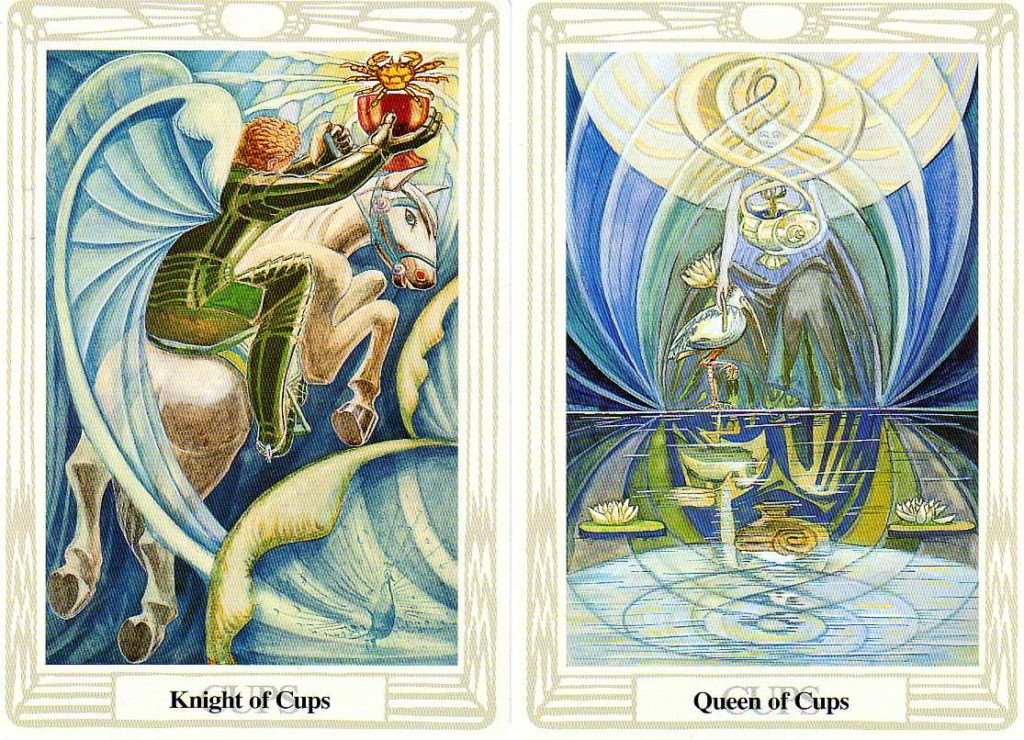
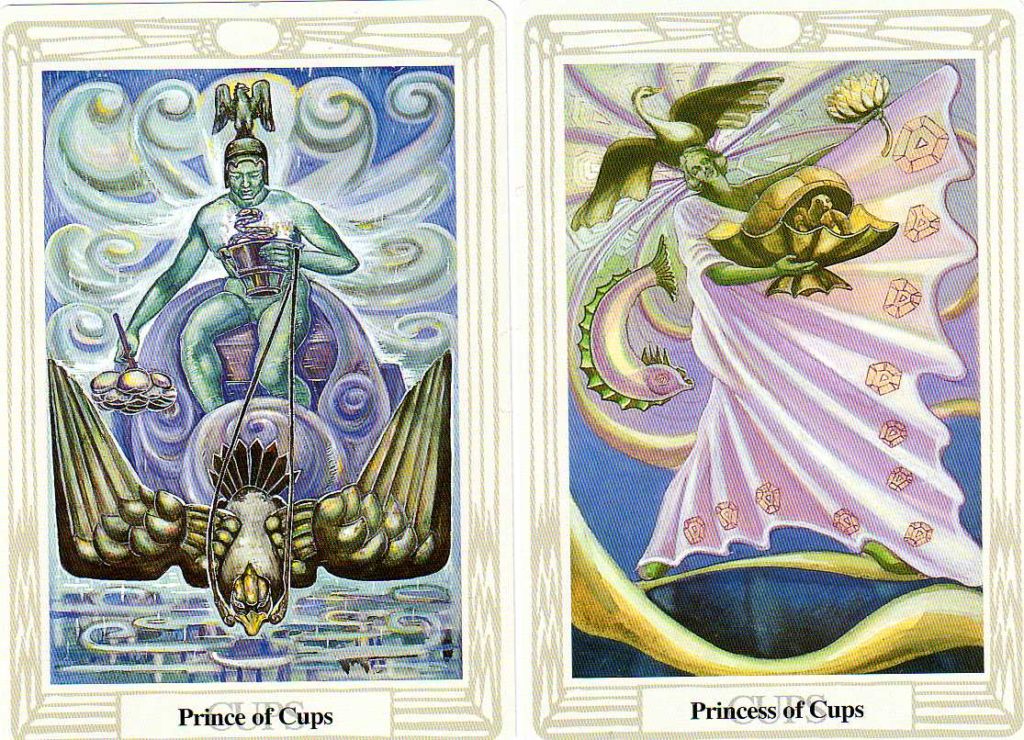
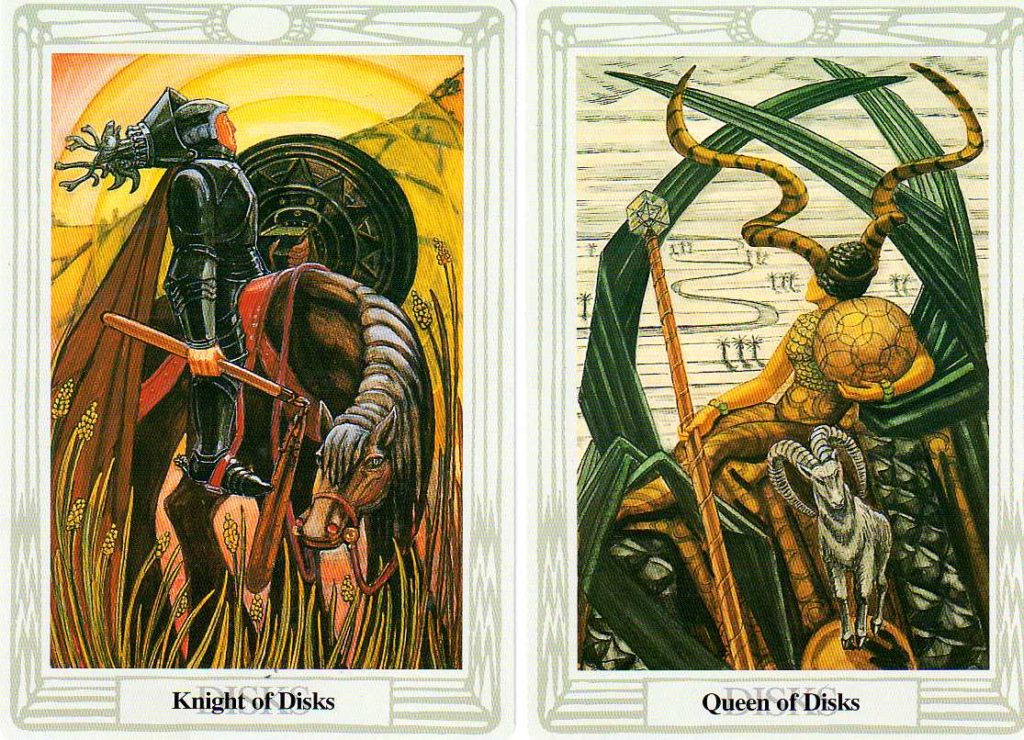
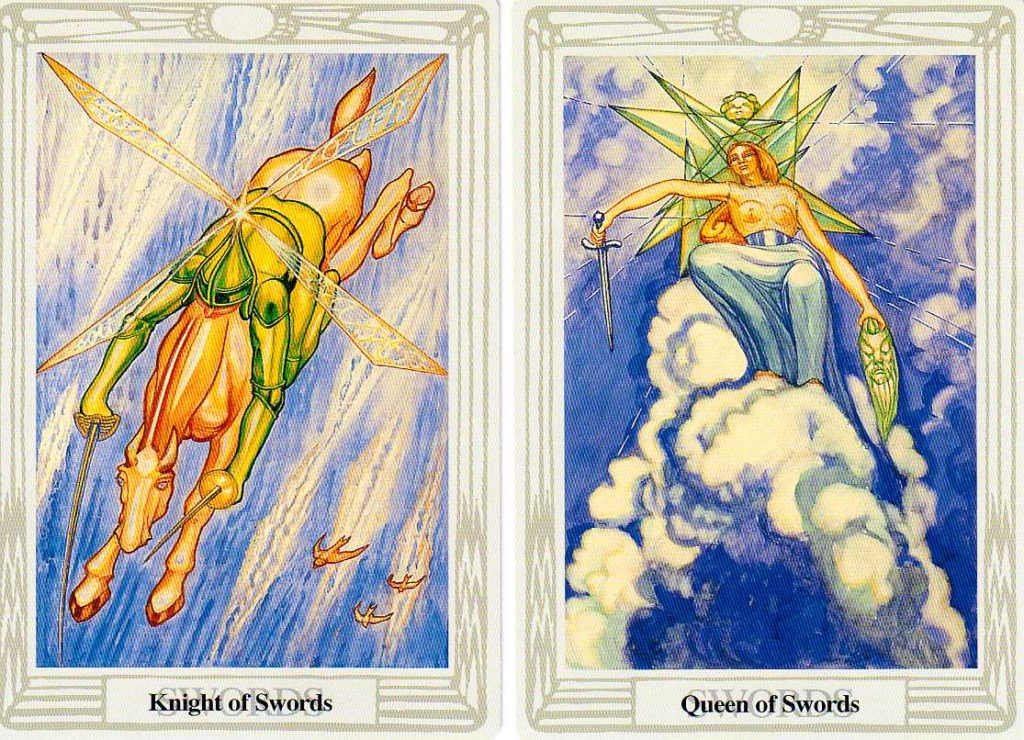
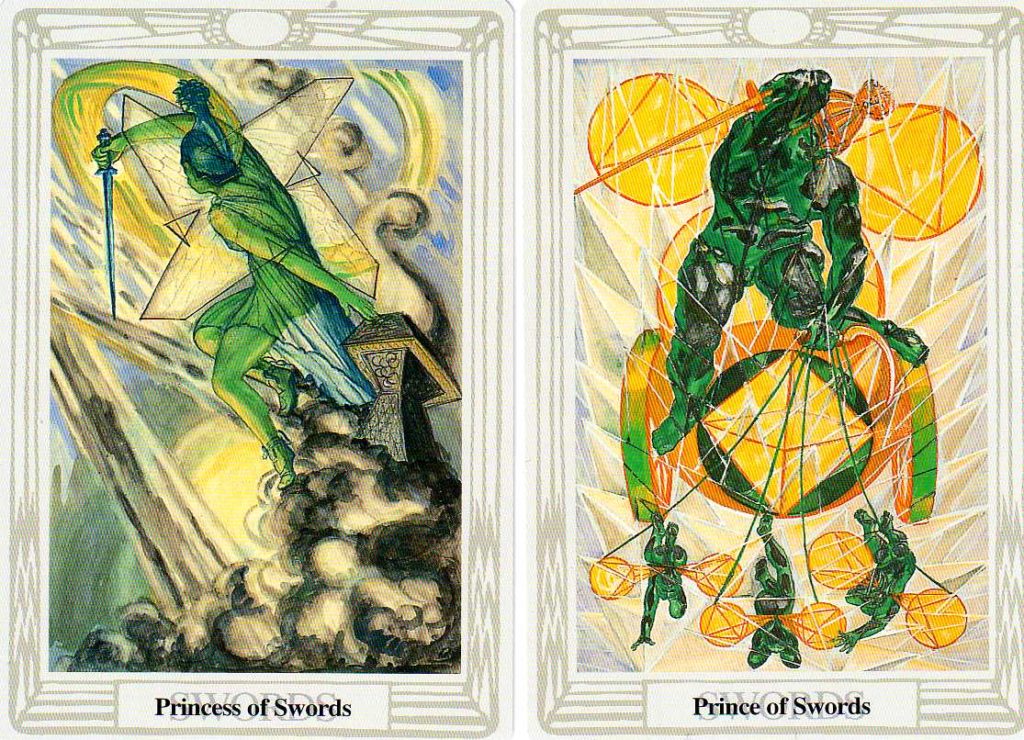
    In line with Golden Dawn thought, we see a change in the Court Card structure.  There are no Pages and Kings in this deck, instead we have Princesses and Princes.

    In the RWS we have a court that is structured like this:  The Page is the lowest rank….then Knight….then Queen….then King.  The story *I* tell myself about them is that the King and Queen have two children – the Knight is older and taking on some of The Firm’s responsibilities and the Page is really just learning her place in the world.

    She can pack quite
    a punch with that Wand!

    Other people have a slightly different story – the King and Queen are right up there at the top of the pack, the Page is not their child, but just a Page, a little servant; the Knight is not their son, just a courtier.  A very FLASHY courtier though.

    But the structure is the same – Page, Knight, Queen, King.

    Not so in the Thoth.

    In Crowley’s story, the Knight is the Consort for the Queen.  The Queen being the old King’s daughter. The Prince is the Son of the Queen and the Knight.  The Princess is won by the Prince and set upon her mother’s throne. Crowley says: ‘She thus awakens the Eld of the old king, who becomes a Knight and so renews the cycle.’

    Explosive Knights!

    ‘She is not only the perfect maiden,’ continues Crowley ‘but (also) the lamenting widow’  of the Prince.

    I know.  It’s like an episode of the real Game of Thrones.

    This transformation of King into Knight, Knight and Queen unity, the production of a Prince, the son’s union with his Princess sister, his transformation itno the Knight, her morphing into Queen…..it’s hugely dynamic and exciting, much more so than the static positions of the RWS, don’t you think?

    What makes it so hideously confusing is that the Knights are on horseback – just as they are in the RWS – and it is SO easy to lapse into thinking of them as Ye Olde Waite Knight.

    The Prince is the son of the Knight and Queen.   A Prince is ALWAYS a Queen’s son – that’s one lynch-pin that will keep your Thoth Tarot Arcana from tumbling into mental disarray when you start to use it!

    The Knight and Queen of Cups
    Prince and Princess of Cups

    *Calling herself Lady Frieda Harris was just a little affectation that she took for herself.  According to Lon Milo DuQuette in his book Understanding Aleister Crowley’s Thoth Tarot (and I cannot recommend this book highly enough if you are planning on a bit of Thoth Dabbling) the correct way to address this estranged wife of a Baronet is Frieda, Lady Harris.  She should only have been calling herself Lady Frieda Harris if her father had had the title.  Debretts? Who needs it. You’re welcome 🙂

    Knight and Queen of Disks

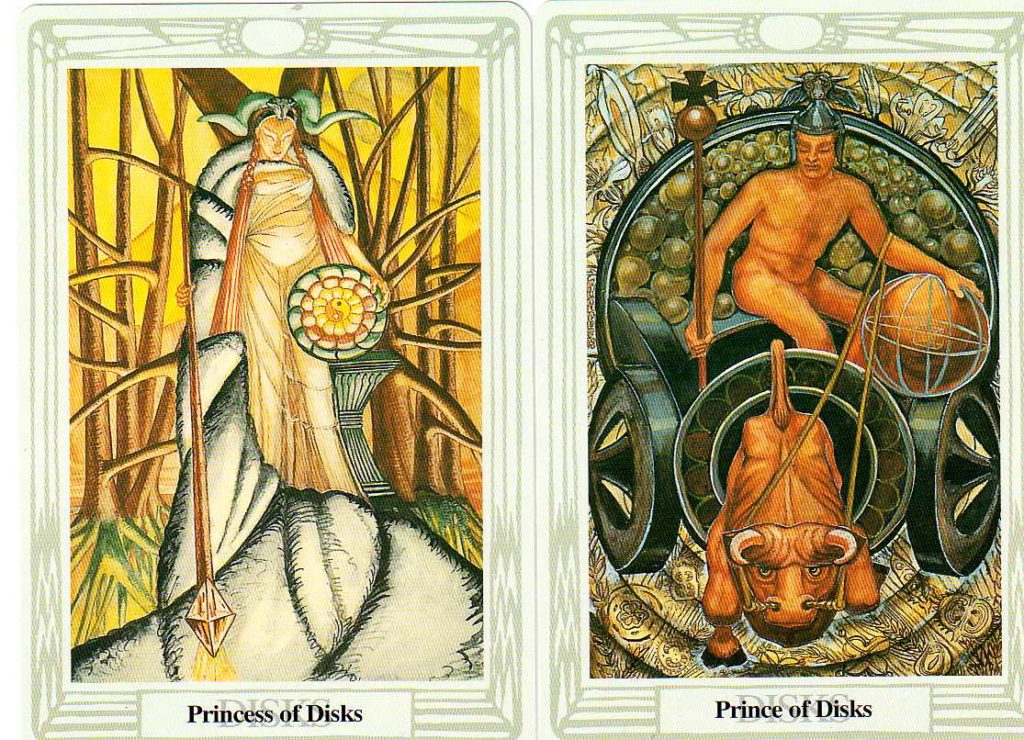
    Princess and Prince of Disks

    Can you spot Tyrion Lannister?!
    Look at the colours in these cards – aren’t they magnificent?  These colourways didn’t just happen by chance….but that’s a story for another day 🙂
    Knight and Queen of Swords

    Princess and Prince of Swords

    All images from the Thoth Tarot, published by US GAmes Systems, words – Aleister Crowley, art Lady Frieda Harris.

    Understanding Aleister Crowley’s Thoth Tarot – Lon Milo DuQuette


    All the Thoth resources on Amazon UK

  • Competition Winner!

    At the beginning of April, I ran a little competition for a Robin Wood Tarot (well, a giveaway more than a competition).  To enter all you had to do was comment somewhere on this blog and become a follower.

    The competition closed at the end of April, but because of the Beltane Tarot Blog Hop, I have been a bit tardy in finding the winner.

    
    A free online randomiser smooshed them around.  The winner is:…….

    PSYCHICSPIRIT!!
    Congratulations!  Please get in touch with me (either message on facebook, e-mail me or DM on twitter) to give me your real name and address and the Robin Wood will be winging its merry way to you!
    Thank you to everyone who took the time to comment and follow.  I hope that you’re still with me and enjoying the blog.  I’ve got a newsletter planned too…… the link’s just over there *points to right*
    If there’s anything Court Cardy that you’d like me to look at specificallyon m’blog, please let me know – I’ll do my best to write something for you!
    Ali x 
  • Say toodle-pip to……The King of Bells!

    Well, I don’t know about you, but the supermoon played havoc with my dreams!  I slept with the curtains open so that I could see the transit of her celestial silveriness as she walked the night sky……

    I took a great deal of care to select which deck I’d be using to receive the message about whose energies would be receding from me at this full moon because I knew it would be delivered IN CAPITAL LETTERS.

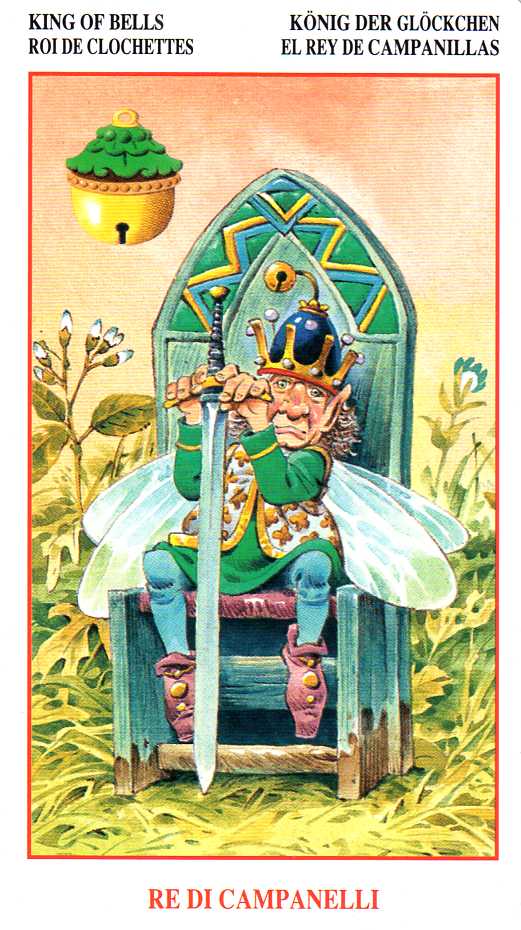
    Using a pendulum, I dowsed over all my decks to find which one I should use.  The pendulum started to swing in a to/fro motion over the Fairy Tarot by Antonio Lupatelli (published by Lo Scarabeo).

    TADAAAH!  The card drawn was the King of Bells.  This is the guy whose influence will be receding from my life from now until the New Moon.

    I have to admit, this is a deck that I don’t often refer to – it was gifted to me as a memento after a lovely TABI member died unexpectedly.  I shall never part with it, but in all honesty, I never read with it either.  It is a semi-illustrated pips deck – there are pips, but also a tiny vignette on each pip card.  I’m trying to get more into semi-illustrated pip decks, so maybe’s a good time to try harder with this deck – because it IS cute.

    The King of Bells is a glum-looking character, seated on his throne with his great sword pointing straight down.  Bells equates to Coins in the traditional suits and according to the LWB, he represents ‘the richness aquired through intelligent work.  Fairies’, says the book, ‘are rarely able to commit themselves to one single activity; but when they do, they often succeed – and  become rich men of property’.

    Well, it’s not just Fairies that have troubles with that! Here’s his non-Fairy counterpart!

    That’s  why he looks so glum – he’d rather be doing loads of other things, rather than amassing wealth!  But well done to him for sticking at it 🙂

    Maybe it’s just as well his influence is receding because I am not the sort of person who does well when stuck at the same thing day-in, day-out.  Well, there’s FACEBOOK of course – but that’s hardly work.  That’s LIFE!

    The single-pointed concentration of the King of Bells is never going to be my forte (or my fifty) and a little bit of me is relieved that I no longer have to try to shoe-horn myself into that particular high-heel.

    I’m a multi-tasker and I’m proud to have interests in lots of different fields – from designing and building websites for a wide variety of clients (from authors and artists to wedding planners and marinas!) and am working my way through a Wikipedia entry for a client,  to doing all the stuff required to run a home (albeit badly!) and attending art classes…… being interested in different things keeps me sparky!  And to be perfectly honest, I’m not motivated by the quest for the Mighty Dollar (Mighty Pound Coin doesn’t sound right) and this is the point where I have to admit it, I think.

    So I say, huzzah to the end of the King of Bells!!! Sure, I might not become rich doing what I do the way that I do it….but I am rich in many other respects – and feel blessed to be so!

    What about you – Are you happy multi-taskers or can you pull-focus down onto one area and master it like the King of Bells?

  • Page of Swords | The Lost Tarot of Nostradamus | John Matthews

    The Page of Swords
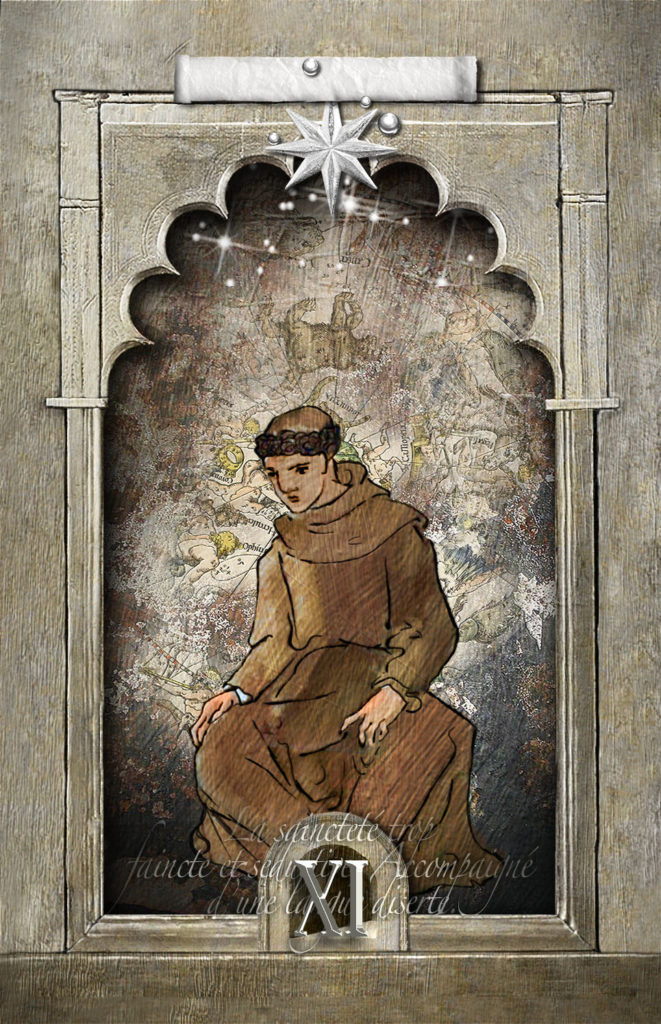
    AKA The Postulant of Stars

    Continuing my regular blog theme of having authors or artists talking about the Page of Swords in their latest or yet-to-be-published decks, nothing could be hotter off the press than this card! It’s so HOT that the image isn’t even completed yet!! Say hello to the Postulant of Stars from the forthcoming Lost Tarot of Nostradamus by John Matthews and Wil Kinghan.

    John Matthews took time out of his busy schedule to answer my questions about this card and the new deck:

    What inspired you to create this particular deck?

    Finding out about the manuscript discovered in the Rome library. When I showed the images to Wil we both said, almost in one breath, it’s a tarot….then we started researching the MS and what the illustrations might mean and found that it really was a tarot – a lost tarot indeed.

    How are the suits designated?

    As there was no real indication of what Nostradamus himself might have called the suits we designed them to reflect the way the cosmos was perceived in his life-time. So we ended up with Stars (Swords) Moons (Vessels) Suns (Staves) and Spheres (Coins). For the last one we used the writings of Johannes Kepler, who was the first to apply a geometric ordering to the universe. Each suit had its associations with alchemical metals and meaning to further deepen the correlatives.

    Are the pip cards in this deck going to be illustrated, un-illustrated or part-illustrated (like the Thoth)?

    Fully illustrated. I’m not a great fan of pip cards or partly illustrated ones. Here you get the full effect. There were enough images in the manuscript to fill every card with symbolism. It was fascinating researching it all and we were constantly amazed at how well it all fitted.

    This particular court card, the Postulant of Stars has a background of zodiac images – so is he going to apply himself to study the stars?

    All of the minor cards have zodiacal imagery as a background. There are connections between every one of the cards and the stars that empower them. This is something we picked up on from the original images.

    What’s your Court structure in this deck? Postulants…and then what?!

    Its actually quite complex. While we followed the general structure of Page, Knight, Queen, King, we had different names for the Court cards in each suite. In the Stars (Swords) we go from Postulant, Cardinal, Abbess, Pope, each one represented by contemporary religious figures from Nostradamus’ time. Then, in Suns (Wands). We have Page, Knight, Lady, Prince to reflect the courtly life of the Renaissance. Moons are connected to the occult and philosophy, so we have Neophyte, Initiate, Prophetess, Master. Finally, the suite of Spheres represents science and alchemy and we have Apprentice, Astronomer, Astrologer, Alchemist. In this way the courts reflect the entire world in which Nostradamus lived.

    How did you and Wil Kinghan create your cards? Do you direct every minute detail or does Wil just let rip with his imagination?

    Normally I would make detailed descriptions of what I felt should be on the cards (as with our other current project ‘The Steampunk Tarot’, also with Wil), but here every single piece of imagery on the cards was redrawn exactly from the original manuscript. We both sat down with the originals and studies them over a period of months, carefully selecting details that we felt reflected the current understanding of the Tarot. We also looked back to the oldest surviving meanings and often went to those rather than the later, post Golden Dawn, meanings. As I said, the imagery was remarkably consistent and convinced us we were right about Nostradamus’ intention of creation of a tarot. Unfortunately he died before he could do so, so we have, in a sense, finished it for him!

    Finally, as a wonderful addition, we asked my wife Caitlin to translate some of Nostradamus’ prophetic quatrains. Then we divided them into couplets and applies one to each card. Again, the imagery was amazingly consistent and we ended up with a very unusual extra part of the divinatory concept. Each reading enables you to create a ’new’ quatrain, which can be read as part of your answer….

    Tell me about the frame device – it’s very striking; what does it add to the deck?

    We wanted to make sure that each suit, and the Majors, were clearly distinguishable from each other, so Wil devised the frames which he built to reflect the meaning of each suit. Also they are of the alchemical metals which we tied into the suits – Gold for the Majors, Silver for Moons, Mercury for Stars, Copper for Suns and Lead for spheres.

    In all I think the deck reflects as far as possible the intention of Nostradamus if he had lived to finish the work he had begun.

    If you’d like to keep up with the deck’s development, John and Wil have a facebook page dedicated to it:  https://www.facebook.com/NostradamusTarot  and Wil’s got a facebook page of his own, which you can find here.
  • Beltane Tarot Blog Hop | Fire Tends To All

    Hello and welcome to the OTHER Game of Thrones!  This blog focuses exclusively on the Court Cards of the Tarot deck – hopefully making the Courts seem a little more fun and a lot less daunting!

    Today you may be here because you’re a regular visitor or because you’ve hopped here from Arwen’s Blog or backwards from Aisling’s blog through the Tarot Blog Hop – either way, I’m very pleased to see you 🙂

    If you want to join in the Court Card chat here on the blog, you can sign up to follow – just there to the right or you can friend up with me on facebook, twitter or add me to your google + Tarot circle!

    Arwen’s blog!

    Aisling’s blog!

    Now you can hop backwards to Arwen’s blog or forwards to Aisling’s blog – enjoy your day! And come back and see me and the Tarot Courts sometime, won’t you?  *flutters hankie in farewell*

    Will Worthington’s work on amazon.co.uk