Category: Uncategorised

  • John Matthews | Camelot Oracle

    In the first part of this two-hander, I spoke with Camelot artist, Will Worthington, with the focus on the portraiture and artwork of the new deck.  Today it’s the deck’s author, John Matthews who chats about Camelot.


    You are exceptionally prolific as an author!  It seems only a
    few weeks ago I was talking to you about the Tarot of Nostradamus and
    here we are again, talking about another new publication – The
    Camelot Oracle.  Do you ever sleep?

    Sleep?
    What’s that? I’m just a workhorse; I work all the time. Can’t
    remember the last time I had a holiday. No, wait, I
    did
    go
    on holiday to the Orkneys two years ago with some very dear friends.
    I remember I spent the first week trying to get used to not doing
    anything, then I did a bit of work on a children’s novel I was
    writing; then it was time to go home! 

    I work late into the night
    most days, sometime as late a 2 am, then sleep a bit longer in the
    morning, then start again…..In fact, there are three new projects
    just about to come out.
    The
    Lost Tarot of Nostradamus,

    which you mentioned, was finished last year, but got held up,


    and it’s only just released. Then there’s the
    Camelot
    Oracle,

    which is due any day; then there’s a third deck:
    The
    Steampunk Tarot: Gods of the Machine
    ,
    which is something I’m sure we’ll be talking about some other
    time. That’s due out in November. But really this is not because
    I’ve written and completed three big jobs in one year (though in
    fact I did do two other things as well as working on a documentary
    film I’m making for my own production company), but because there
    were various problems with the printing, so they all ended up coming
    out of the same time.
    You
    already have the Arthurian Tarot under your belt and many other
    Arthurian-inspired publications – including the Ladies of the Lake –
    what prompted the creation of the Camelot Oracle?
    I’ve
    been using The Camelot Oracle as a teaching device for several years.
    I used to draw a map on a flipchart, and put in the places and what
    was found there; then I’d tell people about the characters – little
    summaries of their lives – and invite participants to select one of
    these characters to journey with. It worked so well, that I started
    thinking: wouldn’t it be great if I could have a permanent map and
    information about the characters that anyone could work with.  
    That
    was the beginning. I put it together in such a way that we had cards
    with the characters on, and the map of the Lands Adventurous, which
    is where all the magical things from the Arthurian legend take place,
    in a huge forest. The publishers loved the idea, and it didn’t take
    much persuading to get Will Worthington involved, because this is the
    theme and subject that brought us together in the first place. He and
    I have always loved the Arthurian legends, and when I suggested to
    him that we do this project he jumped at the opportunity. The
    results, as you’ll see, are amazing. He’s given us 40 portraits
    of the most familiar and extraordinary characters from the Arthurian
    legend. It’s not hard to think how one great it would be to select
    one of these to be a champion – someone to go along with you on an
    adventure.
    My
    blog is about Court Cards, do the characters in the Camelot Oracle
    operate like Court Cards?  If so, are there any direct
    correlations between the citizens of Camelot and the citizens of the
    Tarot?
    The
    Camelot
    Oracle

    isn’t really a tarot in any sense of the word. The idea is that you
    take one of the archetypes as a champion, a companion on the quest.
    Then you take another one to be your challenger. Then you set out on
    your journey; your champion goes with you, your challenger awaits
    your coming, and has a question for you, a challenge. You answer to
    that, and the direction the path you take, and where it leads to,
    generates the Oracle. So the characters in the Camelot Oracle are a
    little bit like the courtiers in tarot in that they can be interacted
    with, and can help you find answers to issues.

    Can the cards be used as, say, a card of the day…. Or other quick spread (eg whose energies help/hinder me today)?


    Yes you can do that – most assuredly. One of the ideas is that you can take any one of the characters as a companion. Each entry includes a meditational sketch for this. And of course you can extend the reading experience by following several paths with several characters.


    Tell
    me about the Path cards?  
    The
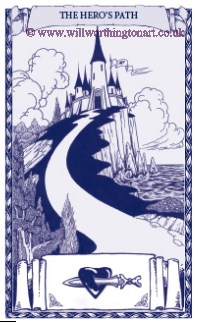
    Path cards are intended to act as either randomly chosen or selected
    pathways to a particular place. So you might take one path leading to
    the castle of the Grail, or another to Lancelot’s Castle of joyous
    guard, and in each case this represents a different reality and helps
    you find an answer to your question.
    What
    does the Camelot Oracle bring to the divinatory table that other
    decks do not?  
    I
    think what makes
    The
    Camelot Oracle

    original is the opportunity gives all those who use it to actually
    interact directly with extraordinary archetypal characters from the
    Arthurian legend. Who can imagine not wanting to go with Arthur
    himself, or Guinevere, or Galahad, or Boars – or any of them, on an
    adventure. Not just any adventure, but one that will actually help
    you discover truths you did not know, answers to issues that may be
    troubling you, actual advice from the great heroes and heroines of
    the Arthurian world?

    Which
    is your favorite illustration?

    JM:
    Really
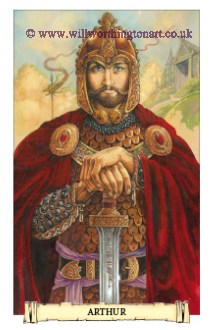
    I love them all. I think inevitably my favorites have to be Arthur
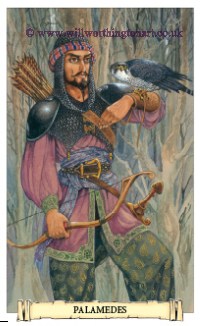
    and Guinevere; but I also have a special affection for Palomides, the
    Saracen knight – there’s something about that amazing face, the
    hawk on his wrist, his costume, that really inspires me. Plus of
    course he’s a great character anyway, though not so well known are
    some of them.
    Who
    is your favorite character in the deck and why?
    Again
    I have to say really it’s all of them. But if I answered the
    question in a different way by saying who my favorite character is in
    the Arthurian legend, then I would have to say Merlin. He just has
    everything. He’s a magician, a seer, a poet, and a warrior. What’s
    not to like?
    What
    are you currently working on and what is your next publication?
    I’m
    afraid the list is quite long! Partly this is again because of delays
    between books getting finished and actually getting into print. Right
    now I have just finished working on the
    Oracle
    of Dr John Dee
    ,
    which has amazing art by Will Kinghan, who did the Steampunk Tarot
    and a couple of other decks that I’ve created. This is going to be
    again quite different from a tarot, but involves all of the many
    disciplines that the amazing Dr Dee practiced. Then I have a couple
    of children’s novels, featuring a character called Henry Hunter,
    who’s a kind of young Sherlock Holmes crossed with the Young
    Indiana Jones. He solves mysteries using his intelligence and
    knowledge of books! It’s a departure for me, but I’m looking
    forward to seeing how they go, because if they go well I have a whole
    series worked out. I’m also just working on a short book about the
    history of shamanism. And if I survive all of those, there are a
    whole bunch of other projects in the wind – including a couple more
    with the amazing Mark Ryan. So plenty to look out for.
  • Will Worthington | The Camelot Oracle

    OK, I hold my hands up – technically this is nothing to do with Court Cards REALLY, but ooooh the gorgeousness of the characters in these paintings simply BEGS me to tell you about them!

    The other thing that I want to point out is that I do some work for Will Worthington and John Matthews on an ongoing basis, but neither of them has asked me to blog about this – but I think you can see from the images just why I HAD to tell you about them!

    I put some questions to the artist, Will Worthington:

    You’ve worked with John Matthews before – are you given free license to create the image that you want or are you given a brief?


    “I’m given a short brief explaining what John’s idea of the character is.

    “As both of us have been very imersed in the Arthuriad for most of our lives we seemed to have the same vision as to the appearance of each character.

    ‘There were some characters that I hadn’t heard of so I just did my interpretation from John’s brief.”

    I know that some of these faces in the Camelot Oracle are portraits – are you willing to divulge which portraits belong to whom?!

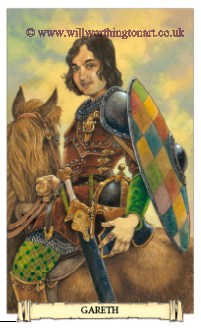
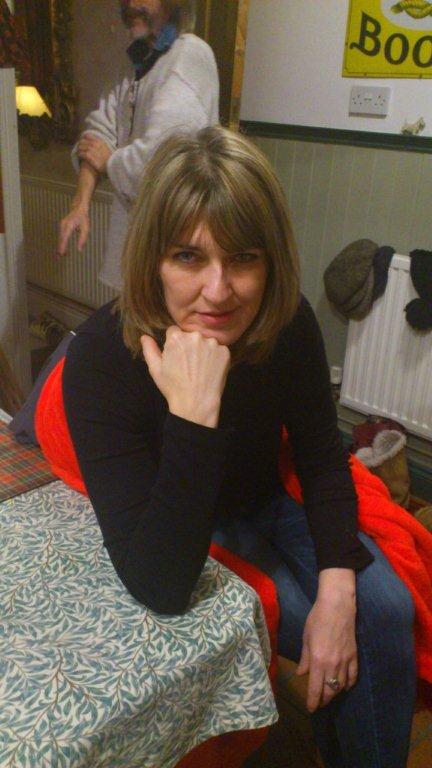
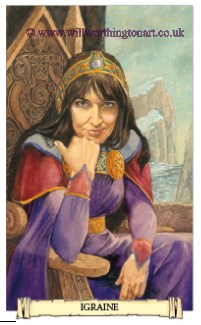
    “The first one was Gawain…we had a photo of [Will’s wife] Wendy’s son Paul looking grumpy and it struck me that he would be perfect.  Once I’d done that I felt that I should do my own son Nolan as well, so he turned out to be Gareth. As they worked well I then did Wendy’s daughter Jenny as Igraine.”

    What about the other faces – do you just make them up or do you have source material that you refer to?


    “As with all my previous decks I just make up the faces, just drawing and drawing until I get something that I feel connects.”

    Which portrait in this deck are you most pleased with?

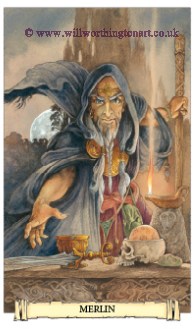
    “That’s a toughie!…discounting the three portraits of our children, I’m particularly fond of Merlin….I’ve not seen any representation of him in any medium that I feel is right to the archetype so that’s my version.

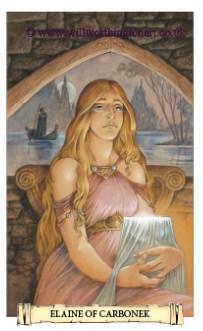
    “I’m also quite happy with Elaine, but I have to say I was disapointed it wasn’t the other Elaine…the lily maid of Astolat…who died of love for Lancelot and whose body was barged down to Camelot and was painted numerous times by many victorian artists. The publishers felt it unwise to have a dead character in the deck! However I put in the barge in the background as a hint.”


    Which overall image are you most pleased with?

    “I guess it must be Arthur…John reckons it’s the best picture of him ever, and coming from him that’s one hell of a compliment.”

    [Dear Reader, you’ll be able to see Arthur on Friday’s post with John Matthews! – Ali]

    How long did it take you to complete all the paintings?

    “I was given six months to the deadline by the publisher which was tight, but I managed to finish before time.”

    Will there be prints available at some stage?

    “Hopefully…if enough people buy Wildwood ones* then I can afford the large cost of printing them.”

    What are you working on now?


    “I’m just starting on a Lenormand deck for Chloe McCracken which is very exciting and a pleasure to work with such a lovely gentle person.

    “Previous to that I was half-way through a painting of Edgar Alan Poe with his Raven….but that’s on hold for six months or so!’

    * Will has 10 fine art prints of the 7 most popular Wildwood Tarot Majors available to purchase via his own website and the Wildwood Tarot website.

    You can follow Will’s facebook page (not run by Will) here

    -o0o-
    Here’s a slideshow of all the images in the Camelot Oracle – I hope you enjoy looking at it as much as I did making it.  Part 2 of this session, where John Matthews helps us understand the Camelot deck’s uses as an Oracle will be up on Friday.  Hope you enjoy!

  • King of Swords | Olympus Tarot | Lo Scarabeo

    It seems only a few days ago that I posted my Queen of Pentacles card. I blame the school holidays – days either drag their heels or fly out of the window, depending on how busy my son is!

    I really enjoyed my Queen of Pentacles moment – I busied myself with my son, travelling to Stirling and Glasgow, enjoying each other’s company rather than me just nagging him to wash dishes/tidy his shoes away etc.

    I’ll miss her….

    But now that the school holidays are ending and my small boy has to face up to the fact that school is looming large on his horizon again, I guess that it’s appropriate that I’ve got the King of Swords.

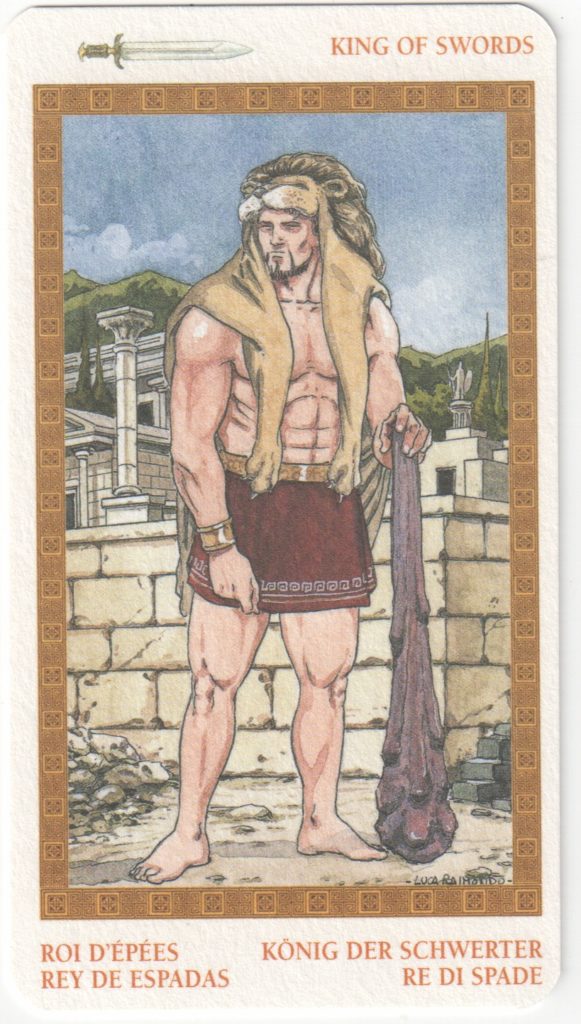
    This is the King from the Olympus Tarot by Lo Scarabeo, illustrated by Luca Raimondo.  Meet Hercules, son of Zeus, complete with the skin of the Nemean Lion.  The skin of this lion was impervious to damage – to the extent that even when Hercules killed the beast (one of his many Labours of Hercules) it could only be skinned using one of its own claws.

    This is a much more active and dynamic King of Swords than we are usually presented with.  Famed for completing his 12 Labours, set for him by the Gods, Hercules is revered more for his great strength than his brain power.

    Yet this is who is to suffuse me with his energies over the coming weeks.

    Perhaps his DETERMINATION will be of use when Sonshine returns to school next week and homework rears its ugly Hydra head?

    Perhaps I too shall use my connections (he was ably assisted by various Gods – to whom he was related – throughout his Trials) or am I to beseech the deities themselves?  I can see quite a lot of Gods’ names being taken in vain as I try to cope with Sonshine, work, marking homework for TABI and cleaning the house for the imminent return of my own domestic demi-god from 6 weeks at sea.

    Perhaps the blend of brains and physicality are key.  I do a lot of sitting around *gestures to self sitting at keyboard* and I really should be more active.  I *know* this, but I don’t do it.

    Time for a change, methinks!

    What does Hercules as the King of Swords mean for you?

  • Page of Swords | Gratitude Tarot | Teresa Deek

    The Page of Awareness
    AKA Page of Swords

    Now here’s something a little bit different for you to peruse – the Page of Awareness from Teresa Deek’s Gratitude Tarot.

    I first came across Teresa’s deck in the Tarot Blog Hop and thought that it was a lovely idea, well-executed.

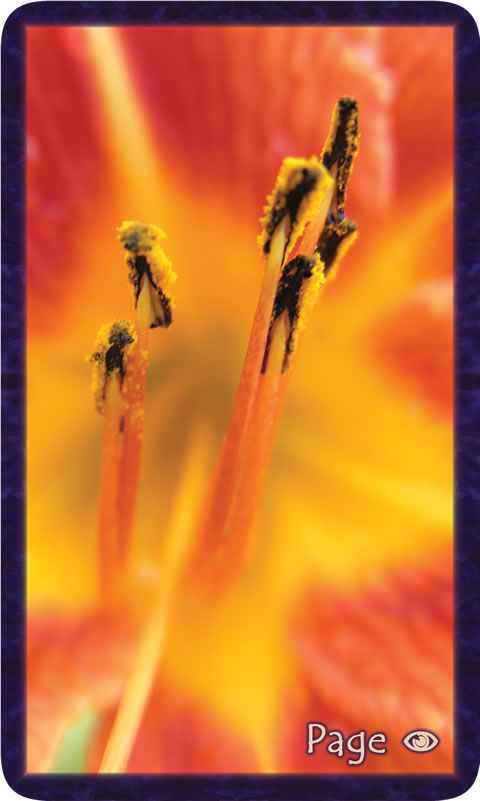
    The macro photo of pollen-dusted stamen of a lily represents this Page – tiny, upright and potent – it feels quite Wandsy to me because I associate the creative/fiery/summer with the hot Wands with cool Swords being more airy and Springlike.

    Teresa’s web page for this card features the following poem (I’ve retained the original formatting):


    Page of Awareness

    children we are
    if we let ourselves be
    declaring ourselves

    bright stars arisen

    pushed up from our smoldering essence
    will you dance with me
    on the head of this pin?

    will you set your troubles adrift

    out to sea
    to see
    their lessons melt
    into our bounteous river
    the meaning to one
    becoming

    the meaning for all

    in the wake of their expulsion
    the grand widening of space

    radiates joy

    into the hearts of soul-family
    flowing as one through our connections

    Well,  that’s a bit different from the norm, isn’t it?  

    Teresa’s site then goes on to provide an interpretation of the card: ‘Youthful passion explodes into your life. See how vital your individual nature is. Rise up in your own fire.’ I say! That sounds positively WANDSY!

    Time to ask some questions about this lovely deck!

    I read from your website that you were inspired to blend the tradition of the Tarot with the elements of gratitude to come up with this beautiful hybrid!

    “Yes!”

    Do you associate any elements/colours/seasons etc with the suits as you have reimagined them, Teresa?

    “I’ve not yet put a lot of thought into that, although my discovery of the elements happened in the order of Thankfulness then Awareness then Community then Kindness. which I could see may follow the seasons from spring through summer to fall and winter.”

    Since we will be talking about the Page of Awareness – what element to you associate with that suit?

    “Awareness is that time in the journey when I began to see that there is Beauty in everything, that the light of the Mystery lights every moment, every item, whether it seems beautiful at first or not.”

    In trad decks – Swords = the element of Air, does that also apply to your deck or is it a set of associations that aren’t applicable for the Gratitude Tarot?

    “Though I don’t focus on the elements a lot when I work with my cards, I’m happy for others to! And so, yes, air would apply to Swords.

    “Pages feel like they are all about movement, action, newness….”

    So the fiery bit for the Page of Swords is not related to any kind of elemental association? It’s just an expression of his movmennt, action and newness?

    “I love that interpretation, yes!  Though I seem to have used more fire imagery in my Awareness (Swords) since I let my heart guide its creation, it is kind of hard to describe the reasons behind my choices and word.”

    The Gratitude meanings to the cards are quite different to what someone might be used to working with in a Tarot. How did you decide which meaning to ascribe to which card?

    “I did work with keywords at the beginning, nudges towards the traditional meanings. Once I got into the detail of writing the short meanings and then the poems, I let intuition take over.”

    So would you recommend that people who use your deck let their intuition guide them or are they best to stick with what you intend for the cards?

    “I always feel it’s best that people let their intuition guide them when working with a deck! We really are tapping into a deeper knowing within ourselves and whichever meanings come up when we use the cards is the one we are meant to see.”

    The images are very beautiful – did you take the pix yourself?

    “Yes – thank you – all of the photos are taken by me, and none of them are photoshopped (except in order to fit them to the card and add the border and title).


    “Photography has been the central part of my journey to Gratitude. It is through taking my photos that I discovered the four elements, and it was my desire to share the enlightening experience of taking the photos, of touching Gratitude so closely, that led me to want to share them as a Tarot deck.”


    Tell me allllll about your Page of Awareness – why you chose that image, how you decided that THIS was the message you wanted him to convey

    “Goodness! It was like the image asked to be included, as so many of them did, tapping my heart as if to say “I have what it takes”. And in the image I saw a reaching forward, upward, into the unknown. I saw the energy of youth, stars rising through the air. This card seeks, longs to be higher…

    …. and thank you for asking about my deck.”

    You can find our more about Teresa’s deck at her website: http://handsongratitude.com/buy-gratitude-tarot/

  • Welcome | The Queen of Pentacles

    This post is a little bit late, but I wanted to include it even though the full moon was last weekend.  I got caught up in posting the Lenny Oracle stuff and the gorgeous Page of Swords from Alexander Daniloff’s Tarot.

    Anyway, here’s the post:

    It was a glorious full moon here at the weekend and I felt EXACTLY in the right frame of mind for my regular draw to see whose energies will assist me towards the dark moon in a couple of weeks time.

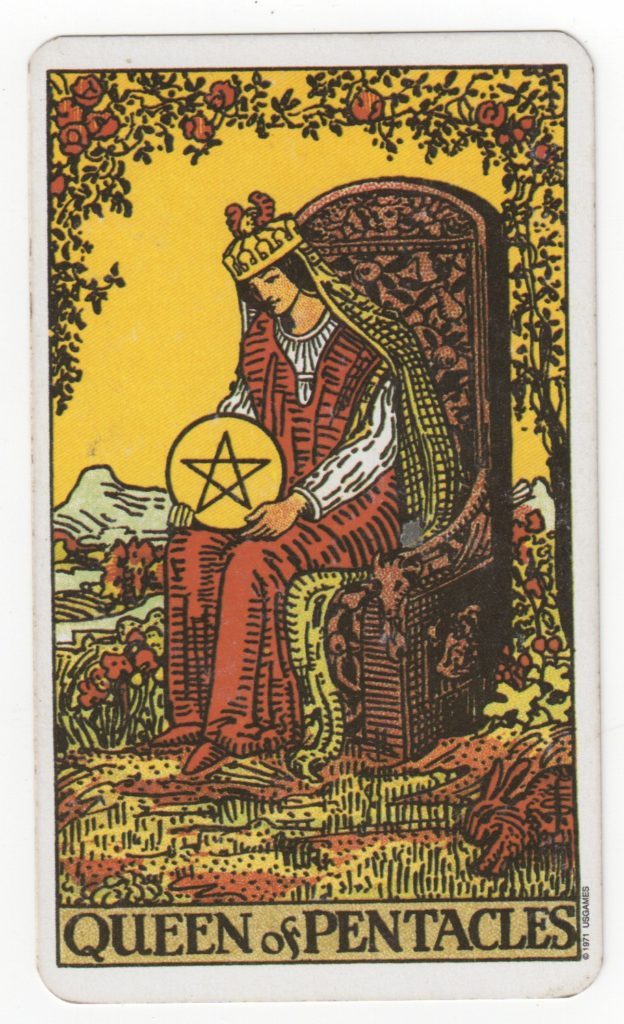
    I used the Rider Waite Smith deck (because, let’s face it – it’s a great Comfy Slippers deck!)  and welcomed the Queen of Pentacles to my life.  At least for the next little while.

    While I like the practical nature of this Queen, it’s more about appreciating it in other people rather than myself.  I am so NOT the Queen of Pentacles.  She’s organised and nurturing.  I’ll tell you how nurturing *I* am.  I abandoned my tomato plants a fortnight ago.  Just abandoned them.  Shut up the polytunnel and forgot about them because they were 12″ tall, devoid of tomatoes and USELESS.  A bit like Kim Kardashian.

    Y’see? I’m not the Queen of Pentacles.

    The Queen of Pentacles would cook a really good meal every night.  I do buy cookery books and fantasise about cooking the food within the glossy pages, but in real life?  In real life, I tend to open packets of filled pasta and boil them to death for 5 minutes before dishing up to my very own Page of Cups.  This immediately turns him into the Page of Swords.

    The Queen looks caring.  She holds her Pentacle gently and with love, as if it was precious and fragile. Which, of course, life is.  She sees life.  She sees life in the manner of the big blue princess in Avatar tells the small damaged human in her arms ‘I see you.’

    I have no recollection of this song in the film at all, do you remember it?!

    But how often to we really SEE something?  We LOOK at plenty of stuff.  Often on facebook.  But we don’t actually SEE it for what it is.  In real life.

    ‘I see you’ is a Native American greeting.  I read that somewhere. To see another is to honour their existence.

    I know.  I am being deep.

    Namaste carries the same sort of meaning.  I found this quote at wisdom quotes 

    “Namaste. I honour the place in your where the entire universe resides… a place of light, of love, of truth, of peace, of wisdom. I honour the place in you where when you are in that place and I am in that place there is only one of us.”
    Mohandas K. Gandhi
    Isn’t that beautiful?

    So let the Queen of Pentacles inform your relationship with the Other:  see it, honour it, attend to it fully.  And THEN go on to facebook 🙂

    Let me know how she materialises in your life over the next week or so 🙂

  • Page of Swords | The Tarot of Alexander Daniloff

    When I first laid eyes on this new Tarot deck by Russian illustrator Alexander Daniloff, I was terribly excited!  I was immediately sucked in by the characters and the colours; it’s a veritable medieval carnival of delights!  


    I had to know more!


    So, continuing on my meme for the Page of Swords (see here, here and here for other Pages and interviews), I asked Alexander whether he would be interested in talking to me a little about his deck.


    It’s a 78-card deck with 3 additional cards – one blank and one each offering variations on Force and Justice.  The cards will measure 141 x 73mm and the card edges are squared.


    Let’s take a look at his Page of Swords.


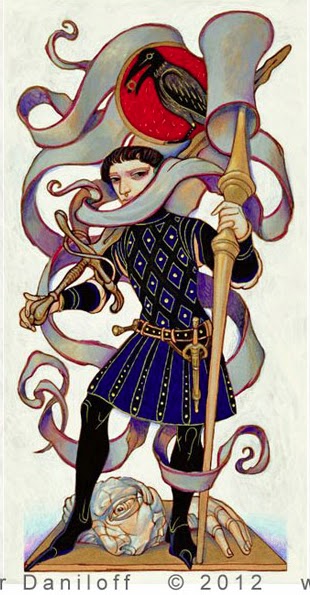
    I’m loving the raven in his banner – they are clever, cruel and entertaining birds, a bit like the Swords family altogether.  See how his banner partly obscures his face? I like that – it feels kinda sneaky – but what of the hand and head at his feet?


    I put some questions to Alexander, the deck’s creator:


    How did you become interested in the Tarot? 


    “I have always been fascinated by the symbolism and medieval emblematic, iconography of miniatures and frescoes.

    “The Tarot for me have been a reason to immerse myself in a medieval atmosphere, crawl between the nobles and the miserable, oscillate between the Moon and the Sun, between Life and Death.

    “I do not know use the Tarot, but interpreting a state of mind, a sentimental message that contains each Arcana I began soon to feel its magic. They gave me a common thread, a compass to connect remote past with today, to create a deck in the classic style, addressed and strengthened a saving irony to avoid the risk of rhetoric.”

    Tell me about your Page of Swords:  


    “The Page of Swords is about espionage, secret service investigation……his face is hidden and a large sword on his shoulder is not immediately visible.


    “I gave him a skinny black suit and a red circle on the flag to make him look like a Ninja! The circle is associated with the symbol of Pentacles – he uses it as camouflage.


    “The Raven with  ring held in its beak is shown in the red circle – stealing.


    “He has one foot resting on the broken head of a statue.  This is a reference to David and Goliath.  He gets what he wants by cunning, guile and unpredictability.  He can conquer brute force.


    All the Pages are limited by the platform under their feet, despite the fact that they are in an open area.”


    Alexander Daniloff is based in Italy and his work can be found here 
    He has a 22-card Majors only tarot currently available and he is just about to start shipping his latest Tarot, from which this marvellous Page has been taken.

  • About Face 2 | The Lenormand Oracle | Andybc

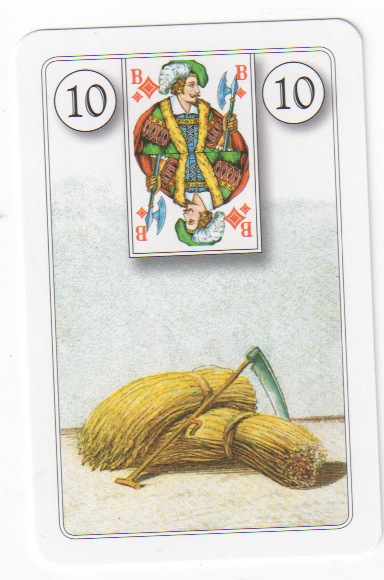
    Scythe: Lenormand (pub Konigs Furt)
    Earlier this week we looked at the Lenormand deck with expert guidance from Helen Riding. Today we look specifically at the face cards in the Lenormand deck, with the help of Andybc:

    Andy, How would we interpret the face cards in the Lenormand?


    Clubs:
    Queen (Snake)
    Sometimes older, highly intelligent, but aloof female, and can be used as a stepmother, if the relationship is cool or frosty. She has the habit of being the “other woman”, or an estranged or ex-partner when the separation was not easy. Not normally bad, however, unless after the Fox. With the Clouds a couple.
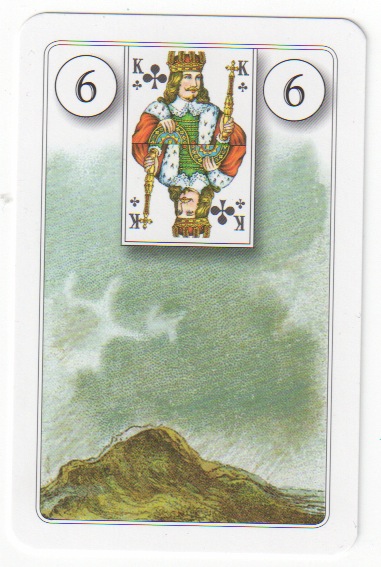
    King (Clouds)
    A difficult man you cannot ever really make out. Has an almost bipolar personality, exaggerated niceness or animosity. Card of the ex-partner (if a bad breakup, or one where you don’t see each other a lot), but can also be anyone you had an acrimonious connection with: stepfather, father, and colleague. Couple with the Snake.
    Knave (Rod)
    A younger person, often, but not always, male who is a very blunt speaker, eager, and occasionally prone to mood swings. Can be a teenager or sometimes a hyperactive and/or athletic person.
    Hearts:
    Queen (Storks):
    She’s normally the same age as the querent, and is often a friend, a sister, or good and friendly work colleague. The Storks would be an estranged or ex-partner, when the parting was friendly and mutual.
    King (House):
    This is often a male who is either older, or wiser, than the client having the reading. It can be a father, older sibling, stepfather, or occasionally a patron/sponsor (rather than a boss). Can also be a friendly ex – partner, someone you still like and see.
    Knave (Heart)
    Normally someone around the same age as the client, who is friendly, warm, and attractive: it tends to describe someone of the opposite gender of the client. Blonde or light brown hair.
    Spades:
    Queen (Bouquet):
    This is a woman who can be roughly the same age, but frequently is older. She’s a friendly and warm female; this would be querent’s mother, aunt or, stepmother or mother-in-law if the relationship is good. She’s typically someone who is charming.
    King (Lilies):
    Frequently, this is a man who is either older than the querent, OR it can be a male lover and therefore any age. If it’s not a lover, it does tend to be someone older. It’s someone you go to for advice, makes you feel safe and protected. A father, grandfather, or an uncle.
    Knave (Child):
    This is the most used Knave, and is simply a child or younger person (below 18) in the person’s life.
    Diamonds:
    Queen (Road):
    This is a woman who is younger, or the same age as the client. She is someone with some uncertainty around her, so for a man it can be on/off girlfriend, or, for a woman a love rival.
    King (Fish):
    Often this is the client’s boss, business partner, or an important male colleague, where there is a good relationship. They are normally the same age as the client, but can be a sibling who is younger.
    Knave (Scythe):
    This is an aggressive and hurtful person, often a bully, who is the same age or a little younger than the client.
    Not Courts:
    Birds (7 of Diamonds)
    A couple, like grandparents, aunts and uncles, sisters, and rarely twins. Often, but not always, older than the querent.
    Bear (10 of Clubs)
    A mature, strong, nurturing woman. Often a mother, grandmother, or aunt; someone that holds a matriarch position in the client’s life.
    High Tower (6 of Spades)
    A mature, aloof and influential man who can be egotistical and cold. A patriarch figure, a father, grandfather, uncle in the client’s life.
    Mountain (8 of Clubs)
    A person in the client’s life, normally but not always male, who is an obstacle or enemy.
    Cavalier (9 of Hearts)
    A young or youthful looking man, very handsome and well dressed. With the Lilies and/or Heart can be a new lover or love interest.
    Dog (10 of Hearts)
    A man of any age, who is warm, friendly, and kind. A friend. Can also be a lover or the husband. 


    There are only 12 face cards in the Lenormand – Jack, Queen, King – just as you would find in a playing card deck.  So which ‘type’ is missing? Does the Jack equate to the Tarot’s Knight and thus the Pages are missing?
    Probably the knight is the one that is not represented in Lenormand; the system follows the French suit pattern, and they dropped the knights for a queen in the fifteenth century.
    The Lenormand’s knaves are not universally, or even continuously, used as people; they are androgynous in interpretation, much like the continental “valets” in tarot. However the comparison is loose due to the absence of the same structure seen in tarot, or regular playing card, fortune telling.
    Apart from the Child we do not use the Rod, Scythe, and Heart that much as people; this could be due to the usage of several non-face cards as people i.e. Cavalier, the Birds, the Bear, Dog, the High Tower, and Mountain.
    Do the Face cards equate to the remaining Tarot card personalities?  If not, what are those 12 personality types, as you would interpret them, Andy?
    No, there is no real similarity. Tarot, and most other playing card systems, has faces that are arraigned through suits and rank. The Lenormand, if stacked in suits, is clearly not randomly divided (look at the clubs), but we do not find the collective qualities needed for suit division evident in tarot, or piquet et cetera.  
    Lenormand faces are interpreted through the traits of their main meaning, not the suit. In the way I teach Lenormand, I get students to compile keyword meanings for each card that correspond nouns and adjectives.
    For the kings and queens, you do the same giving one or two nouns and adjectives that could describe a person i.e. king of spades would be lover, protector, and, attractive, wise.
    Another good example, is the Queen of Clubs (7 – Snake) very often appears as a woman who wears glasses. This is nothing to do with the suit of clubs, but the fact that snakes have poor eyesight.
    Our pool for characteristics is literally in what that card represents, normally, turned into characteristics. Full interpretation is however made by combinations formed by any card touching  (horizontally; vertically; diagonally) the face card. So, if the Queen of Clubs (Snake) had the Ship and Coffin either side of her, she could be a mature woman with dark hair, green eyes (Snake), olive skin or from abroad (Ship), and be musical or unwell (Coffin).
    Apart from the Child, it is not that common for readers to frequently use the knaves for people. However, the same rules apply: a Scythe (knave of diamonds) is a hurtful, spiteful, bully and a Rod (knave of clubs) is a blunt, talkative and hyper person.
    There are also several cards that are Lenormand people: the Cavalier, the Birds, the Bear, Dog, the High Tower, and Mountain. In Germany they tend to see the Bear as an official male, but in most Lenormand ‘schools’ she is a nurturing mother figure, the Mountain is a foreigner or an enemy, again drawing from the symbolism.

    About Andybc:
    I learnt to read palms through my maternal Romany family, and I’m now a professional palmist and cartomante; I also studied classical astrology extensively (horary and personal horoscopes). I authored the Cartomantes’ Cabinet: Lenormand Course, which was well received and have the second edition due out 1st October. I have one coming on fortune telling with tarot in Jan 2013.
    My blog is: http://www.andybctarot.wordpress.com (lots of Lenormand, including meanings and how to do the grand tableau), twitter @AndybCerru

  • About Face: I….the Lenormand | Helen Riding

    6 Clouds:  Lenormand (pub: Konigs Furt)

    To ring some changes, I thought we could explore the Face Cards in the Lenormand Oracle, to see whether they work like Court Cards in Tarot (and if not – how in the heck do you use them?!).  My search has led to two wonderful people – Helen Riding and Andy BC – both extremely talented and well-versed in the lore of the Lenormand Oracle.

    I first came across it a couple of years ago when I bought one that had been damaged from our TABI Conference stock.  Most widely used in mainland Europe, the Lenormand has not been as popular in the English-speaking world – UNTIL NOW!!!  The Lenormand is enjoying a massive surge in popularity and I thought I’d call upon this duo of Lennie Experts to talk about the deck and its history AND the use of face cards in some of the Lenormand decks.

    In this first post of two, Helen Riding very kindly agreed to help get us all up to speed with the deck:

    So – tell me first of all how you became interested in this deck, Helen

    I was drawn to the Lenormand section in the Aeclectic Tarot Forum where Sylvie Steinbach had set up a free study group in 2007, the year she published The Secrets of the Lenormand Oracle which is one of the few English language books on Lenormand currently available. Early in 2010 I bought her book and several others and got hooked. I later put Lenormand aside while studying the Elder Futhark runes and Ogham but got caught up in the latest Lenormand wave on Facebook this year. I was reading Mystical Origins of the Tarot by Paul Huson at the time which shed some light on the meaning of the Lenormand suits and got me more interested in the history of the Lenormand system.

    Tell me about the Lenormand deck (briefly – who was MMe Lenormand, what has she got to do with the decks available today?

    Mlle Lenormand was a famous French fortune-teller in the 18th century. Despite the Age of Enlightenment, laws prohibiting fortune-telling and religious opposition, fortune-telling games and cards were extremely popular in Europe and Lenormand was a highly illustrious figure. After Lenormand’s death in 1843, publishers took the liberty of using her name on several fortune-telling decks including a 36 card deck which it later transpired was published in Germany c1799 as part of a board game with a secondary use of fortune-telling. Various artistic interpretations of this “Lenormand” deck were subsequently sold in Germany where all sorts of games for learning and entertainment were extremely popular in the 19th century. The association with Lenormand no doubt boosted the popularity of the deck and ensured its survival long after many other historical cartomancy decks have been forgotten. Even today many people still cling to the romantic notion that these were the exact cards Lenormand used, and while this deck may have been one of her many fortune-telling tools we just don’t have any evidence for it. We now know the deck was designed by Johann Kaspar Hechtel from Nuremberg and I hope more people acknowledge his role in the future (I am busy creating a Wikipedia page for Hechtel, so there will be no excuse not to know about him).

    The cards sometimes include playing card images – why did that happen – were they always in this oracle or a later addition?

    Hechtel’s board game Das Spiel der Hoffnung (The Game of Hope) may have been structurally based on or inspired by a 6×6 picture lottery board with 36 squares and combined with a stripped playing card deck of 36 cards traditionally used in Germany. The original illustrated cards preserved in the British Museum include both German and French playing card insets. The German playing card insets disappeared in the new so-called “Lenormand” decks published later and some publishers also replaced or supplemented the French playing card insets with text explaining the individual card meanings. These days many Lenormand cards have neither playing card insets nor explanatory text. I prefer the ones with playing card insets only as the playing cards can add a secondary layer of meaning to the cards and I find the canned text distracting although it can be useful to aid understanding of the traditional meanings of the cards.

    Do different Lenormand ‘Schools’ favour different types of decks (eg – do the Germans, for example, make better use of the playing card elements?)

    I would say most traditional schools prefer cards with playing card insets although most Lenormand authors disregard them except for the secondary layer of meaning of the face cards. Unfortunately when the German playing card insets were removed from the deck the original cartomantic meanings of the suits were mostly lost as they differ from the cartomantic meanings of the French suits standard today (although there appears to be an intended theme per suit, clubs and not spades is the trouble suit in Lenormand).

    These are my personal Lenormand playing card suit associations:

    ♥ hearts: water element, love, relationships and family
    ♠ spades/leaves: air element, society, government and travel
    ♦ diamonds/bells: fire element, enterprise, fortune and misfortune
    ♣ clubs/acorns:earth element, survival, hardship and trouble]

    There are face cards included in the playing card references in the Lenormand – which face cards are included (and if they are not all included, why are those that are not included left out?)

    All the face cards (jack, queen and king) are included. The Lenormand deck is based on a traditional German deck with 36 cards equivalent to a standard French deck stripped of the 16 pip cards numbered 2, 3, 4 and 5. Anyone can easily modify a regular playing card deck and use it as a Lenormand deck.

    I should point out here that the primary significator cards in the Lenormand system are not face cards. When the Lenormand deck was designed, aces were ranked highest in each suit and often given a similar treatment to face cards in illustrated decks. (As a matter of interest, the German equivalent to the French ace is actually the deuce as the aces were removed from German playing card decks early on.) This could explain why two of the aces are used as the primary significator cards. Man (A♥) represents a male querent and Woman (A♠) represents a female querent, with the other primary significator representing the querent’s significant other. Some modern decks include additional male and female significators to facilitate readings for people in same-sex relationships.

    Apart from the face cards and primary significators, other cards that can represent people include Dog (10♥) which can represent a friend, known person or third party, Rider (9♥) which can represent a newcomer, messenger or visitor and Birds (7♦) which can represent a couple or siblings.

    How does one interpret those face cards in the Lenormand (You can just provide a list if you want)

    The face cards have primary meanings based on their main symbols:

    ♥ hearts: Heart (J♥), Storks (Q♥), House (K♥)
    ♠ spades/leaves: Child (J♠), Bouquet (Q♠), Lily (K♠)
    ♦ diamonds/bells: Scythe (J♦), Crossroad (Q♦), Fish (K♦)
    ♣ clubs/acorns: Whip (J♣), Snake (Q♣), Clouds (K♣)

    Some readers interpret the face cards as various types of people as alternatives to their primary meanings, and some readers use either face cards or other people cards to represent same-sex partners in the absence of specific cards for this purpose. Personally I find too many cards that can represent people in addition to their primary meanings confusing and generally (never say never) prefer to work with the main symbols on the face cards which do however have an obvious relationship to the face cards.

    In the hearts suit, Heart (J♥) can represent affection, Storks (Q♥) motherhood and House (K♥) family. In the spades suit, Child (J♠) can represent a child, Bouquet (Q♠) beauty and pleasure and Lily (K♠) maturity and experience. In the diamonds suit, Scythe (J♦) can represent danger, Crossroad (Q♦) alternatives or diversification and Fish (K♦) entrepreneurship. In the clubs suit, Whip (J♣) can represent aggression, Snake (Q♣) deception and Clouds (K♣) confusion.

    You can find out more about Helen and The Lenormand at Helen’s blog
    http://www.mywingsofdesireblog.blogspot.com

    Facebook groups:
    Lenormand Cards Study Group
    Lenormand Cards Reading Exchange

  • Autumn Equinox Spread

    I opted out of the Tarot Blog Hop for the Autumn Equinox – not because I didn’t want to do it – but I am up to my armpits in Court Card exercises in the TABI Training (Group 1 – fabulous collection of students *high fives any who might be reading*) and I just didn’t have the time to devote that the Hop deserves.

    But I wanted to join in in some way – so here’s my contribution:

    I love the Autumn Equinox.  I just love Autumn and the thought of settling down somewhere snuggly with my seed catalogues in one hand and a glass of red in the other…… I might have been a dormouse in a previous life, I think 🙂

    Here’s a 3-card spread to do at this time of year.  The Equinox is alllllll about balance – the days and nights are the same length, the ying and the yang, the in and the out, the ebb and the flow…..  But we lack balance in our lives.  Or maybe that’s just me.  It could be that glass of red wine :-).  This spread seeks to redress that balance.

    First of all, get the 16 Court Cards mobilised into a single section.  I used the Druid Craft Courts simply because I had them all close to hand.

    And I used the Morgan Greer deck for the main body of the spread.

    It’s very simple. Cards 1 and 2 are laid out as if at either end of a see-saw and Card 3 goes in the middle

    Card 1:  This is where I am unbalanced and SHORT/DEFICIENT
    Card 2:  This is where I am unbalanced and OVER-ENDOWED
    Card 3: This Court brings me back into balance

    In my reading, Card 1 was the 6 of Wands – Victory. Absolutely. I’m useless at celebrating or even acknowledging my own victories in life.  Believe me, there’s a seething foam of Scottish Presbyterianism churning under the veneer of normality here 🙂

    Card 2 was the 10 of Cups – It feels a bit odd to say that I am over-endowed with family! But what I feel the card alludes to is that I make sacrifices for my family and perhaps I’m hiding/denying too much of myself in order to maintain a happy family? Yes, I can see that too.  There are lots of things I’d love to do, but I don’t do them because I feel that I’ve got to keep the status quo.  Not keep Status Quo.  Although I wouldn’t MIND keeping Status Quo.  Upstairs under lock and key.  *50 Shades of Denim face*

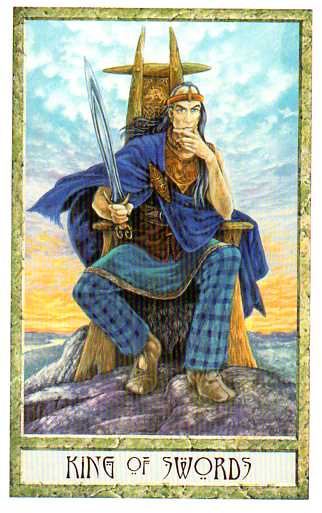
    So who helps me bring all this back into balance? The King of Swords.  In the Druidcraft he looks interested and thoughtful – able to think up a solution (Airy and Swordsy) and able to demonstrate it (Kingly and Fiery).

    Somehow this guy is going to sort it all out for me and over the next few days, I’m going to meditate on the 3 cards of this spread, in pairs (6 Wands and King; King and 10 Cups) and see what solutions he offers me.

    If you try the spread, I’d love to know how it works out for you!

    Happy Equinox, dear reader!

  • September | New Moon | The King of Cups

    Odin – just hanging around

    And so we are huddled once again in the darkness of a moonless night! A sliver of new moon will be upon us – and whose energies will guide me from now until the moon is full once again?

    The Father of Cups from the Haindl, that’s who.

    This deck is very special to me.  It was the first ‘fancy’ Tarot deck that I ever bought.  It was also the first purchase that I ever made on ebay!  I *know.*  I’m a veritable FONT of spiritual insight.

    The image in the card depicts Odin, the Head Honcho god of the Norse pantheon.  The suit of Cups represents the North and the Northern Gods.  Interestingly, the Queen of Cups is The Willdendorf goddess, which I mentioned earlier this month, here.

    We see Odin hanging upside down (exactly like the Hanged Man card) suspended on the World Tree, Yggdrasil.  He is reaching into the Underworld to find the Runes – you may just be able to pick them out, scattered on the ground beneath his outstretched hand.  He has been half-blinded (a payment he made to Mimir) in return for a drink from the giant’s well.  The name Mimir means memory, apparently.  I may have remembered that wrong. *boom tish – eyethankyoo*

    Odin was more than just the Leader of the Norse pack and a God of War, he is also closely associated with more ‘Cups’ orientated subjects such as poetry and magic.  I’m hoping that it’s his Cups associations rather than his warlike tendancies that are coming to the fore for me!

    I usually think of the King of Cups as a slightly laughable figure – kind and diplomatic of course, but always slightly mystified as to where he’s left his car keys.  A bit of a buffoon.  Which is terribly unkind of me and probably says more about the influence of Wands and Swords on me than the poor Father of Cups!

    Yet here he is, taking me by the hand to guide me through to the full moon.

    So – until the full moon, I am prepared to go with the flow, to surrender (Hanged Man stylee) to the Father of Cups and Life Itself (which is totally unlike me).  I will endeavour to be kind and considerate; to accept people at face value; to be diplomatic (let me tell you right now, your bum does NOT look big in that).

    And most importantly, now is the time for me to reach into my own underworld and emerge with knowledge and magic… slightly scary prospect! But if I am prepared to trust the King of Cups, this is the time to do it.

    I’ve taken to intermittent fasting (fast for 24 hours, twice a week) and have been considering a deeper fast with more spiritual endeavours….

    I wondered whether I was on the right track with my thoughts bout the King and drew another card to modify him (as I do with the amplifiers exercise).  I drew the 7 of Wands: Courage.  So I think I’m on the right track after all 😀

    What does the King of Cups mean in your life, right now?