Year: 2015

  • Robin Wood Tarot | Review

    Confession time: I’ve had this deck for years and never really used it. Why? I don’t know – too many new decks flashing their eyes saucily at me, if I’m honest.  But I recently had cause to dig the Robin Wood Tarot out because my good friend Nancy Hendrickson wanted to use it for an exercise that we were doing together. What can I say? I fell in love with the damned thing!

    I’ve made a li’l video to celebrate the fact that by changing my broadband supplier, it no longer takes me DAYS to load up a 1 minute long creation.

    Take a lookie at the video and then see what you think of my observations – I’d love you to add your tuppenceworth in the comments at the end 🙂

    There is a clear elemental colour palette for the suits.  This always makes me very happy!

    Wands are fiery/sunny in yellow/red
    Cups are watery in blue/pink
    Pentacles are earthy/land-orientated in brown/purple
    Swords are Airy/cloudy in blue/white

    First up, let’s look at the Pages.

    To me these all look like girls, but you know what, it doesn’t matter a jot. If you read them as long-haired boys, that’s totally fine.  Each Page holds a gleaming symbol of their suit and each sports a little clue to their personalities on their belts:

    Page of Cups has an artist’s palette
    Page of Swords has a spy glass
    Page of Wands has fire-crackers
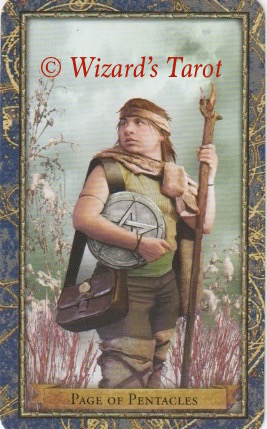
    Page of Pentacles has a book

    Onwards to the bold Knights! As you would expect, they are all mounted:

    Knight of Swords – Pegasus
    Knight of Cups – Seahorse
    Knight of Wands – very fiery steed
    Knight of Pentacles – a proper, solid-looking horse

    The Knight of Cups is actually quite a foamy and active looking horse.  Although he himself is not as dynamic as the Knights of Wands and Swords.  The darling Knight of Pentacles is absolutely rooted in the ploughed fields that surround him.

    The Queens are glorious creatures.  The first thing that I noticed is that the two active/Yang suits of Swords and Wands have standing Queens while Cups and Pentacles are seated.

    Each Queen (bar one) has a flower and an animal associated with them:

    Queen of Swords – rose and butterfly
    Queen of Pentacles – fruit and rabbits
    Queen of Wands – sunflower and cat

    The Queen of Cups doesn’t have anything obviously associated with her.

    The Kings are worthy consorts for their Queens.  They too stand and sit, to match their Queen.

    I love how the King of Swords has a starry night-sky lining to his cloak. The King of Cups drinks from a cup with the Yin/Yang symbol.
    The King of Wands continues his RWS reputation as the Lizard King.
    The King of Pentacles looks comfortable, sitting with his slippers on!

    The Robin Wood is so comforting in its similarities to the RWS, yet its different enough to warrant having both in your collection!  It’s a joy to shuffle and so easy to read with.

    *** Note*** There is also a companion book for this deck, but I don’t have it.  Thanks to Nicole Diamond for the info <3

    *** Note 2 *** There is an App (iOS and Android) – by The Fool’s Dog (who make great apps!)  Thank you for the heads-up on that from Nancy Hendrickson <3

    What do you think of it?

  • Tarot | Scottish Opera

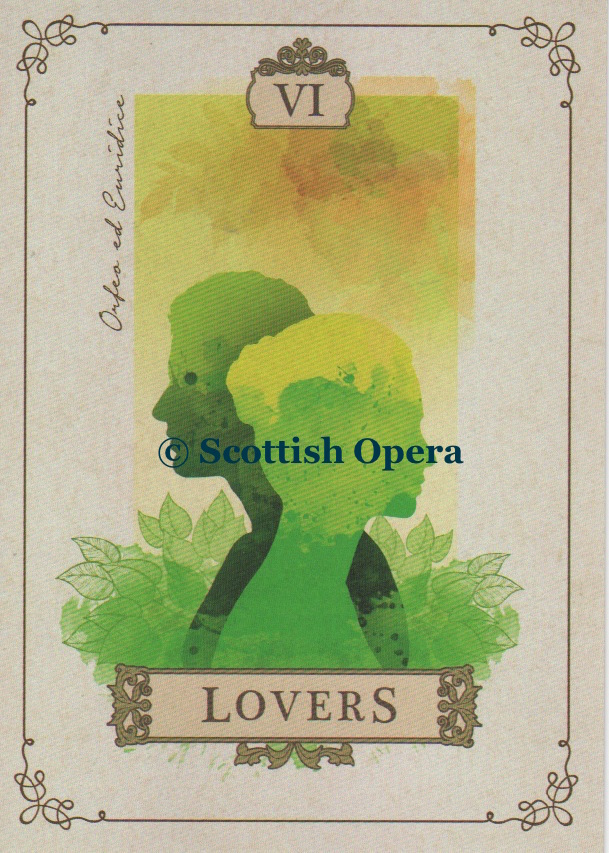
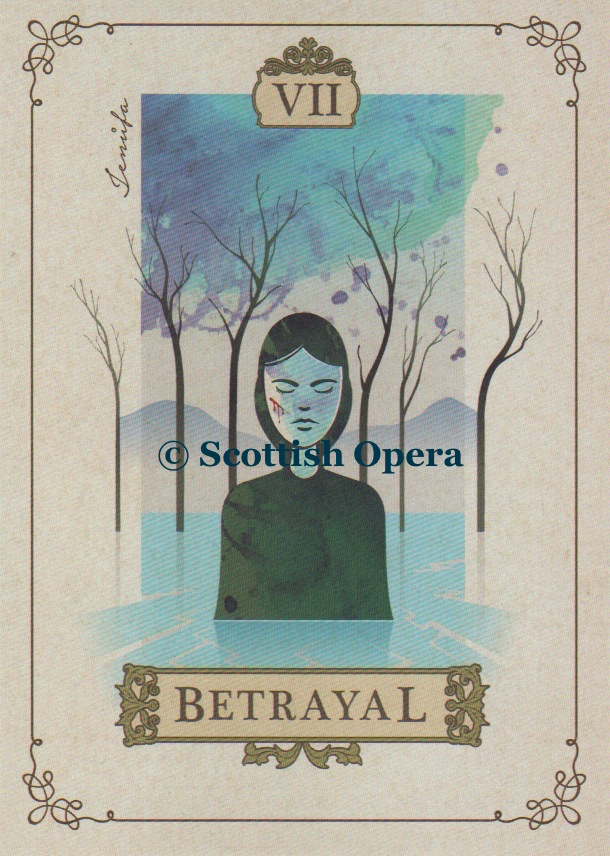
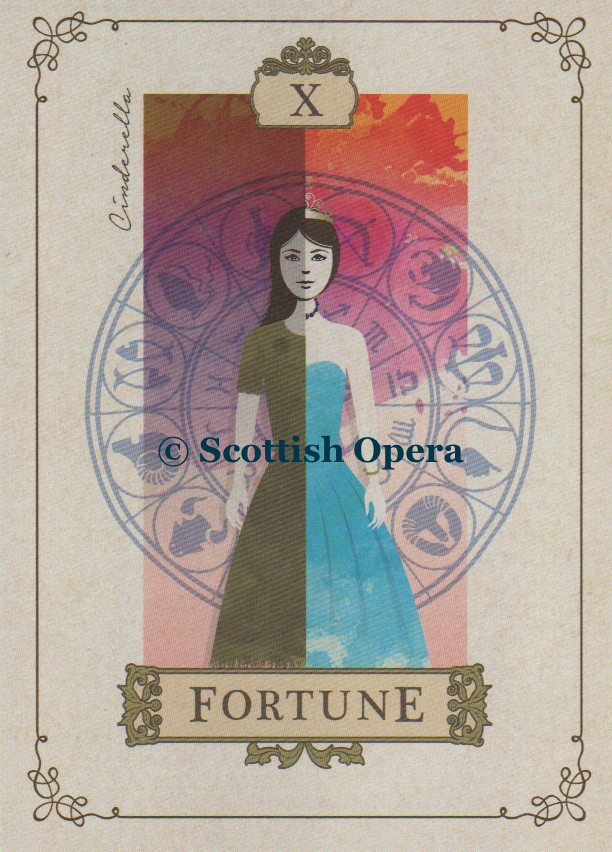
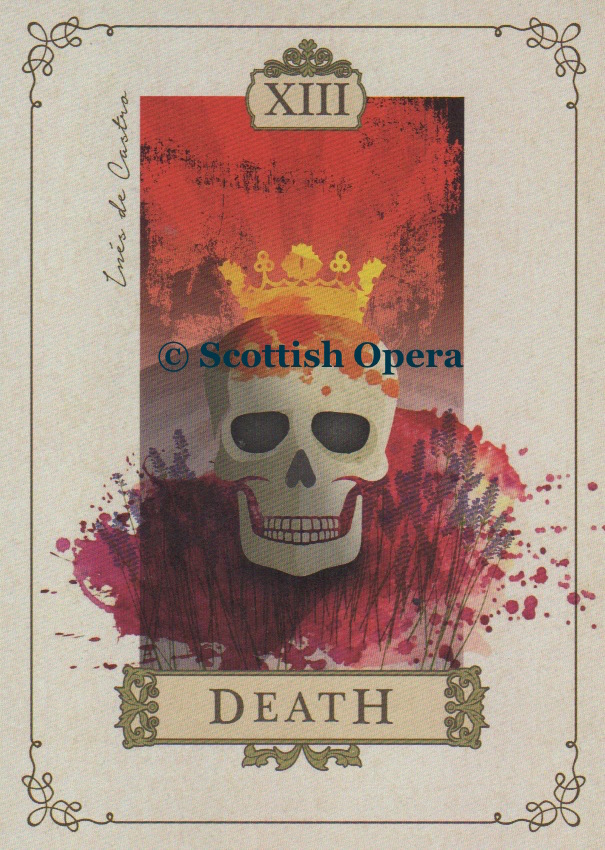
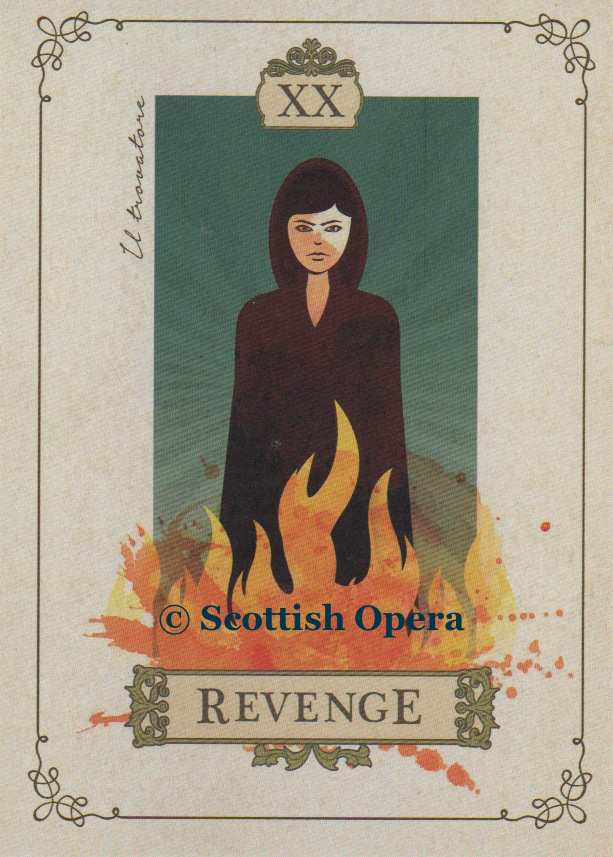
    Just thought I’d share some images that Scottish Opera had printed to promote their season. I cannot tell a lie, this post was scheduled to post a looooong time ago, and failed.  So am popping it out now, because it’s good to share!

    No, they are not proper Tarot cards, nor are they my raison d’etre court cards, but I am sharing them here to remind you to keep your eyes open for Tarot-inspired artworks everywhere.

    These items of ephemera are worth seeking out and procuring to add to your collection.  One day they might be worth something to a collector. But in the meantime, they look excellent in little clip frames on the wall!

  • Marseille Sophistiqué | TPC Games | Review

    So, I decided to hazard another foray into the Dark Arts of Imovie, this time with the Marseille Sophistiqué.  The MS is a rather gorgeous little deck from those clever comic book artists at TPC Games.
    click on the photo to visit TPC Games
    Before we get into the review, I know that there are a couple of glitchy things there in the video, but it takes about an hour for me to load up a video of this teeny tiny size to youtube. Fibre optic? I think we’ve got string here …  
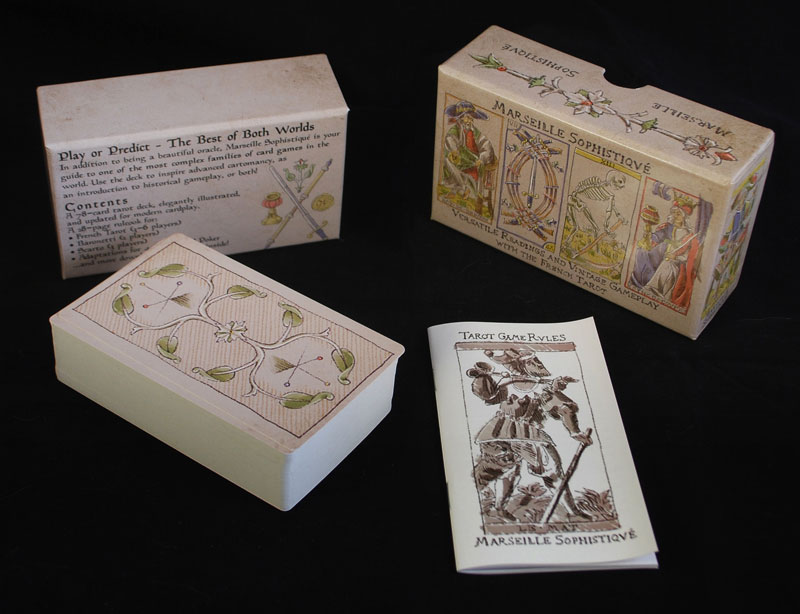
    As you can see from the photo, the box is a sturdy lift-top box that depicts 4 cards from the deck – a Major and a Minor, flanked by a King and Queen.
    The cards themselves are 4 3/4″ tall x 2 3/4 wide and printed on a linen-effect card which results in delightfully slippy shuffling.
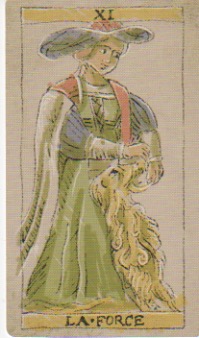
    It’s a 78-card deck with Justice at VIII and La Force at XI.  Yes, the titles are in French.  It’s a Marseille, so, yanno – get over it 🙂  The deck is based (fairly faithfully, I think) on the Conver Marseille Tarot (1760s).
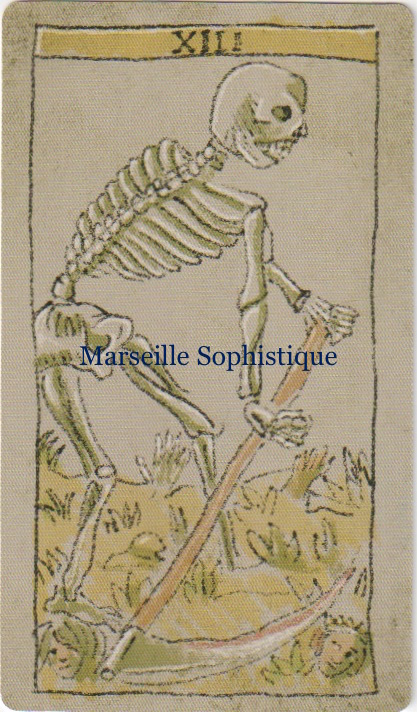
    The Unnamed Chappie
    First up, this is a Tarot that has been created with GAMES in mind, not divination.  There IS a LWB with the deck, but it is stuffed to the gunwales with rules for game playing and details of games, such as Baronetti and French Tarot.  They do mention divination in an Appendix at the back of the LWB, but there are no card meanings included. 
    The first thing you’ll notice are the non-traditional hues of the colour-scheme. If the primary colours of a traditional Marseille have you reaching for your sun-glasses, then this might be the deck for you.  It’s in muted shades of green, gold, blue and red, with white highlights.  Very tasteful!
    The colouring-in is deliberately quite scrappy – like an old deck – with lines clearly visible. However, although you can see the ‘pencil marks’, they colour outside of the lines just enough to be attractively arty and not so much that the untidy artwork shifts the gear-stick on your OCD into overdrive.  

    Scribbly colouring.  I like it.

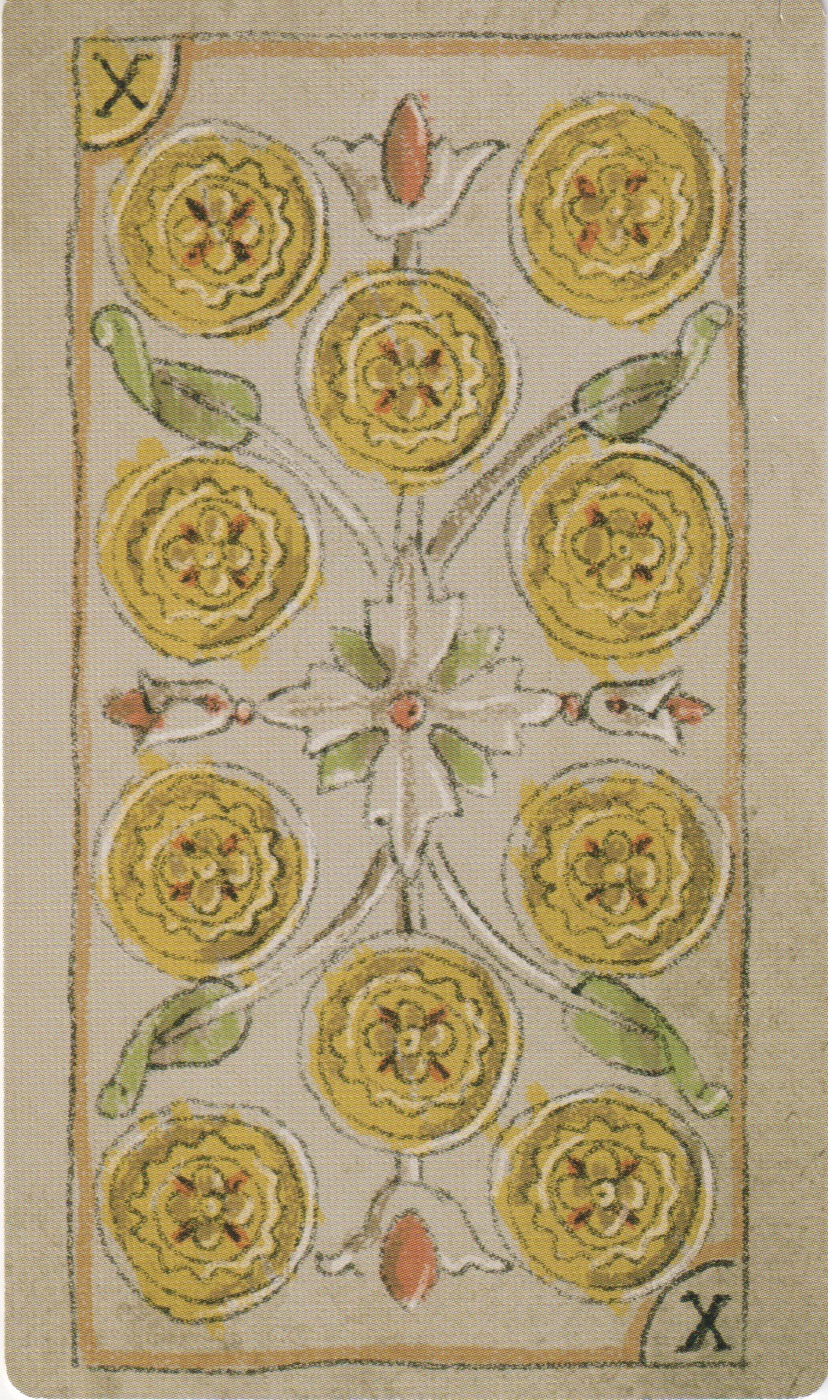
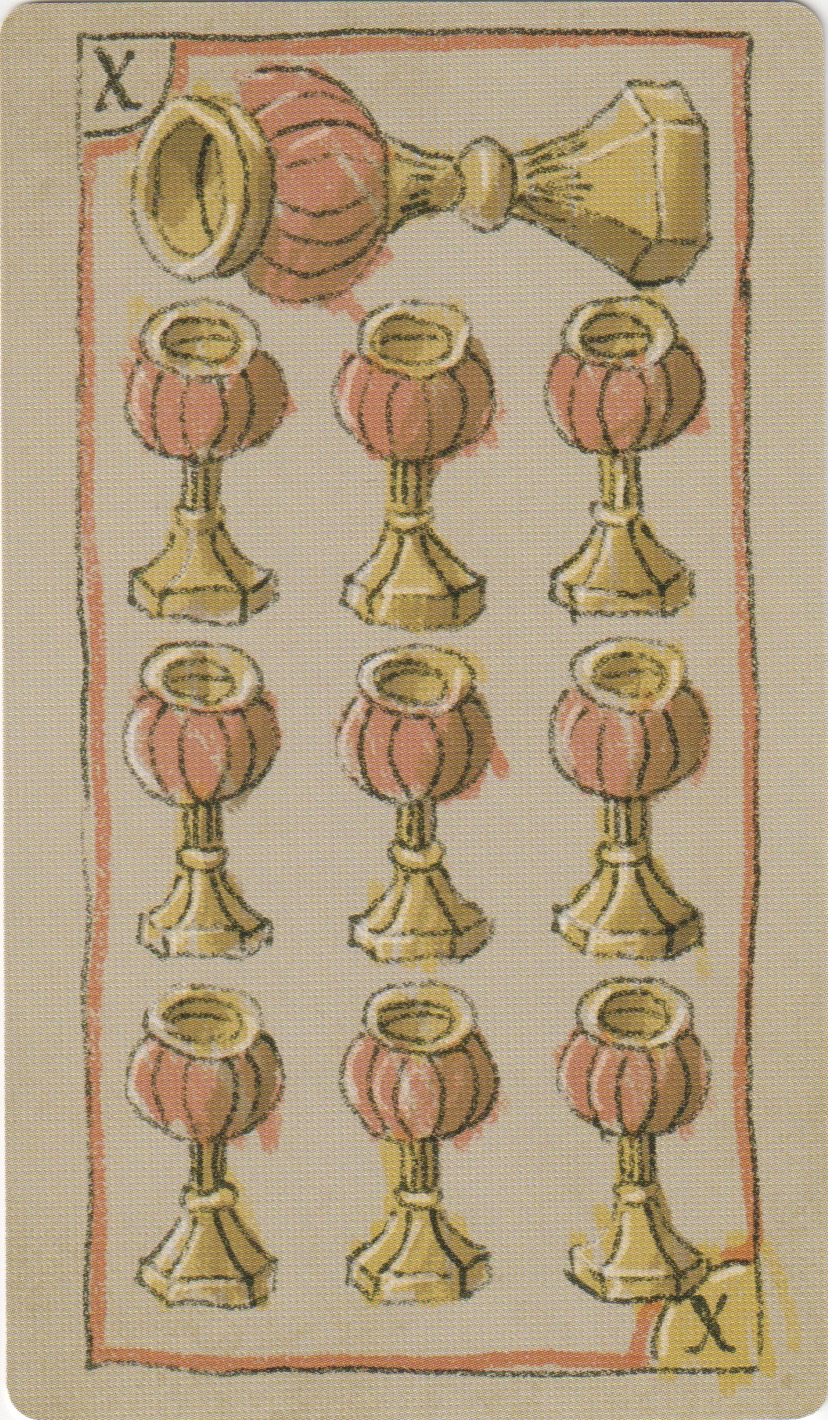
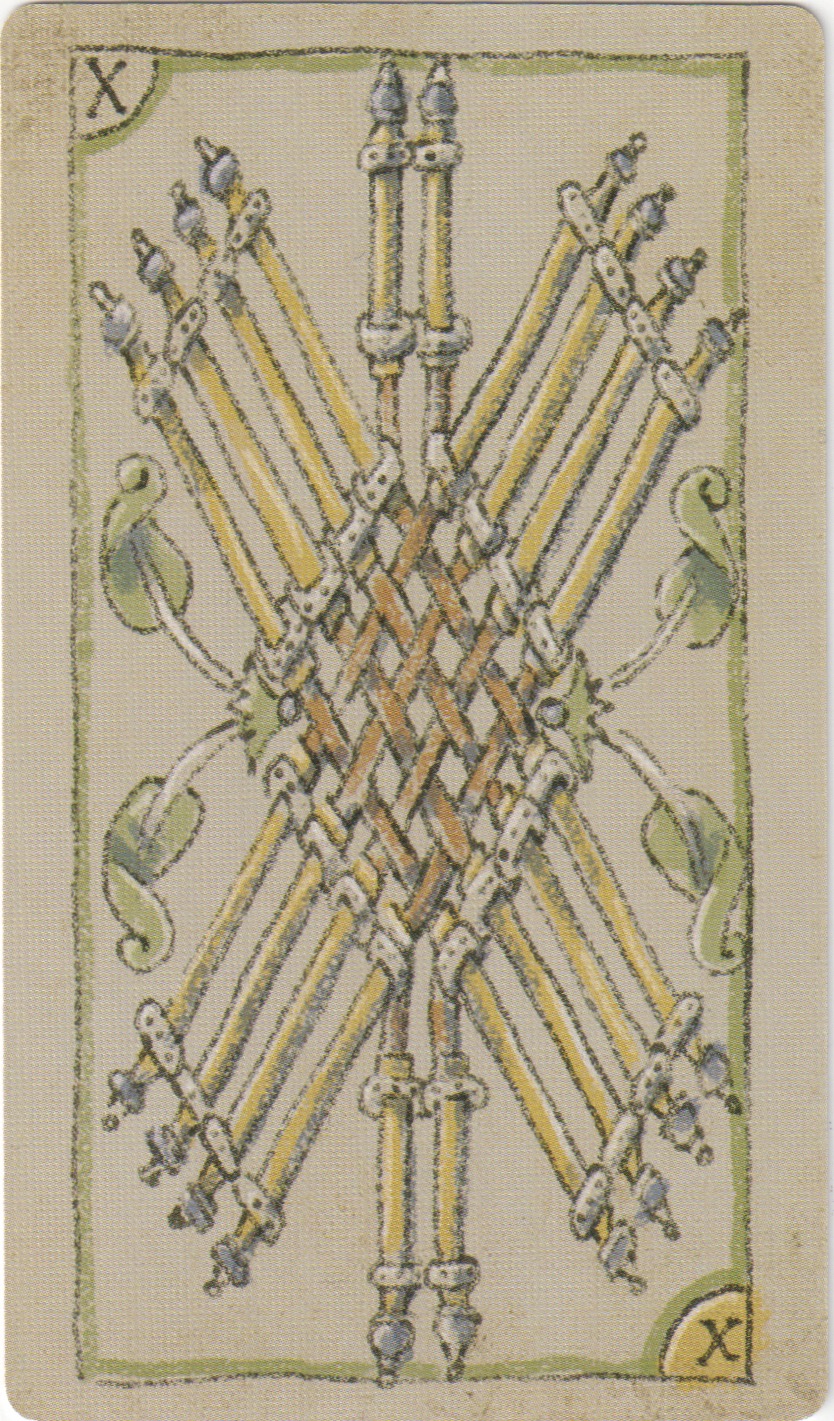
    It’s a 78-card deck, with traditional Marseille pips.  The suits are Deniers, Epees, Batons and Coupe.  The Minors have coloured borders – Cups is red (more like pink, really), Deniers are gold, Swords blue and Batons are green.  These borders also go around the Courts.  The Majors don’t have such a border.

    Above are the four 10s of the deck, to illustrate the Minors.  There is a X symbol for 10 in the top left, bottom right corners.  Where the X coloured yellow is in the bottom right, the card is right-sides up.  Where the yellow X is in the upper left, it is upside down. 
    The back (shown at the end of the video above) is suitable for reversals.
    So, what do I think? It’s a nice size for handling and it shuffles beautifully.  It’s easy to distinguish Swords from Wands thanks to the colours selected.  The muted, almost sugar almond, shades are delicious. And of course, the design is a proven classic.
    I think this deck is gorgeous and a worthy addition to anyone’s collection. 
    Do you have the Marseille Sophistiqué – what do you think of it?
    Do you use it or just admire the artwork?
    How are you at reading with unillustrated pips?
    Want more games to play with it? 
    Update 31/3/17 – the deck can be purchased here  but only US sales, alas!
  • Tarot Thrones is Supporting Syrian Refugees

    No court card humour from me today.  And believe me, be glad that there is no photograph to illustrate today’s blog post.

    I’m appalled  by the humanitarian crisis that we are seeing as a result of Syrians fleeing their homes.  The newspaper headlines would break your heart.

    So, TABI has set up a justgiving page to show the world that Tarot people CARE about what’s happening to these people in their time of crisis.

    No more drowned children.

    Please.

    Let’s put a stop to it.

    https://www.justgiving.com/TABITarotsyria/

    You can make a donation through that portal.

    You can take this code and put it as a button on to your website or your blog and also support us that way.

    To add to your blogger blog, select the ‘add html’ widget in ‘layout’ and drop the code in, save.  That’s it.

    <a href=’http://www.justgiving.com/TABITarotsyria’ title=’JustGiving – Sponsor me now!’ target=’_blank’><img src=’http://www.justgiving.com/App_Themes/JustGiving/images/badges/badge5.gif’ width=’150′ height=’85’ alt=’JustGiving – Sponsor me now!’ /></a>


    Thank you


  • Page of Pentacles | Baking | Focaccia di Recco

    Page of Pentacles
    on his way to Masterchef

    It doesn’t matter what age you are, we are all Pages at something or other. The Tarot deck’s Pages show us in our tentative first steps, those beginner steps at anything: those moments where you wobble uncertainly forwards, sometimes falling – but always getting back up again.

    (more…)

  • The Alchemical Tarot | Robert Place |4th Edition

    The Alchemical Tarot
    on the Throne!

    I’ve been coveting a Robert Place deck for a long time now and lo! because I’m a dozy mare and got my Alchemicals and my Sevenfolds all mixed up, I will shortly be the proud owner of both the decks and the book and poorer than a Church Mouse.

    This is the 4th Edition of this deck and it has been funded via an Indigogo campaign.

    We’ve got four families – Staffs, Swords, Vessels and Coins; nice and traditional.

    Each family member sports their name and also the elemental glyph associated with that suit.  The first thing that you will notice about the courts in the Alchemical Tarot is that the Pages have been replaced with the rank of Lady and the second thing is that the King is not a figure but a creature.

    Let’s take a closer look …

    Suit of Staffs
    Each member of our Staff family stands in a progressively dry landscape, which is perfect because they are identified with the element of Fire (the glyph for fire is at the top of each card).
    The Lady of Staffs reminds me of the Page of Wands in the RWS – they adopt the same kind of pose with their Wands.  In the Alchemical, all the Wands are ablaze.
    The Knight of Staffs, on the other hand, is in a fairly relaxed attitude which is NOT what we associate with him in the RWS.
    The Queen faces us, a burning sceptre in one hand and her flaming wand in the other.  She is barefoot and bare-boobed.
    The King is a red dragon … which is probably a very alchemically thing, but I find him being the only creature in the suit a bit distracting.  There will be a reason for it, but I don’t know what it is because the deck doesn’t come with any kind of LWB.  Which is a pity.
    The suit of Swords
    Moving on to the Swords family, we can see that the Lady of Swords plays a lute.  This might strike you as odd, but the Sola Busca Tarot has the Page of Swords playing a lute too, so a nice nod backwards to this important and ancient deck.
    The Knight of Swords is the only Knight depicted with his face obscured and the only one involved in any kind of fighting.  None of the Knights are on horseback.  I am reliably informed that this is a Wyvern and not the red dragon of the King of Staffs.
    The Queen of Swords looks very much like the Queen of Staffs, same barefoot and balanced pose – sword in each hand.  Curiously, a red wing and a green wing.  Again, something that a LWB might have clarified for me.
    The King is an eagle.  Or a lethal-looking chicken.  Let’s go with the eagle.  The other Swords are depicted amongst clouds, but the King has no background at all.
    The glyph for Air shows us that the suit of Swords is associated with this particular element.  
    The suit of Vessels

    Now to the suit of Vessels.  We see that theyare all found in or on water. All their vessels are different -alembics, jugs, goblets.


    The Lady of Vessels stands ON the water with a jug balanced upon her head.  A light breeze ruffles the waves at her feet. 


    The Knight wades through the water, holding up his golden vessel as if to take a swig from it.  A little fish looks up at him – reminding us of the fish in the RWS Page of Cups.  The waters around him are still and tranquil.


    The Queen of Vessels looks quite different to the other two queens we have encountered so far.  She has both breasts bared and looks towards her suit symbol. She has the finned and fishy tail of a mermaid and she sits on the surface of the water.  The Queen’s large vessel is closed and the stopper resembles a question mark.  I’m sure that she is an alchemical figure, but it is infuriating to have a deck with so much glorious alchemical content and no handy LWB to refer to!

    The King is a crowned whale who seems to be spouting water into a huge goblet on his back.  Except whales spout air out of their breathing holes in real life.  Mind you, in real life they don’t have crowns or goblets on their backs….  The sea around him is white with choppy waves. 

    The suit of Coins

    Just as the Lady of Swords had her suit symbol above her, so the Lady of Coins can have her suit symbol in the coin-like lunar disk in the sky or in the purse around her waist.  She is elaborately dressed and stands before lush vegetation.  The focus of her gaze is the flowers in her hand.

    The Knight of Coins holds a mace, not a sword and his suit symbol is on a great shield that he rests on the ground before him.  He too stands amidst rich greenery, with a castle in the background – perhaps his home.

    The Queen of Coins is naked as the day she was born and her pose links her to the Queen of Vessels (without the fish tail of course).  She cradles and gazes at a cornucopia, whilst holding a small unicursal pentagram in her right hand.  Again the vegetation around her is lush and there are more buildings in the background – she is closer to home than the Knight.

    The King is a crowned lion.  I’m sorry, but I can only think of Aslan when I see this chap.  A great paw rests on a golden disk which contains the image of a lion rampant.  Or self portrait.

    So, what do I think of the deck?

    It’s a fully illustrated deck that gives you a choice of Lovers cards (one more risque than the other!) with enough similarities throughout the deck to the RWS to ensure that even a beginner reader could use it.

    Strength is at XI and Justice is at VIII – the traditional, pre-Golden Dawn positioning.

    There are some images that could do with clarification – for example, the 5 of Staffs is a hand with the five fingers burning; the Hanged Man is not the relaxed beatific saint but a struggling figure strung up by one leg. These image choices could all be easily explained in a LWB.  But there is none included with the deck, which is a pity.

    There IS a large companion book, but it is purchased separately.

    It’s a beautiful deck and I love the muted antique colour-palette throughout.  It’s a dream to shuffle and to use and, even with a limited knowledge of alchemy – it reads beautifully.  I just wish that an LWB had been included.

    I’d love to hear what you think of the Alchemical Tarot 🙂

    Edit:   Thanks to Moti for this information.  You can download the LWB at this link:

      http://robertmplacetarot.com/the-alchemical-tarot-little-white-book/ 

  • TABI’s Tarot Conference 2015 | Court Cards

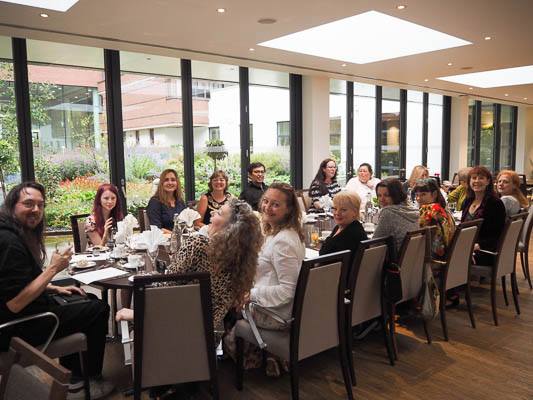
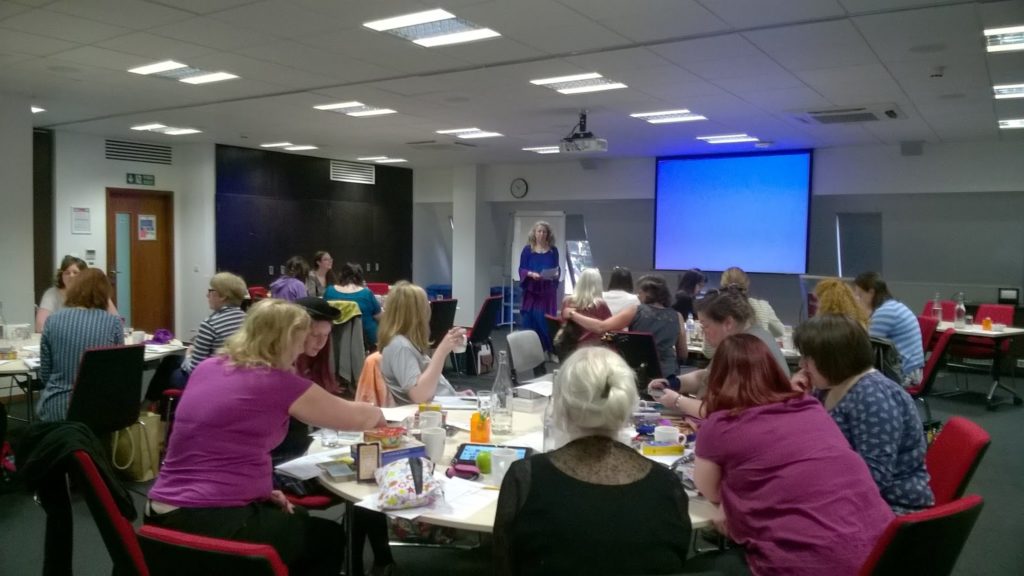
    Saturday saw the return of TABI’s annual Tarot Conference in Birmingham.  Here it is, in court cards:

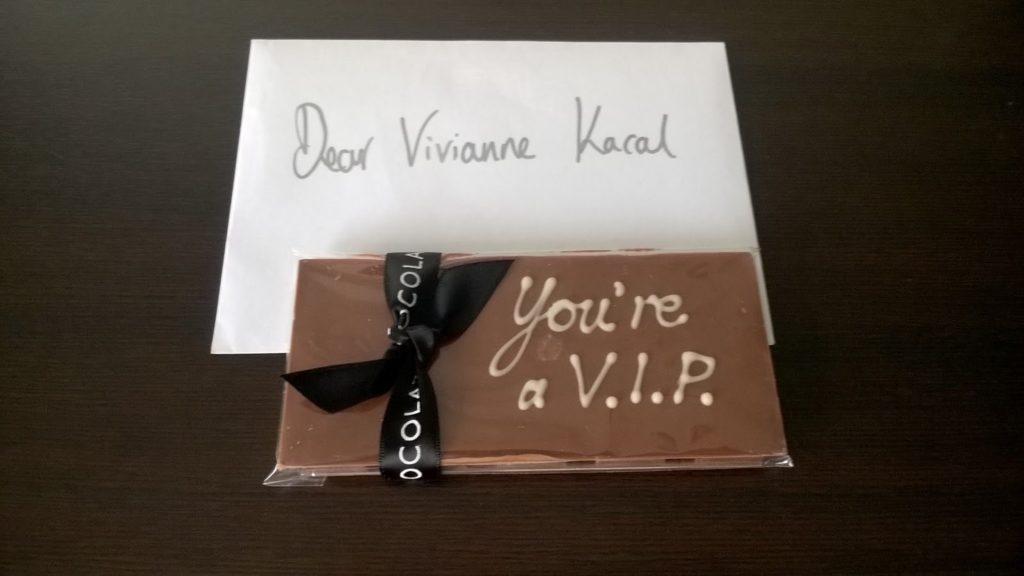
    So we checked in to our rooms and the speakers and organisers had been presented with a li’l hand-made bar of chocolate and a welcome card. Everyone was thrilled and posted photos like this:

    © Viv Kacal 

    As Page of Pentacles, my first thought was ‘Thank God, something to eat. So my photo was like this:

    *wipes chocolate smears from mouth to take photo*

    We met up before dinner on the Friday.  My inner Queen of Wands became my Outer.  Are you digging the leopard print cardi and the gold high heels?

    I’m working my Bette Lynch vibe like mad here.
    © Viv Kacal or Ania Marczyk (I wasn’t looking)

    Our meal on Friday night was very tasty indeed.  I barely stopped eating to look up for photos.  Look – I’m not even drunk.  But my head can’t do that Linda Blair 360 degree thing….

    © Ania Marczyk

    On Saturday morning I was the first speaker on the floor – the warm up act for our wonderful head-liners – Jane Struthers, Andy Boroshevengra and Caitlin Matthews.

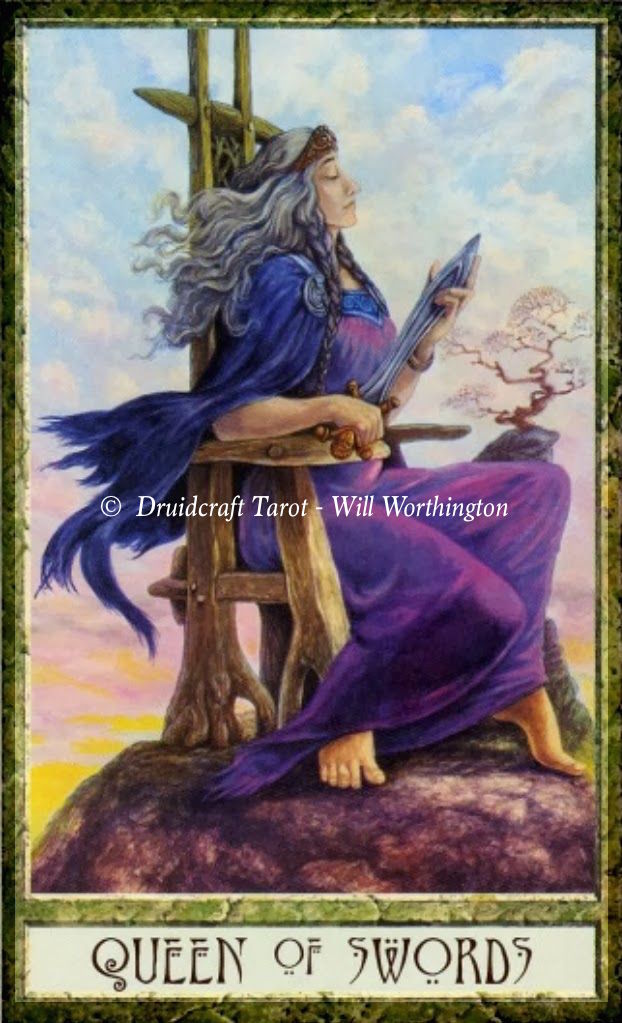
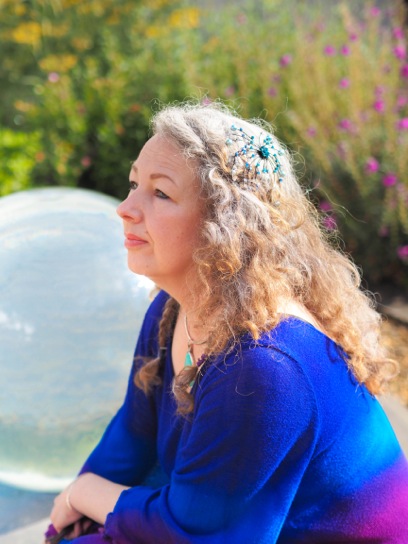
    I attended dressed as the Druidcraft’s Queen of Swords:

    © Viv Kacal (I think)
    That’s me in the spotlight! That’s me as the Queen of Swords 🙂
    It’s me! No, it’s not – it’s the Queen of Swords!

    I didn’t do the bare feet thing though.  Sometimes you can take something too far …. I wore the gold high heels though. See? My outer skin at the Conference was the Queen of Swords, but my feet are forever the Queen of Wands.  Until about lunch time and then they morphed into terribly unflattering running shoes and I went all Queen of Pentacles 😀

    And also managed to double up as Queen of Cups in Ania Marczyk’s forthcoming Meniscus Tarot too.  Tha’ Queen of Swords outfit is VERSATILE!

    Queen of Cups Meniscus Tarot Ania Marczyk
    © Ania Marczyk

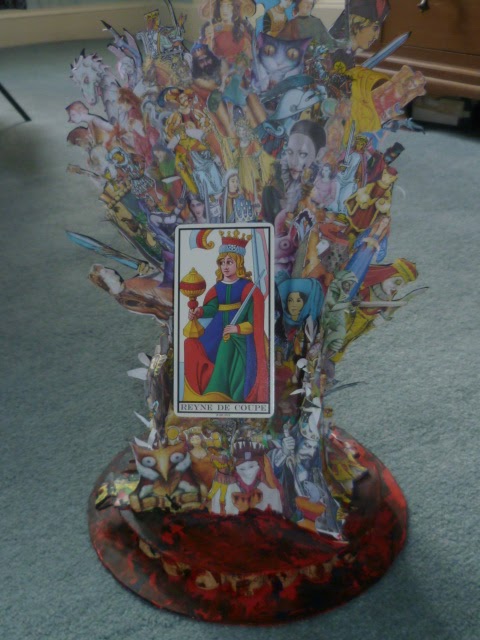
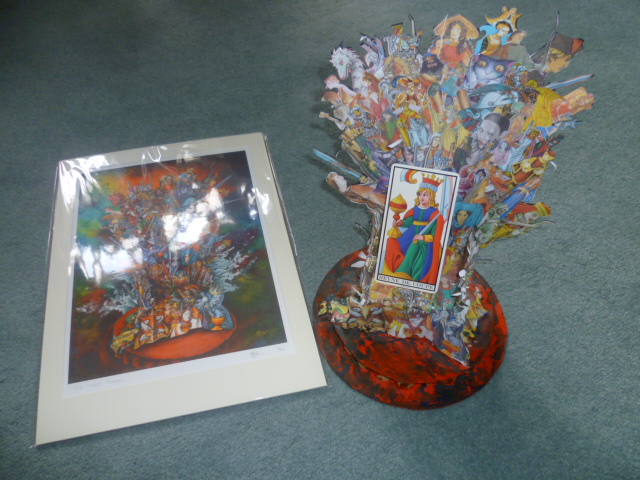
    I brought home a throne – as you do!

    And brought home one of Moti’s beautiful prints!

    Moti’s original painting was there for us to see too – what a talent!

    So, only one question remains ……Why have I not posted pix of the speakers as Court Cards?

    Because they were all complete STARS!

    Coming along next year?!

  • The Book of Shadows | Andrea Aste | Page of Swords |Kickstarter

    Andrea Aste

    I first encountered the delightful genius of Andrea Aste when I was on Arnell Ando’s Tarot Tour of Italy back in April and I was struck a) by the amazing artwork that he showed us and b) the overall vision of his Tarot project.

    So, here’s a quick Q&A with the man himself about that vision and his Tarot deck – through the Page of Swords, of course!
    Me:  Andrea – for those that aren’t aware of your Tarot project can you briefly outline it here?

    Andrea:  “Thanks Alison, it is very kind of you. The project is a vision I had 3 years ago. I wanted to create a multimedia project meant to be a tour of exhibitions: I wanted to re-create a parallel fictional world revolving around a mysterious deck of tarot and a coded Alchemy book… 

    “Thus I started to create the deck and the book.. but While working on them I had many ideas.. the tarot started to tell me their stories, new suggestions, a plot, feelings. I imagine strange places, old dusty libraries, strange alchemists and secret sects..I had a plot for a film..and I did it! 
    “An historical thriller-mockumentary, where I decided to present everything I’ve created as a real archaeological discovery… The goals of the project is always the same: create a parallel world in the Renaissance, to show how, in our world, philosophy, alchemy, magic, occultism, art and new-born sciences were mixed all together. It is a great challenge. I think we need more culture and what better way than to create a series of exhibitions where people can have fun and think, see things in many different ways and discover our perception of reality changed through time? 
    “So, while organising the tour of exhibitions, I thought it would have been great to start to share the project with people. I looked for sponsors in my country, Italy, needless to say in vain. So I decided to make everything in English and go to another level: international one, on kickstarter! 🙂

    Me: Tell me about the Tarot deck itself – is it ‘traditional’ in that it has 78 cards, four suits, 22 Majors etc?


    Andrea: “The deck is very traditional in its concept. I wanted to present it as the first ever created, the origin of all tarot decks. It is a game of fantasy, but a challenge too!

    “I have my artistic style, I wanted to be very personal, in my style, not in a possible renaissance style… so I had to work on the meanings and references of every single card, to make it realistic as a primordial tarot. It was fun and very interesting – I spent months studying books and tarot, consulting historians, logicians, an art expert, a sociologist (one of my best friends has a PhD in Sociology – he’s an expert of magic phenomena from a sociological point of view). 
    “The tarot is inspired by the Marseille deck and above all from the oldest surviving deck: The Visconti Sforza. So, yes, 22 Major Arcana, 78 cards in total, numeral cards in the Italian oldest tradition, with every number represented by the corresponding number of items. The 8 of cups shows 8 cups! 🙂 very traditional 🙂

    Me: Have you renamed any of the cards?

    Andrea: “Actually the card has the name given by the tradition of the Marseille’s deck… but I didn’t want to write in any language: Old Latin? Old English? German? Italian? Which language could ever being used to create the first tarot?

    “So, I opted for NONE… I invented a code, every symbol is a set of meanings, like in Egyptian hieroglyphs, or the Mayan’s symbols. So every name of every card is composed of symbols that capture the name of the card and its meaning.  It was a very complex game to play…but I loved it, but it was a dream I had from the time when I was studying philosophy at University: invent a language, a parallel world, a fantasy realm where to settle my stories… 🙂 I did year before, transforming it into my full time job! 🙂

    Me:  Let’s look specifically at the Page of Swords (on right) – there are no keywords or titles as such on the card … but there are those mysterious symbols! Can you explain for me the symbols and what the card represents within your deck?


    Andrea: “Every symbols has a meaning, a set of meanings all correlated one to the others.

    “The Page of Swords’s name it is compose by two symbols: The first means “warrior”, “guard”,”the one who is fighting for…”. The second one is the symbol of the “Swords”. The court cards are the less related to the tradition. I kept the meaning, but not the figures. I wanted them to be set in the parallel world with fantastic creatures, strange costumes, no clear cultural references – they are set in a mythical past. They are mysterious and very visionary. In this way I can use them in the future to evolve other part of the parallel world, to expand the world I created two years ago with Torineide, an exhibition held at the Natural Science Museum of my home city, Turin. 
    “The fantastic creatures and some of the characters I created there come back in The Book of Shadows. The idea is to create over time, a huge fictional world, where everything is interconnected. a multimedia project… I guess I will be very busy in the future 🙂

    Me:  I think that you will be VERY busy in the future, Andrea!  Here at Tarot Thrones, I focus on the court cards of the Tarot.  Your courts are structured Page, Knight, Queen and King – what do those ranks mean within your deck?

    Andrea: “I respected the traditional ranks and names of the traditional decks. I’ve just taken the “tetragonal” structure of the 4 cards and give them a fantastic-fictional background.

    Me: Could a beginner Tarotist use your deck or is it aimed at experienced readers?

    Andrea:  “I guess a beginner could have lot of fun with this deck and project, but like in every aspect of life, the more culture, curious, and active toward the world you are, the better you can reach out and understand it.

    “We have the misfortune to live in time where there is not enough time to go deep in what we like or what interests us – there are too many pressures, too many roles and rules we “are” forced to follow and play

    “For example – Who would take a German Grammar and dictionary just for the pleasure to read Faust by Goethe? Just the ones who have allowed themselves to do it… Difficult time, culture is everything, poetry,  music, art – if we lose these, we lose what makes us human…we are not robots, our goal is not to produce or consume but to explore, learn and improve ourselves 🙂

    Me:  Tell me about the other items that make up your whole Book of Shadows project?


    Andrea: “The Book of Shadows is a deck, a book that tells part of its stories and with all the “technical” data about the cards,  along with the new spreads inspired to the major constellations, the symbols, etc… and the film.

    “The pivotal point of the project is the mockumentary: “The Book of Shadows”. It’s an historical thriller revolving around the mystery of the manuscript and the tarot created by the Alchemist.

    “Philosophy, history and science are intermingled with fictional facts, invented arcane references and symbols, citations of esoteric passages from fabricated manuscripts, all of which are used to create an illusion of authenticity and truthfulness. The narration is accompanied by sensationalised newspaper articles, commentary and arguments by fictional cultural intellectuals, logicians, archaeologists and art historians, etc…

    “To create a perfect illusion of veracity some selected guests, who are well known international experts in different fields, have been contacted to be interviewed, so that they could express their point of view about the Alchemist’s works as if they were real. Fiction and reality had to be totally fused together: Prof. Roger Scruton, Prof. Augustus Casely-Hayford, Mary K. Greer, Chris Butler, Arnell Ando.

    “In certain moments the fabric of the parallel world is ripped apart and another level of reality appear: an animation, narrated by international star Arturo Brachetti, tells the Alchemist’s story.

    “In his search for knowledge, the Alchemist devises a new game: the Tarot cards. He wanted to challenge Nature and, by cheating her, to gain her secrets. But Destiny thwarts his plans and reality shatters into thousands of pieces. The Tarot cards take life transporting the Alchemist into a discovery journey…

    Me:  It sounds amazing! You are showcasing your work in Australia soon?


    Andrea:  “I will present the Film, the international première and the project 🙂 yes.

    Me:  There are only a few days left on the kickstarter – can people still contribute?

    Andrea: “Yes sure. we need help to make the parallel world real, to make it grow, and share it 🙂

    It’s not too late to support Andrea’s vision – and bag yourself a copy of this intriguing deck!

    https://www.kickstarter.com/projects/1769110239/the-book-of-shadows-the-lost-code-of-the-tarot

    or you can keep up with the deck’s development on facebook!

    TABI has backed this project!

    *** EDIT  21 April 2017 *** The deck and accompanying book can now be purchased on Amazon as ‘The Lost Code of Tarot‘ 

  • Strength | Summer Solstice | Blog Hop

    Welcome to the Midsummer
    Blog hop! If you’ve happened here by chance, then you are in for a
    treat if you follow the links below to all the other blog hoppers who
    are providing a chain that runs from 0 The Fool through to XXI The
    World.
    My card of choice is
    Strength.
    Most decks published today show
    Strength as Major Arcana VIII, however this wasn’t always the case.
    In older Marseille-style decks Justice is found at position
    VIII.
    So why the switch? Well, Back in the early 1900s, The Golden Dawn’s 
    A
    E Waite (the creator of the Rider Waite Smith Tarot) was keen to add
    astrological references to the Major Arcana.  But if Strength (Leo),
    kept her position at Major XI, then pesky Justice (Libra) would disrupt
    their plan to show all the Astrological trumps in their correct
    order. 
    And Lo! The switch was made!  Righting some ancient Tarot wrong, no doubt 🙂
    Aleister Crowley, another but more notorious member of the Golden Dawn, stuck resolutely to the traditional
    numbering for his Thoth deck. But changed the names of the cards – Strength became Lust.  Contrary ol’ coot!
    Does this order-switching matter? Probably
    not really, because back in the day, the old decks didn’t have numbered
    Major Arcana cards. 
    Why were numbers added? I fondly imagine that the various City States of Italy – each more powerful and vainglorious than the
    next – ended up with different cards in different orders.  It’s easy to imagine courtly gents in tights arguing heatedly about whether Temperance scored more points than Justice in their card game.  That’s the sort of argument that can get you run through with a rapier….
    But I digress, what I REALLY wanted to share with you is the evolution
    of the image:
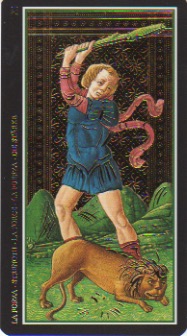
    Visconti Sforza – 1451

    Hercules giving the Ebil Nemean lion a jolly good thrashing.
    Pretty danged violent to our contemporary eyes, isn’t it? 
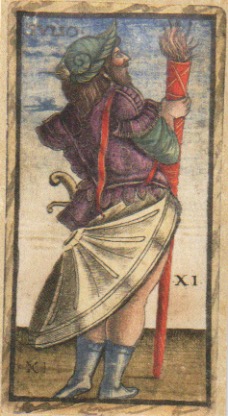
    The Sola Busca Tarot – 1491

    A completely different viewpoint from a completely unique deck.
     This is Tulio, meditating on the night

    Don’t mix up card VIII which shows a child being dismembered over a fire by Nero – that’s Justice, not Strength!


    This is a deck crammed with alchemical symbolism 🙂

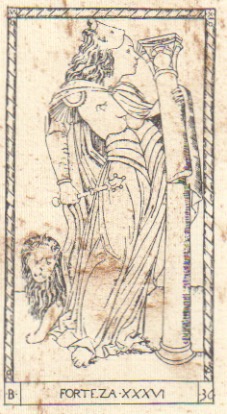
    Tarot del Mantegna – 1470(ll Meneghello version)


    A woman holds a club and wears a lion’s mask.
    There is also a lion behind her and a broken column.
    The broken column is traditionally the symbol for Forteza.


    BTW – this deck doesn’t actually have anything to do with Mantegna 🙂

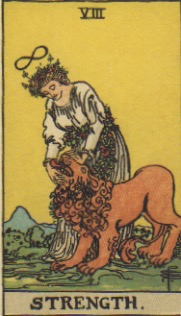
    The Rider Waite Smith – 1909

    The combination of lion, woman and physicality that we strongly associate with this card makes an appearance.

    Tarot Sophistique – 2014

    A contemporary version of a Marseille Tarot image 
    Woman and Lion
    we can see the nascent leminscate of the RWS in the circle of her hat.

    Strength earned her place in the Tarot deck by dint of being one of the four Cardinal Virtues: Fortitude.

    The other virtues are Prudence (The High Priestess), Temperance and Justice (represented by, erm, Temperance and Justice).

    I like the virtue of Fortitude being part of the Tarot deck.  But Fortitude and Strength have slightly differing meanings:

    Fortitude means courage in
    pain or adversary.
    Strength means:
    a) the
    quality or state of being physically strong
    b) the capacity of an
    object or substance to withstand great force or pressure
    The subtle difference is that Fortitude brings a moral strength, a valour (indeed a Virtue!) to the heart of the card, which Strength alone does not.
    And there endeth the Lesson on Strength!
    Hope you’re ready to hop onwards to the next card?
  • Page of Swords | The Tarot of Mr Punch | Doug Thornsjo

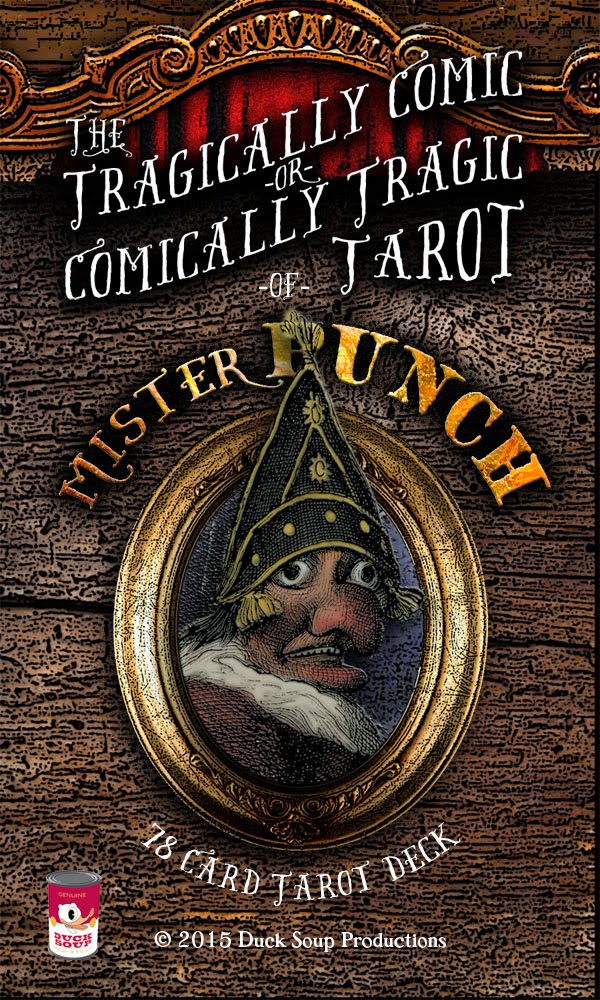
    Sometimes you see a project and it’s just such a perfect storm that you wonder why it was never done before! That’s how I felt when Doug Thornsjo (Tarot of the Zirkus Magis, Tarot Lombardi Dannegiatto etc) began sharing images from his Tarot of Mr Punch: The rambunctious personality of Mr Punch will make a great ‘no punches pulled’ *groan – sorry, that was awful!* tarot deck.


    I asked Doug if he could answer some questions about his new deck and woohoo!!!! HE SAID YES!!

    Me: So, tell me how you got interested in creating Tarot decks?
    Doug: This is going to sound like a flip answer, but I don’t mean it that way: it’s just human nature that you’re going to want to do whatever it is you like. If you like reading books, you’re going to want to write a novel. If you like watching sports (although personally I can’t imagine a worse waste of a person’s life), you’re going to want to play. Tarot is one of the things that I’ve always liked, so from the beginning I always wanted to make my own. The cosmic axis simply did not come into alignment for this to happen until a couple of years ago.

    Me: You’ve created a few decks so far, The Tarot of Mr Punch is the deck that we are looking at specifically today.  

    I am intrigued to learn that the roots of Mr Punch stretch back to the 16th century Italian Commedia del Arte figures – Pulcinella. 

    Doug: Yes, Mister Punch and the Tarot go back a long way together! I’m just lucky no one thought of the connection before!

    Me: This Pulcinella figure was a comic figure who could say quite outrageous things – like the court jester …. but by the time the puppet shows that we are more familiar with came along, he had morphed into a modern day Homer Simpson character – a bit of a buffoon who can do quite violent things?
    Doug: I wouldn’t compare him to Homer Simpson (who is a dolt) and I wouldn’t call him a buffoon. Mister Punch is very, very smart. Not a nice man, it must be said, but smart. Smarter than you or me or anyone. The court jester can get away with telling the truth because he’s clever about it. Mister Punch out-smarts everyone: the police, the judges, the hangman, even Death and The Devil themselves. He always wins — always — because he is the smartest one in the room. He’s also Quite a Mean Old Bastard, who makes no distinction between hitting you with a club (or wand!) and hitting you with words.
    *** just as an aside – why does Mr Punch always look the same – hooked nose and chin? ***
    Doug: Also a hump back. Don’t forget that! He’s a very well-established character and when something works you don’t mess with it. When Punch appears on the stage he needs to be instantly recognisable. Again, it sounds like a flip answer, but if you changed his appearance he simply wouldn’t be Punch. 
    Maybe this has something to do with it and maybe this has nothing to do with it, but in profile, his head and face look exactly like a lobster’s claw. It’s a great design for a mean old bastard, because it’s harsh and pinchy and bitey. 
    Me: What was it about Mr Punch that made you think – this would make a great Tarot deck?
    Doug: See above: they both go way back, have similar origins, and have evolved together over the years. More than that, both Punch & Judy shows and the Tarot deal with the Big Issues of life in a compressed and even detached form. Relationships, family, legal issues, emotions, Life and even Death itself. All the Big Issues of Life that we struggle with, he’s been there and done that. The fact that, as we know him now, he is essentially a Victorian figure — that didn’t hurt, either. His age gives him weight and authority and style, too. 
    The creator/editors of PUNCH magazine realized that he would make a good mascot because a) he’s a snarky little fellow and b) he’s seen and done it all, and is capable of giving any kind of authority figure a damn good spanking. And that includes Supernatural Beings and Deities of all sorts.

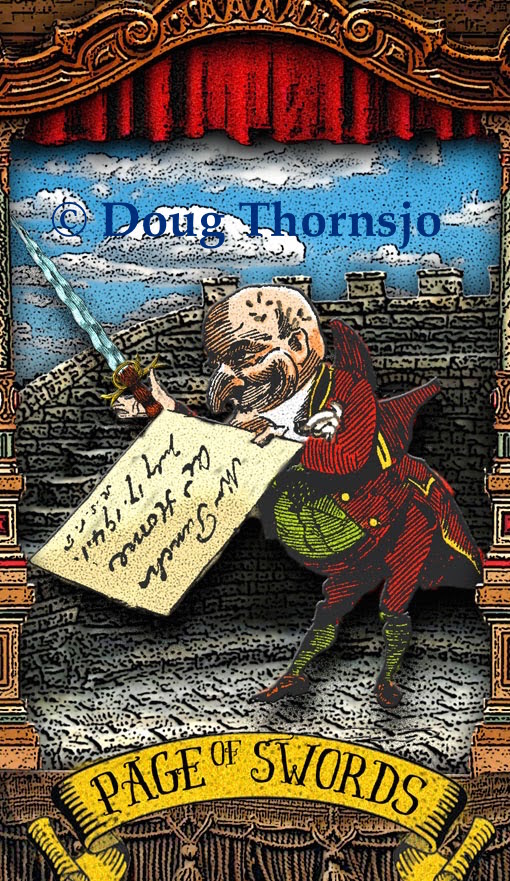
    Me:  The Page of Swords is the card that we are taking a look at specifically today. Tell me about the image – what was your source material, how did you transform it into the Tarot card?
    Doug: The figure is taken from what they call a “spot illustration” — not a full cartoon — from the pages of PUNCH magazine, circa 1880s-90s. I coloured him, put an especially twisty sword into his hand, and then because the suit of swords needs air and clouds, I set him on the battlements of a model castle that I “artified.” The first version I did had him inside a castle setting, and that didn’t work for me. With swords you have to have air, sky and clouds. 
    Me: Tell me about the structure of the deck itself – are we talking RWSy, Thothy, Marseille-y influences?
    Doug: Not so much Thoth this time, except for maybe two or three cards. I will say that with any deck I work on, I do not confine myself to one (or any) particular school of symbolism. This appears to annoy some people who want their decks to be ALL RWS or ALL Thoth or Marseilles. I may start with a certain school of symbolism, but I like to mix it up and I’m always working towards doing things my own way. I haven’t completely succeeded at that with any tarot deck I’ve done so far. The closest I’ve come to succeeding is with my Marvelous Oracle of Oz.
    Me: Are there any surprises in your Majors? Anything renamed?
    Doug: Not really. I do have “Art” in place of Temperance, with symbolism that’s neither particularly Thoth or RWS, and I do have “The Aeon” in place of Judgement Day, featuring a cartoon from Punch magazine that just practically reeks of Thoth symbolism. I probably will never create a Tarot deck with a conventional Judgement Day card in it, since it’s a specific kind of Christian symbol that I don’t agree with and can’t abide. No, Ladies and Gentlemen, when you die you are NOT going to grow wings and fly up and sit in the clouds with the angels, thank you very much.
    Me: In the Minors, is the structure traditional – Ace to 10 and four courts? 
    Doug: Yes; although personally, I tend to stack the Court Cards all together, separate from all the pips. I stack all my decks up with the courts following the majors King to Page in each suit, and then the pips one to ten in each suit, so that the ten of pentacles is always the last card in the deck. That’s the way the deck comes packaged. I think — although I won’t swear to it — that this reflects a Thoth bias. 
    Me: That’s interesting – Why do you put them there? Do you see the Courts as filters or an interface for all that Major Arcana energy by putting them between the Majors (archetypal energy) and the Minors (individual effort)?

    Doug: I’m smiling as I type this, but I don’t see all those Kings and Queens and Princesses and Knights and Princes consorting with the peasantry or the riff-raff. They want to hang out with their own kind. 
    And I do see them as being separate — they’re read differently than either the majors or minors. They do act as a filter between the two. When I bought my Thoth deck, it came stacked up like this, and I thought “if it’s good enough for crazy Uncle Aleister, it’s good enough for me…” In TAROT FOR YOURSELF, Mary Smith (if I remember correctly), stacks them separately but puts them at the end. 

    What are your Court card ranks in the deck?
    King, Queen, Knight, Page.
    Me:  For those who are not very familiar with the Thoth deck, In the Thoth, the Court Cards are Princess, Prince, Queen and Knight … with the Princess associated with traditional Page energies, The Prince with Knightly energies, The Queen with, erm, the Queen and the dashing Knight replacing the old King.   So the Knight in the Thoth is the Young King.  

    Doug: Ally’s Knights are more virile aspects of the King, it seems. This raises another issue for me: why is the pagan female deity represented at all stages of her development (maiden, maturity and crone), but the pagan male god is ONLY ever represented as being young and virile and full of himself? Mister Horney God. I personally can’t respect that image and wonder why he’s never presented as being older and wiser and someone who thinks with the head on his shoulders, not the one between his legs. But I digress… 🙂

    Me: How do you see your Knights’ role in the Tarot of Mr Punch – is he more Kingly (like in the Thoth) or is he the young explorer of the RWS? 

    So, yeah, my court cards are more RWS than Thoth. My Kings are accomplished, older men and the Knights are dashing young squires. In the Punch deck the Knight of Wands is so young that he’s riding on a wooden hobby-horse!
    Me: What are your suits in the deck? 
    Doug: Wands, Cups, Swords, Pentacles — although the latter are represented visually as coins.
    Me: Are the pips fully-illustrated or pips? 
    Doug:  Now, this is interesting! When I started out, this was just going to be a Marseilles-style deck with plain ol’ pip cards. As I got into it, I found for several reasons that I wanted and needed to create illustrated minors. I did the Cups first, in my first mind-set, and so they are the most pip-ish cards in the deck. But I kept sticking Punch into them in ways that were illustrative. So by the time I started the next suit, which was wands, it suddenly turned into full-on illustrated minors. So the end result is a little bit schizophrenic.
    Me: Which is the last card in the deck, for you?  10 Pentacles? 

    Doug: Yes, the ten. It makes sense to me that Legacy, Fulfillment, Promise for the future should be the last card, and as most decks arrange their ten coins in a Tree of Life pattern, that’s a perfect symbol to end on. From a writer’s point of view, if there’s a single card in the deck that says “The End,” it’s the ten of pents.

    Me: Which card in the deck was the most fun to make?
    Doug: I can’t really think of any one card that stands out: a LOT of them were fun to make — but the thing that makes a design fun is when everything — your ideas and your base materials and the execution — just all slide together and dovetail as if the final design was simply meant to be. There were a number of cards in the deck like that, and it’s always a delight when you get that pleasant surprise of everything coming together just naturally and perfectly.
    Me: Which card did you struggle most with to get just perfect?
    Doug: In the Majors — “The Lovers” was Quite a Bastard. In the Minors, the two of Pentacles went out of its way to annoy me. As a rule, though, the hardest part is finding the right base image, the one that says what you want it to say the way it ought to be said. That was easily the most time-consuming part of this deck’s process. 
    Me: Are there any particular colour themes in your suits – are your Wands particularly orange or red, for example? 
    Doug:  Nnnnnn-ot really. The wands are more woody than fiery. The swords are appropriately airy. But the cards all have a puppet-theatre proscenium surrounding them, so colour-wise they’re really more brown than anything else. That ought to make them popular with the Steampunk crowd….
    Me: Have you incorporated any other system into your deck – for example, astrology?


    Doug: Astrology and numerology are beyond me. However


    … if the language of theatre is a system, then yes: the whole conceit behind the deck is theatrical. There’s a precedent for this, Marcus Katz and Tali Goodwin have their book out now exploring theatrical connections in Pamela Colman Smith’s work, and I think he’s got another project coming that takes another step in that direction, stemming from Pamela’s personal use of toy theatres. 

    Being specifically derived from puppet plays, this deck takes several steps in that direction, and I have another project in mind that will push it still further. So — The Language of Theatre: not abstract symbology but staged Drama, “All the World’s a Play” — Enter The Devil Stage Right. The Emperor comes downstage and speaks sotto voce directly to the audience, breaking through the Fourth Wall. I’m deeply steeped in theatre myself, my first novel Persephone’s Torch has a theatrical setting and is itself theatrical in structure. if encouraging people to think outside of themselves and objectify their lives and issues (and the cards) as players on a stage… if that can be considered a system, than that’s the system I used….
    If you would like to see a bit more of The Tarot of Mr Punch or buy a copy please visit Doug’s site for the deck.
    See Doug Thornjo’s entire creative oeuvre  at www.ducksoup.me
    You can also find Doug on facebook: