Year: 2015

  • Holiday to Italy! The Tarot Pages

    I cannot believe that my long-anticipated holiday to Italy with Arnell Ando’s Tarot Tour will begin this weekend!

    It has been booked for about 8 months and suddenly IT IS HERE!

    On Saturday I will fly from Glasgow to Heathrow and spend the night at the Heathrow Thistle Hotel.  Not that I’ll be able to sleep much – too excited for that!

    Then on Sunday morning, I and Caitlín Matthews rendez-vous in Departures and fly out to Milan together!

    I hope she’s able to cope with my nervous excitement – I’ve not been abroad since 1997!!  Unless you could the Isle of Man a couple of years ago.  And I don’t!

    Once safely landed in Milan, we take the train to Milan central and hop over to our hotel (which is near to where the train station).

    We check in and hopefully meet up with some of the others.  Perhaps factor in a bit of exploring … maybe an ice-cream.  Well, it’s ITALY, isn’t it? And then we ALL get together for a pizza dinner at a nearby restaurant.

    And then what will we do?

    Gosh where to begin?! 14 days of Tarot-orientated history, surrounded by like-minded people, visiting the Sola Busca Tarot in the Brera… and tons more!

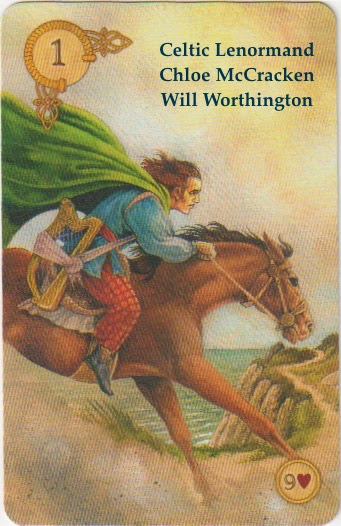
    I illustrate this post with the Rider card from the beautiful Celtic Lenormand by Chloe McCracken and Will Worthington to capture my excitement about the journey and the whole holiday shebang!

    In my heart I will be carrying the Tarot’s Pages – eager to travel, eager to learn, eager to make new friendships and eager for new experiences!

  • Poldark | King of Hearts?

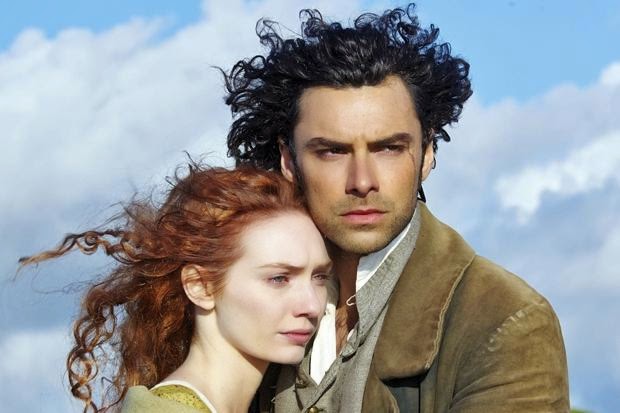
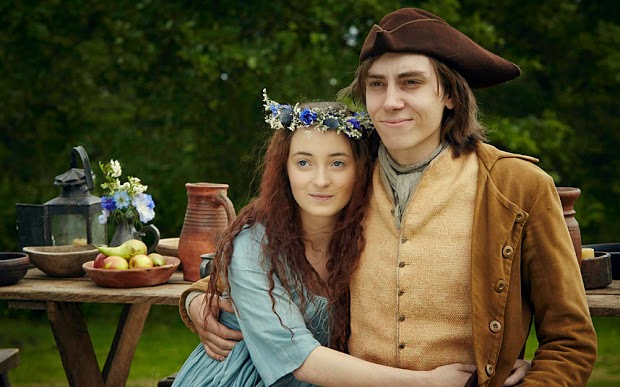
    Ross and Demelza

    Well, he’s exceptionally easy on the eye, isn’t he?  In case you have been living under a rock (or in America *waves to the cousins over the pond*) let me bring you up to speed:

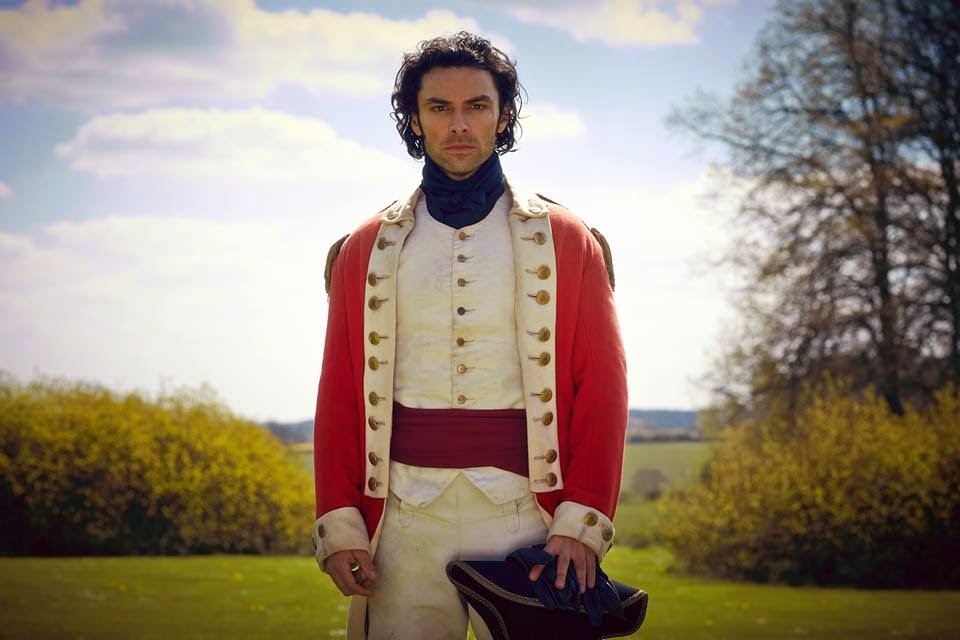
    The 1970s BBC TV drama series, Poldark, has been remade with the smouldering Aiden Turner as the eponymous hero.  Captain Poldark returns from the American Civil War after an absence of 3 years with an amazing scar and Elizabeth, his beloved, on his mind.

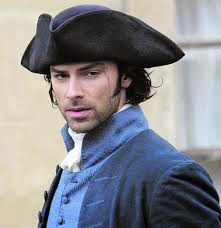
    Here he is in uniform.  You are welcome.

    He is no sooner plonked in a chair at his uncle’s house (the man hasn’t even stopped to have a wash or shave – which makes him even more touselled and utterly divine) when he discovers that Elizabeth is now set to marry drippy cousin Francis. Well, he had been gone for a LONG time and the poor girl thought he was dead.

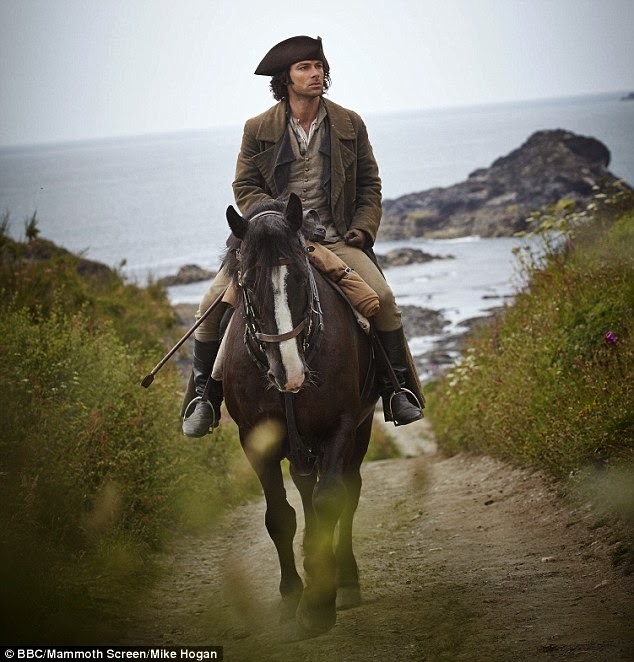
    In Poldark, there is much in the way of galloping over the Cornish clifftops – dark hair streaming behind him, his (frankly) GODLIKE visage darker and stormier than a night at sea.  Chuck Heathcliff and Mr Rochester into a blender and flick the switch: you would pour out Captain Ross Poldark…

    Here he is again.  Because: I don’t need a reason.

    If the characters are not galloping across storm-tossed clifftops, then they are standing looking out to sea (waiting for the herring).

    He rescues a boy from a beating in Truro and discovers that when out of the baggy trews and unbecoming hat she is actually a 18th century version of Lily Cole – fiery of hair, blue of eyes and winsome of smile. Only with a flatter chest.

    Poldark sees the suffering of the ordinary man in the field.  Or mine.  And resolves to make things better.  He re-opens Wheel Leisure (The Wheel of Fortune if there ever was one!) and gets his people back to work, but looking for copper, not tin.

    And on Sunday, Demelza pulled on a lovely frock that just happened to make her hair even more fiery and her eyes even more like sea-glass and poor old Ross could not resist.

    A quick roll on the bolsters and lo! They are married.

    So, which court card is Ross Poldark?

    Well, he’s several of them, actually – just as you would expect of a multi-layered and realistic (albeit stunningly, wolfishly handsome) character.

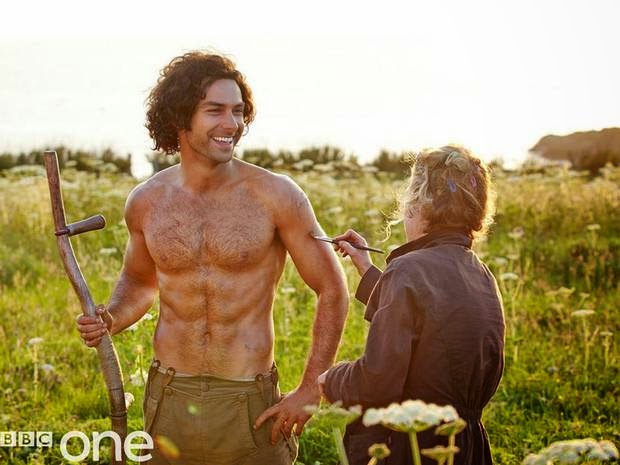
    ‘Parently he wasn’t happy when the BBC released this image of him topless.
    I’m not complaining ….

    In his treatment of his tenants and the poor, he is generous and sympathetic – handing out jobs and houses.  In caring about people and SHOWING he cares about people, he is the King of Cups.

    Grateful tenants getting married.
    Ends up in pokey for 2 years for not listening to Cap’n Poldark’s anti-poaching advice.

    His heart still beats faster for the Elizabeth and her billowing pillow lips, but he also beds the innocent Demelza (oh don’t worry, she’s as keen as mustard to do it).  And then marries her.

    He has loved Elizabeth for years – and I’d associate that steadiness with the suit of Pentacles.  But he is fairly quickly smitten with Demelza and marries her in the space of about 3 minutes.  That’s rash and impulsive action and that’s Knightly.  So I’m going to go with the Knight of Wands for this one (edit:  I had originally written Pentacles in error! Put it down to my Poldarkian excitement! Thanks to Viv for the heads up!)

    He reopens the Wheal Leisure mine – he uses his Swords logic and communication skills to persuade men to invest in his new venture – mining copper instead of tin.  King of Swords, I think for that one.  Or, because it is a new and untested venture, is the Page of Wands more appropriate?

    And when the mine is open, he can be found every day, deep in the mine, working alongside his men, leading by example …..working in his white shirt, delightfully sweaty and hands-on with honest toil.   For me that’s Pentacle energy!

    He’s a marvellous mixture of traits – as REAL people are.

    Demelza to follow…. 😀

    So, even if you haven’t seen this series, but know the Robin Ellis series, chip in with your observations of the lovely Captain!

    All men should immediately return to wearing long hair and tricorns….
    Frock coats also welcome 🙂

  • The Tarot Masters | Editor: Kim Arnold

    I was very fortunate to be invited as a speaker at Kim Arnold’s UK Tarot Conference in London a couple of years back.

    I spoke about how to interpret Court Cards – which won’t surprise you, I’m sure!

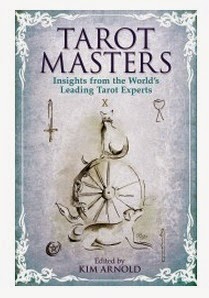
    Kim invited all those Tarot speakers from her previous Conferences, such as Rachel Pollack, Mary K Greer, Caitlin Matthews, Ciro Marchetti, Carrie Paris, Alfred Douglas … and *cough* me to write an essay on a Tarot Major Arcana card and then compiled them into a book which has now been published by Hay House.

    Tarot Masters wrote this.
    What I’m doing in amongst them, no-one knows….

    It’s not a ‘reference’ book, but gives you some nice insights into lots of Tarot authors, how they got started on their journey and their opinions on their chosen Tarot Major.

    You can purchase the book direct from Amazon by clicking on

    The Tarot Masters: Insights From the World’s Leading Tarot Experts

    In the interests of transparency, please note that if you purchase using this link, I receive a small shekel from Amazon.

    *holds cap out plaintively* got a shekel for an ex-leper? *spurious Monty Python reference*

  • Tarot Knights | Musketeers

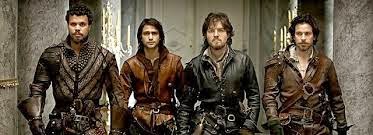
    For the past 6 weeks, Friday nights have been dominated by my obsessive need to watch the swash-buckling gorgeousness that is The Musketeers on BBC1.  Who better to illustrate the fast-moving antics of the Tarot’s Knights?

    Athos, Porthos, D'Artagnan, Aramis - the Tarot's court card knights

    The incredibly handsome cast of Muskys have been a delight to watch as they struggled with the evil Rochefort as he plays the spineless French King against his Queen like the consummate player (and Spanish spy!) that he is.

    The second series drew to a close on Friday (what do you mean, you haven’t watched Series 1?!) and I await news of a third series with bated breath.

    So, let’s take a look at just which Musky equates to which Tarot Knight!

    require([“mojo/signup-forms/Loader”], function(L) { L.start({“baseUrl”:”mc.us2.list-manage.com”,”uuid”:”a1532eabd65d034238367b6cc”,”lid”:”d3826d02b7″}) })


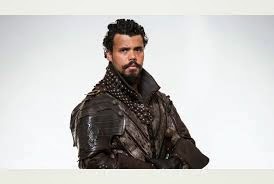
    Porthos – The Knight of Pentacles

    Howard Charles | Porthos | BBC Musketeers | Tarot Court Card | Knight of Pentacles
    Porthos – The Knight of Pentacles

    The most physically strong of the Musketeers, Porthos is also the most exotic-looking.  Offspring of a North African servant mother and a French Aristo father, actor Howard Charles, is the embodiment of the dependable, powerful and resiliant Porthos.

    Poor Porthos doesn’t get much in the way of romantic story-lines, but he’s the strength and backbone of the Musketeers – carousing and punching his way through the series!

    What does the Knight of Pentacles mean? 

    The Knight of Pentacles is slow to rouse to passion, but when his blood is up, he is determined and focussed.  He will not be easily put off or distracted, but could, unfortunately, be mistaken for the most boring of the Musketeers.  Ladies, wise-up.

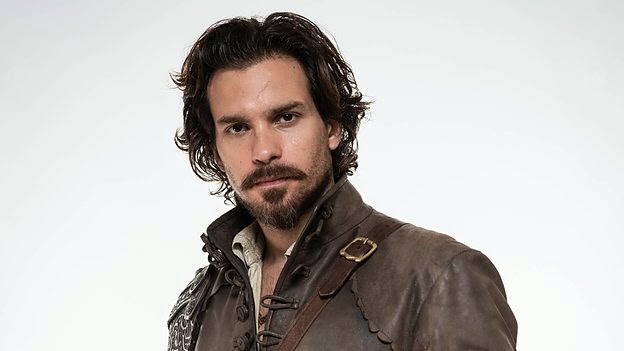
    Aramis – The Knight of Cups

    Aramis | Knight of Cups | Musketeers | BBC | Santiago Cabrera
    Aramis – The Knight of Cups

    Aramis is the romantic one.  After falling in love with the Queen and their eventual encounter in the Convent, Aramis becomes her Knight in Shining Armour.

    Aramis’s love for the Queen is very much an idealised romantic union – she is utterly unobtainable and he loves her from afar.  She is on a pedestal – would he be able to love her with such a pure heart if he had to visit the loo after her every morning?

    At the end of this series he devotes himself to God and goes off to become a Monk.  He IS our Knight of Cups.

    The BBC cast Santiago Cabrera as Lancelot in their Merlin series a few years back.  What can I say, the boy’s got IT?!

    What does the Knight of Cups mean?

    The Knight of Cups is a dreamer and a romantic.  He has a loving heart and the soul of a poet.  Prone to idealising the object of his affections, he is in love with the idea of love and might not have the cojones to knuckle down when things get tough.

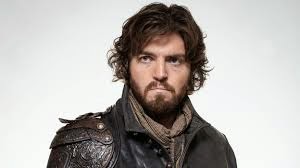
    Athos – Knight of Swords

    Athos | Tarot Court Card | Knight of Swords | BBC | Musketeers | Tom Burke
    Athos – The Knight of Swords

    Let’s just pause here for a moment, shall we?

    *sighs wistfully at Tom Burke and wipes drool from mouth*

    Athos is our tortured Knight of Swords.  Wounded by the ‘betrayal’ of his wife, Athos keeps his heart to himself (because, his gloriously wicked wife, Milday De Winter actually still has it).  Thoughtful, brooding, stealing EVERY scene that he’s in, Athos is the righteously intense Knight of Swords.

    What does the Knight of Swords mean?

    This Knight in particular lives inside his head and can fall prey to whatever demons lurk inside his head.  Fast-moving and whip-sharp, the Knight of Swords relies on his brain-power to tell him what to do and doesn’t trust the truth of his emotions.

    D’Artagnan – The Knight of Wands

    D'Artagnan | Tarot Court Card | Knight of Wands
    D’Artagnan – The Knight of Wands

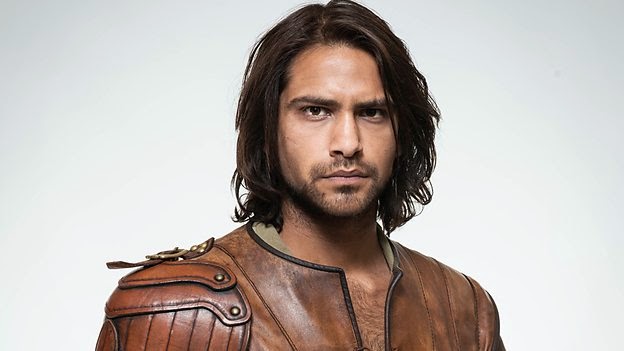
    Ah, and here he is – always the favourite Musketeer – D’Artagnan. Younger than his companions, he is impulsive and fiery.  In Series One, he constantly tries to become a Musketeer. Athos et al regard him as a younger brother who causes much tutting and head-shaking by the others, before he is bailed out and dusted down for his next exploit.  Keen as mustard, passionate and generous of spirit, D’Artagnan is played by Luke Pasquelino with glorious elan.

    What does the Knight of Wands mean?

    The fastest-moving of the Knights, The Knight of Wands burns brightly, but not for long!  His passions are quick to rise, but he lacks the resolve of the Pentacles, the emotions of the Cups, and the clarity of the Swords.  This is the guy who will promise you the moon to get what he wants and as soon as you have surrendered and been thoroughly ”explored’, he will move on to the next challenge.

    When called upon to describe what the Tarot knights are like as people, you could do a lot worse than remember the Four Musketeers!

    …I DID mention that the were a GREAT-looking cast, didn’t I? Well the women in the cast are equally unforgettable.  Constance, Milady De Winter and The Queen – they will be in a later post!

    Now, saddle me up your finest stallion, we have a war to wage against Spain!

    “All for one ……”

  • King of Pentacles | Google’s mobile friendly algorithm change

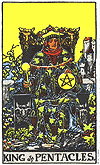
    King of Pentacles | Rider Waite Smith Tarot | US Games Systems

    I’ve heard from a couple of colleagues now that Google is changing their algorithm to weight in favour of mobile friendly sites.  That clearly also affects Tarot sites, so, with both my web-design hat and my Tarot hats perched precariously on my head, I am impersonating the King of Pentacles.

    Here are a couple of things you might want to take a look at before you pay your webmaster any more money:

    First, run all urls for your website through google’s own mobile-friendly checker:

    https://www.google.com/webmasters/tools/mobile-friendly/

    If computer says ‘yes’ then you are good to go!

    If your site is hosted on blogger or wordpress, it is easy to get a mobile version.  I’m on Blogger and all you have to do is go to ‘template’ and there you will find an option to create a mobile-friendly version.  If you’ve customised your blogger site a bit, then pick ‘customise’ version and you will at least get your header.

    If computer says ‘no’ then there are some components that your site is failing on.

    Check out this guide: https://developers.google.com/webmasters/mobile-sites/mobile-seo/common-mistakes/

    Google is NOT stopping listing non-mobile-friendly sites, but those who ARE mobile-friendly will score higher on their algorithm.

    require([“mojo/signup-forms/Loader”], function(L) { L.start({“baseUrl”:”mc.us2.list-manage.com”,”uuid”:”a1532eabd65d034238367b6cc”,”lid”:”d3826d02b7″}) })

    Normal Tarot service will be resumed directly  🙂

  • Kickstarter | Locus Tarot

    Locus Tarot | Mike Stop Continues

    I am sometimes contacted by people who are trying to raise awareness for their Tarot Kickstarter projects and, mostly, I don’t get involved.  However, the Locus Tarot which went live on 5 March piqued my interest and I wanted to find out more.

    Locus is an 80-card deck that is SO stripped back that if it took anything else off, it would be on a public indecency charge!


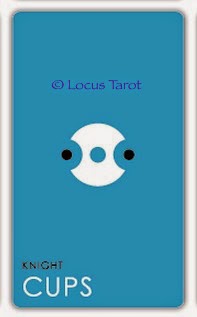
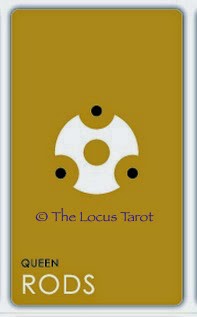
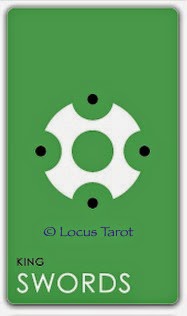
    I was about to lead-off my look at the Locus Tarot by saying that this deck has unillustrated pips… but truthfully the Majors and Courts are just as ‘unillustrated’ as the pips, relying on arrangements of variously coloured circles – or cut-away circles – and dots on either coloured backgrounds (Minors and Courts) or a black background (Majors).

    I asked the deck’s creator, Mike Stop Continues (real name – I asked lol!) to guide me through it – with special emphasis on the Court Cards, of course!

    Can you explain, briefly, why you have gone for such a stripped back and minimalist look for your deck?

    Sure! The idea came about after a few years of learning the tarot. I began to feel that for all the variety of decks out there, the true nature of the cards were forever out of reach. I came to realise that each card is a sliver-of-infinity, countless possible interpretations contained within, but that an illustration could only depict a single variation. We do our best to remain malleable as readers, but seeing the same images time and again entrains the mind to see things just one way. Besides, if the Eight of Cups doesn’t always indicate a sea journey, why on earth should it depict one?
    I realised I was looking for a deck without representational art. I wanted a deck that would point to the forces at work, rather than aim to illustrate one variation. No longer would the cards mislead a reader’s intuition, instead taking the role of The Hierophant, who does not lead, yet points the way.
    No such deck existed, so I had to make it myself.
    What sort of reader is your deck aimed at – beginners or experienced readers?
    I like to think the deck is ideal for beginners, masters, and non-readers alike.
    Beginners will find in the Locus all the great forces of the tarot without the hurdle of learning the meaning of 78 cards. Rather, the beginner can learn just the primary rules (depicted in the patterns of each card) and read them with ease.
    Masters will find the Locus to be a fresh perspective on their craft and a very useful lens through which to see the world. I believe the diversity of tarot is one of its greatest strengths, and I do not seek to replace tradition reading style, but to join with it in the support of something greater.
    Finally, I think the deck great for non-readers who for whatever reason lack the interest in traditional tarot, yet might find the Locus to be a consistent, modern tool for self-discovery, creative exploration, or free association. Perhaps it’s the perfect gateway into the world of the arcane.
    The suits are named, Stones, Cups, Rods and Swords and they are colour-coded, but not necessarily the colours that people would associate with those suits – green for Swords, for example.  Why did you select the colour/suit matches that you did?

    I was originally working with a more traditional colour palette bent towards the seasons. The colours were fantastic, textured pastels—olive, ochre, mauve, and steel. In some other context, they would have been marvellous, but for the purposes of this deck, they left me feeling trapped. I worked for months tweaking these colours and finally threw them all out. They just didn’t work.

    But in their place, I found red, blue, yellow, and green. Red for the root chakra and the needs of the physical body, blue for the throat chakra and our communion within ourselves and social groups, yellow for the solar plexus at the seat of our power, and green for the heart-mind at our meditative centre. Put differently—red for the clay of the earth, blue for the waters of the sea, yellow for the fires of the sun, and green for the wind through the grass and the trees.
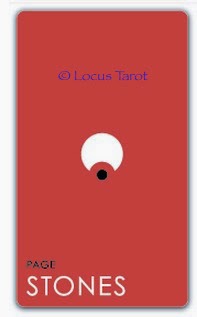
    Page of Stones | Locus Tarot | Mike Stop ContinuesLet’s take a look at your Courts.  Other than the colour coding, the images are the same for each rank, ie the Page of Stones is the same image as the other three pages, but in red. I know that the titles are on the cards, but won’t this make things difficult for readers to interpret?

    Keeping in mind my goal was not to represent, but to signify, I think it actually makes it easier for the reader to interpret.

    Rather than depicting one house as fair and one house as dark, and rather than positioning otherwise vital personages in but one symbolic portrait, I chose instead to point to the fact that truly, all Pages share a Pageness, just as all of house Stone share a general Stoniness.

    I believe that suggesting anything further about any of the Royalty is misleading. To me, the Royalty each embody a cluster of personality traits, these traits sometimes arising in a man, sometimes in a woman, and sometimes simply surfacing within ourselves. Since so much of others’ character is a matter of our own projection, we must often look within for the persona we truly engage with in the presence of a court card.

    I agree that all Pages share qualities and all members of the same household share qualities.  I also agree that each court embodies a cluster of personality trait – in either man or woman.  But I believe this regardless of what deck I’m using – does there need to be a deck where these methods of interpretation need to be built in to the card images? Will the Locus Tarot cards not INCREASE the amount of projection that takes place, because there is so little imagery for a Tarotist to work with? 

    require([“mojo/signup-forms/Loader”], function(L) { L.start({“baseUrl”:”mc.us2.list-manage.com”,”uuid”:”a1532eabd65d034238367b6cc”,”lid”:”d3826d02b7″}) })

    Such a great question! There are some tools, like Astrology, that try to take the reader out of the picture. These tools approach divination more as a science than an art. I do fully believe that science will ultimately reveal what about the universe makes divination work, though I feel all divinatory tools we currently possess draw their strength from the years of evolution that have made human beings so receptive to the world around us. We are genetically tuned to divine much better than any technology we’ve yet developed.
    This is why I feel it’s so important the Locus strip away even imagery. If Astrology is divination as science, then the Tarot, and the Locus more than any deck I’ve seen, is divination as art. The more we peel away, the more we reveal. Projection is only the reverse of intuition, and while the danger of projection is just as strong regardless of what deck one uses, I feel we stand to gain even greater rewards for giving intuition full reign.
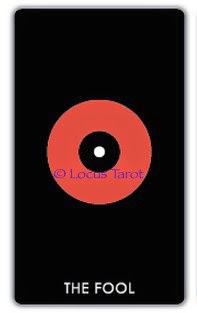
    Another example is in the Major Arcana where cards such as The Fool, Justice, Temperance and Judgment are all shown as concentric circles – just with different coloured outer rings. Why are there groups of four cards depicted this way?

    In removing the numbers from the Major Arcana, I began to see them as the intersection of elements in varying arrangement. The 24 cards are split into four elemental groups. Within each group, there is one card influenced by each of the four elements. The Chariot, for example, is water influenced by fire.
    That leaves two cards within each of the four elemental groups. One set of four depict elements in full engagement with the other forces of the world, which I often call extroversions. Another set of four—The Fool, Justice, Temperance, and Judgment—represent the elements acting without impulse within themselves. This group, I call introversions.
    The extroversions each represent the method through which they grant access to the world and the powers with which they engage it. The introversions, at the opposite side of the spectrum, represent the center from which that element acts, and the inherent balance present within that elemental force. The Fool offers innocence and curiosity from which one would embark on the physical world, Justice offers balance and inevitability to broach the emotional world, Temperance offers experience and composure from which to act, and Judgment offers experience and renewal to those engaging in the intellectual and spiritual exploration.
    For the same reason that the court cards have similar patterns with differing colouring, so too do the Majors. The introversions each feature a disc of their primary element with a white dot symbolizing stability at their centre. In all majors that white dot appears, one can expect a force un-inclined to reach.
    This question also points to another difference in reading the Locus. Removing the illustrations is not merely a surface change. The goal is for the Locus reader instead to interpret the intersections of these forces differently depending on the context. Truly, the names of all the cards remain only as a guide.
    Where I to interpret, say, Temperance in a reading, I would not immediately go to the traditional notion of a stable centre from which to act or to refrain from action. I would read the force as the undiluted core of fire. Were this drawn in a spread about a new relationship, I might interpret this card to suggest their passion was secure, or that so long as the pressure was maintained, the new challenges would not be their undoing. These interpretations would vary based on the situation as I knew it to be. In a reading about a business venture, I might read the card to suggest the momentum of the current initiative will persist from beginning to end, or perhaps that the actions required for a successful conclusion are ultimately the responsibility of the querant himself.
    Sounds really interesting – but quite tricky to pull-off convincingly.  While many Tarotists use elements whilst working with the cards, I think they form an additional layer that a Tarotist could incorporate or omit (like astrological associations) but your deck uses them as the absolute foundation for interpreting the cards – does your accompanying book explain how to interpret expressions like ‘undiluted core of fire’ in sample situations? 
    It most definitely does! Ultimately, the system is much easier to apply than it sounds. Most aspects are concepts readers are already incredibly familiar with. The booklet delves into the concepts (20 in all—10 numbers, 4 elements, positive/negative, macrocosm/microcosm, inner/outer), then explores how to combine them in each Arcana, then goes into contextualizing their meaning in spreads, and finally offers a card-by-card interpretation with regards to a few different topics.
    The Courts tend to represent either the querant (or someone known to them) or energies around the situation in question, do your Courts represent the same?
    In the Locus Tarot, the court cards can always represent an internal aspect of one’s self, or someone on the outside. Any court station can be of any gender. Their names are retained entirely for reference.
    Looking at your Knight cards, I feel that the two poles that the Knights veer between are depicted and I like how the image looks a bit like an axe head (probably not the sort of interpretation that you envisaged lol!), but how one distinguish the characteristics of the Knight of Cups from the Knight of Swords?
    An axe head! Fantastic! I see it more as a shield myself, but I think of that card like psychology’s picture of the rabbit and the duck. Some people see it one way and some the other. Given a long enough timeline, I suppose we might shift back and forth over which one we see more readily.
    In the case of the Knights, I consider the only relevant distinction between them to be the element of their house. They are otherwise similar in their knighthood. After all, all kinds of people find themselves to be lovers or champions, even if they go about such activities in completely different ways. The difference, most importantly, is the context of the reading.
    Yes, I can totally see that, Mike 🙂

    But if I’m reading this as an axe-head or a shield – am I not defeating the purpose of you stripping out the imagery in the first place? 
    Valid argument, and one I deliberated over for a long time, but these signs felt right to me, and so I stuck with them, though not because of how they might be interpreted representationally, but for how they evolve from station to station.
    The images do suggest a Page’s helmet, and Knight’s shield, a Queen’s breastplate, and a King’s round table, each offering the increasing stability of their stations, but the relationship between these images is more important. If you take a look, you’ll notice that each symbol contains all of the elements of the previous symbol, only adding to it, just as one accumulates experience with the increasing stability of age. I prefer this perspective of the symbols, perhaps more so for the representationalism my unconscious managed to slip through.

    That’s interesting! why would the Pages have a helmet, the Queen a breastplate and the King a round table.  For example – the Queens are not particularly warlike in their interpretations.  If anything I see them more as the Tarot’s guardians – perhaps better suited to a shield 😀

    I think about it this way. The Pages’ internal motivation is governed by air, their thoughts, and so they protect their head. The Knights are motivated by fire, their potency, and so protect their hands. The Queens are motivated by water, and must protect the heart of their houses with a breastplate. The Kings, motivated by earth, rule with wisdom, and protect the stability of their house at the round table.

    Are there any astrological associations that you would want coupled with your Court cards.  The King of Swords is, traditionally, associated with Fixed Air and Aquarius.
    My primary aim for the Locus Tarot was to offer readers and actionable model of the world with the kind of beautiful congruence I sense in the universe itself. Just as with the Kabbalah, and just as with numerology in the Major Arcana, I have never felt Astrology to be a very useful addition to the Royalty.
    It’s an 80-card deck – what are your additional cards and what do they bring to your Tarot?
    The million-dollar question!
    In designing discovering the patterns of the Major Arcana we talked about earlier—the influenced cards, the introversions, and the extroversions—I soon came to realised the patterns fit so precisely across all 22 traditional Majors. The only problem was that two from the final group, the extroversions, were missing!
    Though the Locus makes a clean start of so much of the tarot, I was not eager to break convention unnecessarily. I only changed things where it made sense, and only minimally. For a long time I considered changing the names of cards or removing the text altogether, but I pulled back, fearing such extremist would make the deck an unrealistic reach for new readers.
    Nevertheless, I knew I needed two more Majors of a certain character. The Wheel was the extroversion of water and The Universe was the extroversion of air, but I still needed the extroversions of earth and fire. I looked around, and found nothing that fit the bill. The task fell to me.
    A few different naming conventions came to mind, but considering the character suggested by The Wheel and The World, I felt The Bridge and The Portal to be the perfect complements as the extroversions of earth and fire. Remember, if you will, that the extroversions concern access and passage.
    The Bridge grants passage to even the most remote vistas of the physical world. The Wheel opens us up to the highs and lows of our emotional responses. The Portal links us to all possible worlds, giving us choice and inspiring inventiveness. The Universe, finally, is the entrance to our higher selves, where thought finds clarity and the spirit finds wholeness. Just as the other sets of Majors the Locus Tarot presents, I find this set as integral as it is informative.

    Thank you so much for taking the time to chat with me, Alison! I truly appreciate it. I ask only that your readers check out the Locus Tarot campaign, and if they like it, to support it, share it, and ask me anything!

    And you can visit Mike’s website to see his other projects
    I’d love to know what you think of Mike’s deck!
  • Tarot Blog Hop | Spring Equinox | The Troll

    Welcome to Tarot Thones Towers, where the great, the good and the mind-meltingly bored at work come along to read about my take on the Tarot’s Court Cards.  Whether you are here because you have hopped here from either Olivia’s or Chloe’s blogs or just stumbled upon me in the dark, you are most welcome *offers plate of warm buttered scones and bids you sit in the BEST comfy chair*


    Our Wrangler, Ania, set us a challenge to write about what grumbles we have with the composition of the Tarot – who has outlived their use? Who needs a style overhaul or even a spot of plastic surgery? Who’s missing?

    I must admit that I was stumped.

    I write about court cards and, while no-one these days talks about sending their Smallum off to become a Page as the first step on their career ladder, I think his role in the Tarot is clear – regardless of his name.

    Likewise the Knight.  Most contemporary Knights are to be found corpulently propping up the bar in the House of Lords, rather than embracing their teen-spirit adventurer.  Yet we’re all quite clear about what the Knight’s questing drive is about.  So I don’t want to change him either…. no, I’m keeping the Courts as they are, thank you 🙂

    Even those cards with strange titles (Hierophant, I’m looking at you) all serve a valuable purpose in the Tarot deck.  If they didn’t, they would have been cast OUT in the cold, like those two bare-foot beggars in the 5 of Pentacles.

    Instead I decided to look at what was truly missing from the deck and I came up with one 21st century character that none of the Majors seems to adequately fit:

    The Troll….

    A face you could never get fed-up punching 🙂

    require([“mojo/signup-forms/Loader”], function(L) { L.start({“baseUrl”:”mc.us2.list-manage.com”,”uuid”:”a1532eabd65d034238367b6cc”,”lid”:”d3826d02b7″}) })

    He is both contemporary in nature and ancient in lineage.

    He is the fairy-tale fearsome creature who skulks beneath the bridge as the billy-goats gruff trip trap their way over… and the very real and heartless individual who revels in their anonymity, behaving abominably and hurtfully on line, just because they can.

    I fancy that the Troll card image would feature some innocuous-looking person sitting at a desk typing away at a computer.  However, in the mirror on the wall behind the computer would be their reflection – and it would not be purty.

    The Troll card would arise in a reading for people who were either indulging in bad behaviour (on-line or off-line) or for people who are being subjected to trolling behaviour.

    What is trolling behaviour?  Here are a couple of examples:

    Got a memorial page to a deceased child? The Troll will pop some utterly uncalled for and emotionally incendiary comment …. just because they can.

    A celebrity looking a little portlier than they did when they were 20 years old? Trolls will gloat and berate you …. just because they can.

    Have the temerity to suggest that a woman should go onto a bank note? Get death threats from trolls.

    Be an older lady on TV and yes, they’ll even raise their ugly heads to snigger at yours.

    In real life Trolls are inadequate, cowardly, pathetically infantile, thoughtless, c*ntfuttocks (MAN, that felt good to write!) who create a malevolent self to exert the power that they do not possess in their real lives.

    Like perverted superheroes they indulge in their superpower – to wound and inflict pain – simply because they can.

    In the Tarot deck, I think he would lie between The Hierophant and The Lovers – aware of what stepping out of societies cultural traces can do, but not yet enabled relationship-wise (possibly NEVER enabled relationship-wise). Trumped by the Chariot’s willpower and kicked into touch by the all-seeing eyes of Justice.

    Yes, my addition to the Tarot deck is the Troll.

    Before you hop off to the next blog, if there were a Troll card in the deck, what would it mean to you?

    PREVIOUS BLOG | MASTER LIST | NEXT BLOG

  • Review | Holistic Tarot | Benebell Wen

    This is a massive book!

    Literally,  it is the size of a house brick and runs to 845 pages – and that’s NOT including 27 pages of index.

    Metaphorically, the Tarot landscape that it covers extends as far as the eye can see and THEN round some corners!  It is epic in its scope, in the true sense of the word.

    The strap line for this book is ‘An Integrative Approach to Using Tarot for Personal Growth’
    Quite a claim!

    But where to start?!

    I’ve decided to focus on the Court card information in the book, because that’s what I’m all about here.  But I’ll also be referring to other parts of the book to give you as rounded a picture as I can without actually making the review the same length as the book!

    My recommendation for people who are struggling with the Court Cards is Mary K Greer’s work ‘Understanding The Tarot Court’, so how does Benebell’s work compare?  Pretty darned well, akshully…

    There are 26 pages devoted to working with Court Cards, plus 32 pages in the ‘Cyclopedia of Card Meanings’ which tells how how to interpret Tarot cards.

    Let’s take a look at the entries in that Cyclopedia.

    Each card is illustrated (as is the entire book) by b&w Rider Waite Smith images and clearly labelled with their elemental associations.  Keywords are provided for each Court – eg Page of Swords is : ambitious, judicious and communicative.  There are also some reversed meanings provided.

    However, in the book she does explore working with the Marseille Tarot and the Thoth, so this should not be limted to RWS fans.

    The personality of each Court is then deftly outlined with some nice touches – eg Queen of Swords in French playing card tradition is Athena and can thus be linked with Athena-like qualities.  Benebell also offers insights into some of the symbols in each court – eg the heart on the reins of the Knight of Swords horse.  Plus, help is given if there are 2, 3 or 4 of a court rank in a spread.

    There is also a short section on reversed interpretations for each card.

    Now, we move on to the 26 pages devoted to working with the Courts which is altogether meatier and where Benebell explores the Cyclopedia information in much greater depth.

    There are charts of physical attributes, personality traits, age indications, Astrological attributions…multiple courts in spreads, character keywords, elemental associations, left/right symbolism … all interspersed with case studies (actual and hypothetical) to show how to use the information.  All beautifully easy to read and understand.

    Frankly, I think my court card blog is redundant now!

    The rest of the book is equally comprehensive.  It’s as though Benebell has taken EVERYTHING Tarot and managed to cram it into a book. More importantly it’s not a huge dislocated work – it’s really well laid out and you could read it from beginning to end (if you’ve got a spare couple of months lol!) or just dip in and out when you have a specific question (remember, there is a huge index to help you!).

    The book covers spreads, ethics (including inappropriate questions), Tarot and Love, shuffling, associations for the suits, journalling.  There is NOTHING left out of this book!  Believe me, I tested it:

    What about the Opening of The Key spread?  It’s there, plus the other operations too.

    Does she mention the Mamluk playing cards? Yup

    What about devising a spread? Yep  And plenty more besides!

    Numerology?  Yep

    Astrology?  Of course!

    Legal beagle stuff? Yes – how to work as a professional Tarotist in the US and keep yourself on the right side of the law (Benebell is an attorney!); it’s all there.  And all useful, even to us in the UK.

    require([“mojo/signup-forms/Loader”], function(L) { L.start({“baseUrl”:”mc.us2.list-manage.com”,”uuid”:”a1532eabd65d034238367b6cc”,”lid”:”d3826d02b7″}) })
    But this isn’t some rehash of the World’s Most Popular Tarot Books into one ginormous reference book, there is plenty of Benebell’s personality (insights from her Eastern heritage) and her own professional input – pages of templates for readers to make use of – from ‘records of readings’ to ‘morning routine sheet’,  card profile templates and loads of source notes for the discerning reader to explore 😀

    Now -is it an integrative approach to using tarot for personal growth as the strap line claims?

    It is filled with Tarot knowledge and insight, that’s for sure.  Will it help readers excavate their own interior worlds? Yes, absolutely.

    But I feel that Tarot is what it is: and yes, that’s a marvellous tool for self-exploration.  But it is also for giving readings, whatever those readings might entail.  And the information in the book WILL help you give excellent readings, even if you are not into using Tarot to explore your own inner life 🙂

    My advice? Clear a space and buy a copy! Once you’ve got this, you’ve pretty much got everything you need to be a good, practical Tarotist!

    Want to buy it?!  You can click straight through on this link and voila! AND you also help me keep the wolf from the door 😀

    Holistic Tarot: An Integrative Approach to Using Tarot for Personal Growth

    Published by North Atlantic Books

  • Full Moon | March | Virgo

    It’s that time of the month again, when the moon becomes full and we turn our attentions to the Court Card that bathes in its glorious light!  Yes, on 5 March, our Full Moon rides again!
    This month, the sun sign is Pisces and so our full moon lands in the opposite sign, Virgo.

    In Tarot, Virgo is represented by the Knight of Pentacles.


    I’ve saddled up a small collection of Knights for you to peruse.  Feel free to run your hands lovingly over their fetlocks…

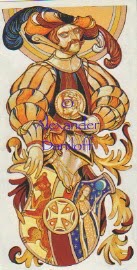
    Consider first the Knight of Pentacles from the Alexander Daniloff Tarot.

    In warm shades of russet and gold, he proudly sports an enormous hat and announces that he is an Earth sign by gently holding his coin like a trophy against his torso.

    He carries no weapon, just a money bag at his belt.  His only concession to his military rank is his shield and his helmet.  Items purely for defence.

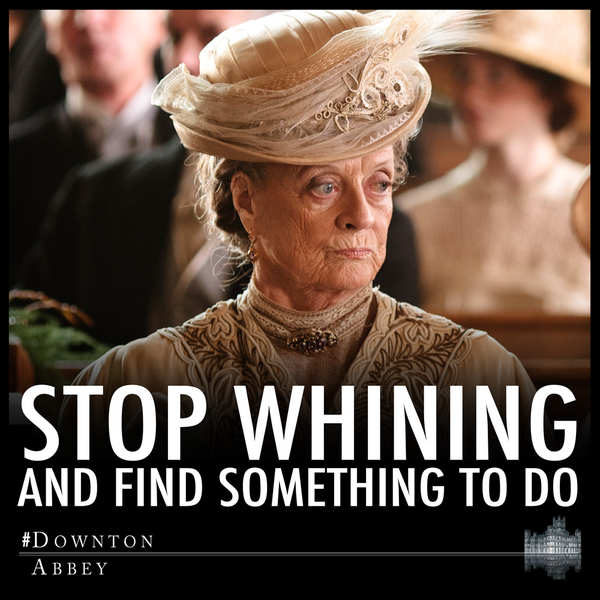
    Let’s take another look at that hat.  It would not look out of place on the redoubtable Dowager Countess of Grantham:

    It features some outstanding feathers – reminding us that Knights have an airy and unpredictable component.  However, when married to the solidness of Earth, they don’t sit comfortably together.

    He can find his Knightly duties a little tough: He is called to be adventurous and an explorer, but he’d really rather do his exploring a little closer to home.  ‘Why try to conquer outer space when we have not yet understood our oceans?’ thinks this Knight.

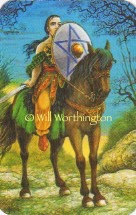
    In the Druidcraft we see him, almost shy, peeping over his shield as he rests his sword arm on his horse’s flank.  He’s in no rush to go anywhere.

    He is slow to anger or rouse to passion, but once his heart is engaged, he will not be swayed from his course.  He represents dogged determination and slow but steady progress.

    Of all the Knights that might set off looking for you, the Knight of Pentacles is the guy that WILL find you.  Yes, long after the Knights of Wands and Swords have galloped off on a new quest, long after the Knight of Cups rededicates his ballad to another fair maiden, no matter how long it takes, he’ll be there.

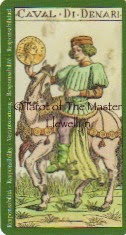
    In Lo Scarabeo’s The Tarot of The Masters, his keyword is ‘Responsibility’.

    The Knight of Pentacles can be a frustrated character – someone who longs to travel, but who is somehow prevented from doing so, either by home commitments, lack of finances or even health issues.

    Or he might be someone far from home who longs for the delights of her own fireside.

    This character is stubborn, the least flexible of the Knights, practical and single-minded in a way that the other, more exciting Knights are not.

    He directs us to:

    • Take on an adventure – even a tiny one!
    • Follow one project through to the end!
    • Explore new ways to make your money work harder (but not high risk!)
    • Try a new type of exercise – nothing too fast-moving!

    Sorry that it’s been a whole MONTH since I last posted.  I am still here reading and writing like mad.  I’m hoping that you’ll still drop by Thrones for a comfy chair and a coffee.  Maybe even Eccles cakes …

  • Full Moon | Leo | February | King of Wands

    As the moon trundles around its orbit, we find her passing through Leo for February’s full moon tonight (3 February).

    This means that we shall find ourselves acquainted with the energies of that most magnetic of the Tarot court personalities, the King of Wands.

    Someone who is working their King of Wands energy is someone whose inner life and outer life are as one – there is no conflict between what’s going on in his head and heart and what he is called to do. And, by Jingo – they are called to be active in the world!

    His appearance in your life encourages you to take action in those matters that you feel passionately about.  And you don’t take action in a small, quiet way – my goodness no! The King of Wands is someone that you can see for miles off!  Let people see you walking your talk with confidence and enthusiasm!

    This character likes people to look at him! He’s fond of nice things and doesn’t mind showing them off.  That could make him a royal pain in the arse, but fortunately his show-off gene is accompanied by a generous gene too – so if you hang around with King of Wands people, there’s a good chance that you will benefit from their largesse!

    King of Wands people are very good at seeing the Big Picture in a situation.  They seem to be able to rise above the fray and see all the horizons with clarity.

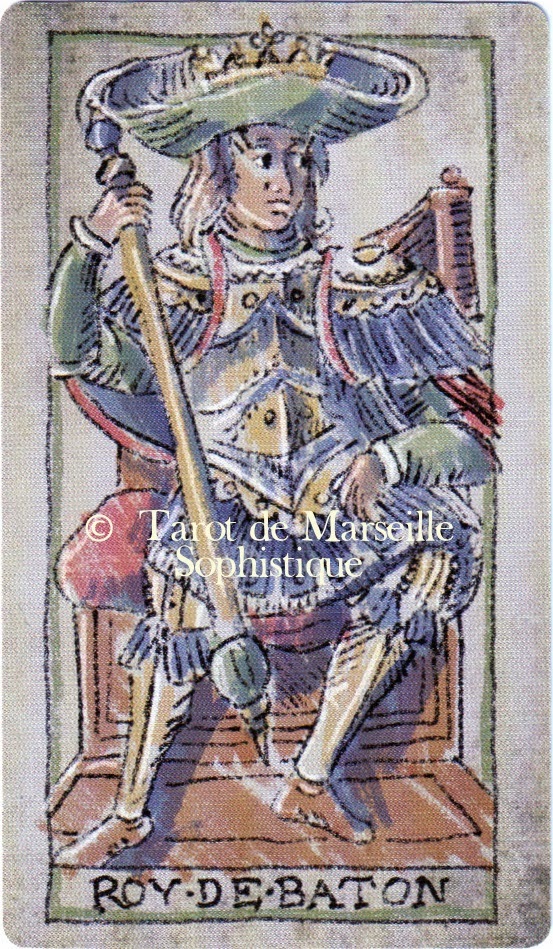
    All the Wands Courts are forwards-looking energies and this King from the Kickstarter-funded Marseille Sophistique is pictured looking off to the right.  For me, the right is the direction of the future.

    It’s a good time, says the King of Wands, to take action and get moving towards your bright and beautiful future!

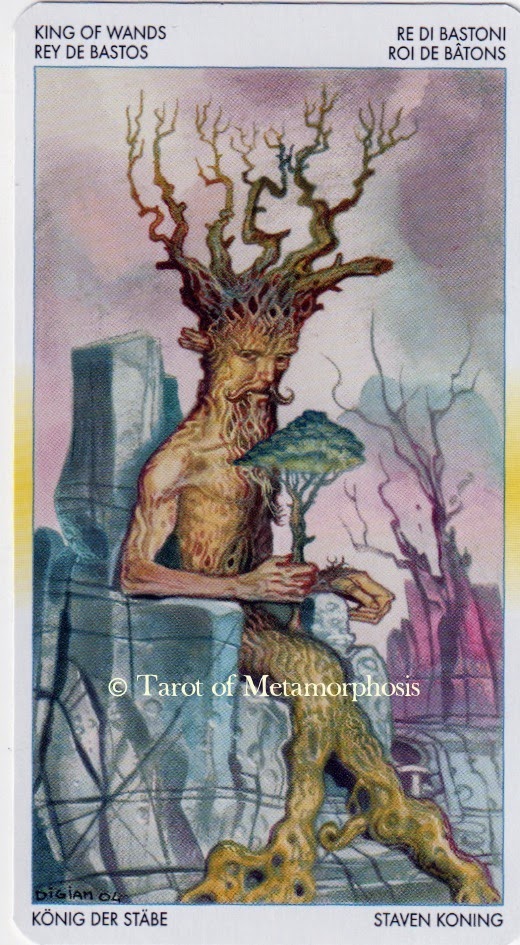
    Here in the King of Wands from the Tarot of Metamorphosis, we see clearly how he is associated with the strength and growth.  There are smokey grey and pink clouds behind this King – makes me think that there is a forest fire somewhere!

    That reinfoces the idea that when this King catches fire, you can see the results from quite a distance!

    Today the King of Wands asks:

    What do you feel passionately about? What BOLD steps can you take today that move you towards that passion?

    Are there any confusing situations that can be grasped with more clarity right now?

    The King of Wands says:  It’s time to look forward with confidence!