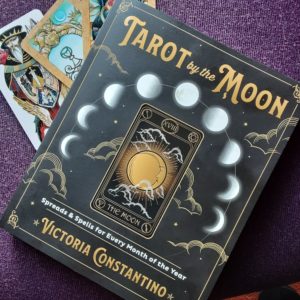
The latest book to drop with a satisfying thud onto the doormat here at Tarot Thrones Towers is Tarot by The Moon by Victoria Constantino (Llewellyn). I’m always on the search for new books to deepen my Tarot knowledge or widen my spiritual horizons, so I was eager to see what this book had to offer.
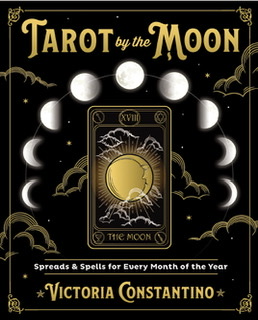
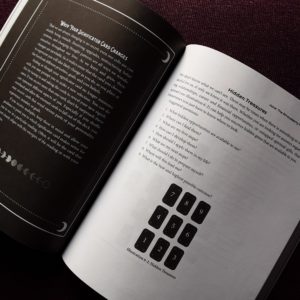
Let’s start with the book’s vital statistics, shall we? Tarot by the Moon is a good-sized paperback, running to 240 pages (including the index); about the same dimensions as Mary K Greer’s 21 Ways To Read A Tarot Card. The cover artwork (see image above) by Kevin R Brown is very attractive with phases of the moon on a soft matt black background flanking a glossy Moon tarot card; it’s very tactile! Inside the book we have lots of spread illustrations and graphics in black and white.
The author, Victoria Constantino, is a new name to me (but hey ho, I’m not exactly Ms Tarot filofax, so don’t read too much into that lol!) but she has a background in publishing and a slew of publications that includes poetry and fiction as well as a Master’s degree in Writing. Although her website biog confirms that she’s a longterm tarot practitioner, Tarot by the Moon is her first tarot book.
So – it’s time to dive in!
The book is laid out in chapters that are named after the months of the year along with the best-known full moon name for that month. For example, Chapter 1 is ‘January: The Wolf Moon‘ and carries on in that vein through to December (The Cold Moon) and then includes a chapter for The Blue Moon and then zooms off into some useful Appendices.
But let’s just back up a little and focus on the Introduction which runs to 20 pages. In this section Victoria gives us a Tarot Ready Reckoner section for those who are perhaps new to card reading – how to use the book, a comprehensive outline on how to interpret the tarot that includes four pages on common tarot symbols (which is actually not bad for content at all!) and numerological correspondences before looking at days of the week and their planetary associations … and rounds off with the energetic qualities of the various moon phases (eg the dark moon being a good time for journey work, past life regression and so on). The introduction closes with an explanation of the more unusual moons – mini moon, super moon, blood moon etc.
There is a lot of content in that Introduction, so don’t skim over it!
Since it is almost November, I thought I’d focus on that month to see what the book could offer me. The full moon for the month is called The Beaver Moon and the chapter begins by linking the productivity of beavers (who are busy getting their dams in order at this time of year) to creating stability (important in a beaver dam!), getting your foundations right, clearing blocks etc.
And this is how the chapters function throughout the book; Constantino paints a broad summary of the energies of that month’s particular moon, based on the Algonquin full moon name, and then crams the chapter with spreads and spells to help work with that energy. Of course, you don’t need to restrict ‘creating stability’ to the month of November – you are encouraged to dive in to any topic at any time, depending upon your own need and interests. I think that using the full moon names is an inventive way to group spells and spreads together.
So, back to November. There are six tarot spreads, most involving 10 cards that allow you to explore productivity, stability, foundations, security, clearing blocks and a work and career spread to round things off. The chapter then delves into spells and rituals – summoning a perfect career opportunity, creating solid financial foundations and paving the way for success.
Victoria gives recommended days and moon phases for the spells and rituals. They involve quite a lot of stuff – crystals, coloured candles, herbs and spices, coloured inks etc – so this isn’t really about just grabbing gear from your kitchen drawers and getting on with it. It’s about preparing, which is a vital part of RITUAL after all!
Throughout the book there are side bar tips. For November it’s thinking about animal symbolism in tarot and automatic writing – which is fun, if you haven’t tried it yet! There are a lot of interesting snippets to explore – cleansing and charging crystals, what repeat cards might mean, the wisdom of flowers … just to name a handful.
It was time to try out one of the spreads from November and since it’s Nanowrimo month … the productivity spread seemed like the obvious place to start. I’ll be writing up the actual reading in a couple of days time. In summary – I found the spread useful.
Now I want to scoot ahead into the Appendices. Appendix A covers Meditations, B concerns amplifying your intentions (a full moon ritual), Appendix C takes a brief look at incorporating Feng Shui Ba Guas. And then we have a few pages for you to make your own Notes at the back.
So, what do I think of it now that I’ve shown you around?
First of all, I have not read every chapter prior to this review. I read the introduction, dipped into the other chapters and then worked through the chapter that I would be using for the coming month, by way of deeper example.
It’s a book that dips into different belief systems – Native American, Wiccan, pagan systems and even forays into feng shui – which is a massive cultural arc but which works because the author does not focus too deeply on any one system – for example, the feng shui Appendix is about 200 words and a brief table. This is enough to whet your appetite if you want to explore further, but not too much that it bogs you down in detail. As Victoria says: “It is written from the belief that we are all one, that there is truth to be found everywhere – in every culture and belief system – and that we all share more similarities than differences.”
I really like how the various full moon names have been the focus of the chapter contents. I think this is inventive and there is a lot of bang for your buck as far as spreads and spells are concerned (the book contains 66 spreads and 45 spells/rituals). However, if you buy it thinking that everything in the book is directly linked to something lunar, then you will be disappointed. It’s as it states on the cover: Spreads and Spells for Every Month of the Year.
Who would enjoy Tarot by the Moon? Victoria says on her website that the book is: ‘the ultimate guide for seekers of wisdom, for those on the healing journey, and for anyone who wishes to become empowered in manifesting the life of their dreams’. For me, I think it’s fun for anyone who loves exploring new tarot spreads or who loves rituals to help them take action (and who also has a lot of crystals and that kind of thing around the house – which is not me lol!). It will be a useful resource if you want to work on specific areas of your life on an organised monthly basis, and I can see it being a neat first tarot book for someone who mostly does rituals – a nice way for them to expand into our crazy tarot world.
You can find out more about Victoria on her WEBSITE.
Book published on 2 November 2021 in UK, but e-book already available. Available from all good retailers – buy locally if you can!

Stop being confused by court cards! Start being excited by the possibilities! Become a court card adventurer along with me 🙂 The Tarot’s Court Cards are my specialist area. They talk to me. Not LITERALLY though ….