Tag: Significator

  • Significators | Philip and Stephanie Carr-Gomm | The Book of English Magic

    Click on image to visit site

    Since I started this blog, I have been ferreting out different ways to help you choose a significator for your client (or yourself!) in your Tarot work.

    Here’s another method:  Philip and Stephanie Carr Gomm have devised two sets of questions that help you (or your querent) work out which suit and which rank best suits your personality.
    I reproduce them here with kind permission from the Carr-Gomms:
    Finding the SUIT that best applies to you:
    A – I’m an intuitive, enthusiastic person, who loves starting projects and tends to have ten new ideas before breakfast. I’m not so good at finishing things, though, and I can lack focus because I’m interested in so many things.
    B – I’m a sensitive, emotional person. I feel very deeply, and can cry easily. My heart goes out to people and animals who are suffering, and I feel drawn to the arts and the healing professions.
    C – I spend a lot of my time thinking and analysing. Some might call me an intellectual, and I can be accused of having my head in the clouds. I sometimes feel detached from everyday events and can find it hard to express my feelings.
    D – I’m a practical person – I just like to get to work and do things, rather than endlessly theorising about them or talking about them. I’m good with my hands and like making people feel at home.
    If you choose A – you’re a WAND, B – you’re a CUP,  C – you’re a SWORD and D – you’re a PENTACLE
    Congratulations! You’re halfway there!
    Now you have to find the RANK that best applies to you:
    A. I feel young and innocent most of the time. Sometimes this makes me feel uncomfortable or embarrassed when I’m in the company of other adults who seem so ‘grown-up’. I feel as if I have so much potential that I’m only beginning to explore.
    B. I like to get on with things. I want to be of use to the world, but I sometimes jump into things too impulsively. It makes me feel clumsy sometimes, but I prefer action to too much thinking.
    C. I feel quite mature and aware of myself and what I’m doing in the world. I value creativity and compassion and like to nurture these qualities in myself and those around me.
    D. I feel in charge of myself and my life, and am considered an authority figure by some people. I have accomplished a good deal and try to be socially responsible.
    If you choose A – you’re a PAGE/PRINCESS, B – you’re a KNIGHT, C- you’re a QUEEN and D – you’re a KING.
    Isn’t that just THE most elegant, straightforward way to sort out the Court Card that best represents you?
    To find out more:
    a) The Questionnaire is on pp456-458 in The Book of English Magic
    b) Thumbnail personality sketches on pp 458 – 465 of the same book.
    c)  Delve into the large book that accompanies The DruidCraft Tarot.
    My own insight into this method is that if you answer the questions WITH YOUR TAROT QUERY IN MIND, you could end up with different Courts representing you for different scenarios.   However, if you answer the questions keeping in mind how you see yourself generally, you will come up with a Court Card significator to represent you in ALL instances.
    What do you think of this method of selecting a Significator? 

  • Significators | Old fashioned toot?!

    Tooting for Significators!

    When I started this court card blog, I banged on and on and on some more about using Court Cards as significators and you, dear reader, mostly snortled good-naturedly into your coffee and told me that you didn’t use significators.

    There were a couple of solid reasons why people didn’t use significators:

    Reason 1:  If you use a significator, it removes that card from the deck and so it can’t arise within the main body of the reading.

    My reply:  And? When ANY card turns up in a spread, it precludes it from turning up in any other position in that spread, doesn’t it?   *kind and conciliatory face*  Why not just have a separate set of gorgeous court cards to work along side your working deck?  Then you allow for all the courts to turn up in the actual reading 🙂

    But no, you still weren’t buying into the idea….

    Reason 2:  A significator is soooooooooo old-fashioned!

    My reply:  It sure is.  But it’s a great way of settling your mind to the task in hand and taking your client INTO the reading with you and, for me, that’s an important part of the ritual.

    Nope, you were still shaking your head and looking apologetically at the floor……

    And then, when I was out tramping through the woods with the dog, a moment of insight!  Yes, JEN-YOU-INE enlightenment, dear reader!!

    Significators aren’t old-fashioned at all!

    You do use them……

    Every single day…….

    On Facebook, Twitter, forums (forii?!), your blog…. anywhere that you have an on-line presence…. you DO use significators because…..

    A SIGNIFICATOR IS AN AVATAR!!!!

    You select an image of yourself that you want to present to that community, don’t you? Whether it’s a  photo of yourself or a witty kitten image, you choose it to convey something ESSENTIAL about you to that community.

    That’s exactly what a significator does.

    You and your client select a card that best conveys something essential about the sitter and the situation in which they find themselves.  In effect, you create an avatar of your sitter.

    And the secret sauce?  Your interpretations of court cards will go through the ROOF if you start working with them consciously, as avatars.

    My session on Court Cards at the UK Tarot Conference next month focuses on the CONSCIOUS use of Court Cards.

    And that’s it    *shrugs*

    That’s my bright idea.

    And it cost me a friendship to be able to tell you that.  More of which at a later date, I suspect.

  • 30 Day Tarot Challenge | Day 6

    This Game of Thrones | 30 Day Tarot Challenge | Day 6
    Celtic Cross Tarot Spread
    What do you think of it?

    The question for Day 6 of the Challenge is:  What was the first Tarot spread that you learned?

    I can’t actually remember, but the one that DOES stick in my mind is the Celtic Cross spread from the TABI Training course, so that must have been one of the first.

    And when you think about it, the Celtic Cross tarot spread looks nothing like a real Celtic Cross, does it?


    Certainly it’s one of the most popular spreads but I’m not very sure of its history.  I know that it’s mentioned in A E Waite’s ‘Pictorial Key To The Tarot’ but I’m unclear as to whether there are any written records of it before the clever clogs of the Golden Dawn got involved….

    If anyone has any more info about this, I’d love to hear from you!

    There are lots of variations on the Celtic Cross theme and, of course, I luff it to death because, not only is it a good-sized spread to use,  it has a significator!

    And since this blog is about Court Cards, anything that promotes the Courts as A Force For Good is FINE by me 😀

    Why do I bother with a significator? Primarily because it allows me

    a) to gain some insight into my client’s view of themselves – if I’m letting them pick a significator based purely on the imagery of the card.  I like them to explain to me why they’ve chosen the card that they have – it can be very revealing!

    b) to get my head in the zone by taking my client INTO the spread with me.

    I like to use the Druidcraft Tarot court as significators, because they are so expressive.  Doesn’t matter what deck I’m using, it will be the Druidcraft Court they select from!  Why don’t I just use the courts from the deck that I’m working with?  Well, if I do that, then the card used as the significator cannot possibly come up in the reading.  But by using a different set of 16 courts, I have the full 78-card deck at my client’s disposal.

    Anyway, enough of me, what about you?  What was the first spread that you learned?! Share it – one can never have too many good spreads at your disposal!

  • OOTK | First Operation | Golden Dawn

    OOTK.

    I know.

    It sounds like something an orangutang might say if it happened to be the librarian at a University for Wizards* but in this case it stands for Opening Of The Key.  And it’s a Tarot spread.

    The whole OOTK shebang involves four stages, but today,  we are going to look at only the first part of the first stage, or First Operation.

    I could write pages on the background to this spread, rattling on about the great occult meanings imbued within it – the Princesses!  The Aces!

    But I like to keep things simple, so I’m providing only a tiny bit of background for you – but be aware there is more to know 🙂

    OOTK was designed by the Great and The Good of the Golden Dawn, it is an impressive set of four manoeuvres that perfectly suits that highly intellectualised GD approach to the Tarot.

    Today we’re just looking at the First Operation. Actually, just the first part of the First Operation.

    This can be used perfectly well as a stand-alone spread and one need never venture into the thigh-high swirling waters of the other three operations if you don’t want to.

    Anyway, let’s crack on!

    Using whichever manner you are comfortable with, select a significator for your client. Or let them select one.

    Allow the querent to shuffle the cards and formulate their question.

    All you are going to ask them to do is split the deck into four.

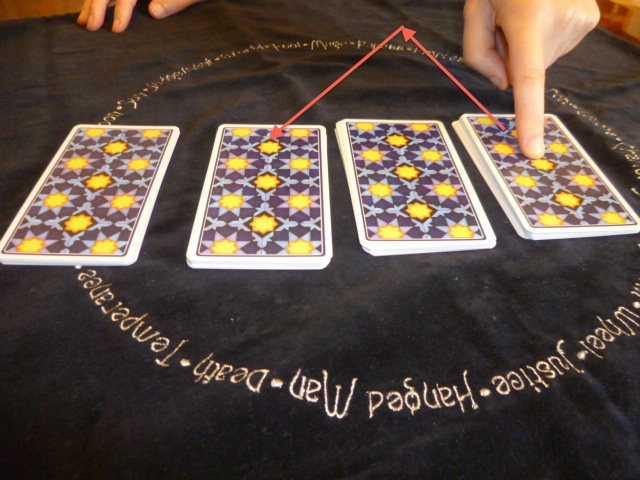
    First of all you ask them to half the deck – placing one half on the right of the area to which you will use for the spread and the other half towards the left.

    The red arrow shows the position of your two initial stacks

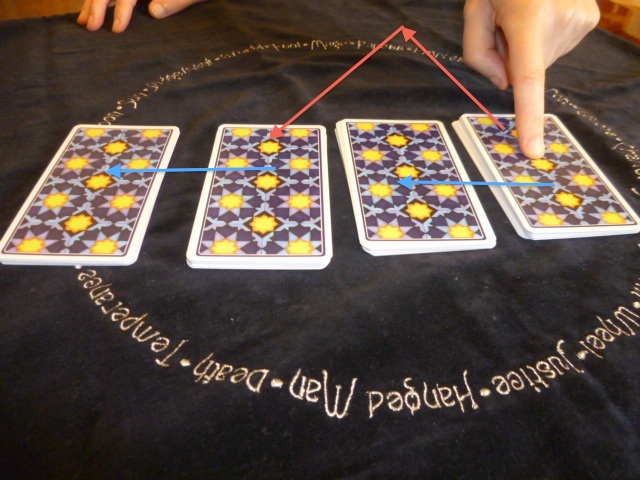
    Then half each portion again, again laying half immediately to the left of the portion from which it was cleaved.

    The blue arrows show the positions of the second stacks.

    The cards on the extreme right (the stack to which I am pointing) represent the Fire energies , then Water, then Air and the final stack on the extreme left represent the Earth.

    Now, you might be lucky and have all four piles roughly the same height.  More than likely you will have one pile substantially larger or smaller than the others.

    You might be able to hazard some thoughts about what the largest/smallest pile might mean?  You can include these musings in your reading, if you like.

    Turn each stack over and read according to the stack that it is in.

    To illustrate:  the 6 of Cups  in the Fire stack.  The Water of the Cups weakens the Fire of the stack.  This might indicate that one’s natural fiery energies (optimism, expansion, career) are being adversely affected by the watery Cups energy of the 6.  Perhaps the sitter is brooding on something from the past that is holding back their natural enthusiasm for a situation?

    Do the same for each of the four stacks and it will give you an overview of what the rest of the reading is about; paving the way for the subsequent Operations.  However, you can actually just stop there if you like!

    But since WE are concerned with the Court Cards and their role, here as significator, we’re going to plough on a tiny bit further……..

    Search through every pile – without disturbing the order of the cards – until you find the stack that the significator is in.

    At this point, the Golden Dawn advocate the following:

    If the Significator is NOT found in the correct stack then the reading is abandoned.  What they mean by ‘correct stack’ is that if the question is to do with the emotional problems of a relationship, you would hope to find the Significator in the second stack, the Water pile.  If it was to do with one’s health, one might expect to find it in the Earth pile……and so on,  but I don’t ascribe to that *shrug*.

    I’m in the Carry On Regardless Team 😀

    The reason for this is that it is not always clear to the sitter (and consequently to the reader) what the querent’s issue is REALLY about.  For example – maybe the sitter thinks that it is a problem about sex (for me, that would be the fire stack) but the issue may actually be entirely emotional, or health-related (ie either the Water or the Earth stacks).  So I’m all for continuing with the reading!

    So, you’ve found the stack with the Significator.  Let’s assume that you are going ahead with the reading – what next?

    ………..tune in next time to find out 😀

    *If you don’t read any novels by Terry Pratchett, then this reference is completely meaningless.  I apologise.  But urge you to read them.