Tag: Phillip Carr-Gomm

  • Druidcraft Tarot | Rebox

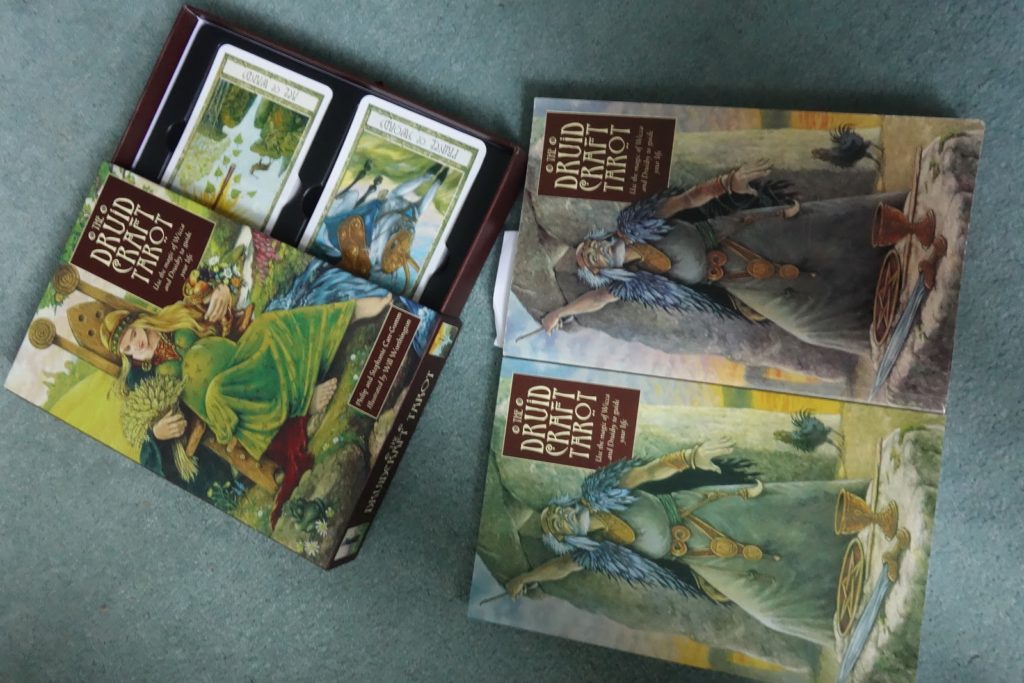
    Just before Christmas I was provided with a review deck of the newly reboxed Druidcraft Tarot.

    Druidcraft Tarot | all versions | Tarot Thrones
    new box, brighter coloured book cover

    Even a casual perusal of back posts from me will show that the Druidcraft is one of my absolute favourites and I fondly recall buying my first copy from a little incense-infused shop in Glastonbury when I met up with some tarot friends from TABI waaaaaaaaay back in the mists of time – 2004!

    (more…)

  • Significators | Philip and Stephanie Carr-Gomm | The Book of English Magic

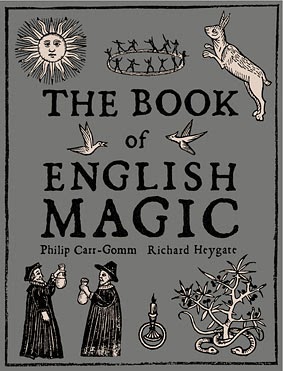
    Click on image to visit site

    Since I started this blog, I have been ferreting out different ways to help you choose a significator for your client (or yourself!) in your Tarot work.

    Here’s another method:  Philip and Stephanie Carr Gomm have devised two sets of questions that help you (or your querent) work out which suit and which rank best suits your personality.
    I reproduce them here with kind permission from the Carr-Gomms:
    Finding the SUIT that best applies to you:
    A – I’m an intuitive, enthusiastic person, who loves starting projects and tends to have ten new ideas before breakfast. I’m not so good at finishing things, though, and I can lack focus because I’m interested in so many things.
    B – I’m a sensitive, emotional person. I feel very deeply, and can cry easily. My heart goes out to people and animals who are suffering, and I feel drawn to the arts and the healing professions.
    C – I spend a lot of my time thinking and analysing. Some might call me an intellectual, and I can be accused of having my head in the clouds. I sometimes feel detached from everyday events and can find it hard to express my feelings.
    D – I’m a practical person – I just like to get to work and do things, rather than endlessly theorising about them or talking about them. I’m good with my hands and like making people feel at home.
    If you choose A – you’re a WAND, B – you’re a CUP,  C – you’re a SWORD and D – you’re a PENTACLE
    Congratulations! You’re halfway there!
    Now you have to find the RANK that best applies to you:
    A. I feel young and innocent most of the time. Sometimes this makes me feel uncomfortable or embarrassed when I’m in the company of other adults who seem so ‘grown-up’. I feel as if I have so much potential that I’m only beginning to explore.
    B. I like to get on with things. I want to be of use to the world, but I sometimes jump into things too impulsively. It makes me feel clumsy sometimes, but I prefer action to too much thinking.
    C. I feel quite mature and aware of myself and what I’m doing in the world. I value creativity and compassion and like to nurture these qualities in myself and those around me.
    D. I feel in charge of myself and my life, and am considered an authority figure by some people. I have accomplished a good deal and try to be socially responsible.
    If you choose A – you’re a PAGE/PRINCESS, B – you’re a KNIGHT, C- you’re a QUEEN and D – you’re a KING.
    Isn’t that just THE most elegant, straightforward way to sort out the Court Card that best represents you?
    To find out more:
    a) The Questionnaire is on pp456-458 in The Book of English Magic
    b) Thumbnail personality sketches on pp 458 – 465 of the same book.
    c)  Delve into the large book that accompanies The DruidCraft Tarot.
    My own insight into this method is that if you answer the questions WITH YOUR TAROT QUERY IN MIND, you could end up with different Courts representing you for different scenarios.   However, if you answer the questions keeping in mind how you see yourself generally, you will come up with a Court Card significator to represent you in ALL instances.
    What do you think of this method of selecting a Significator? 
  • Philip and Stephanie Carr-Gomm | Interview

    Whose favourite Druidcraft Tarot card
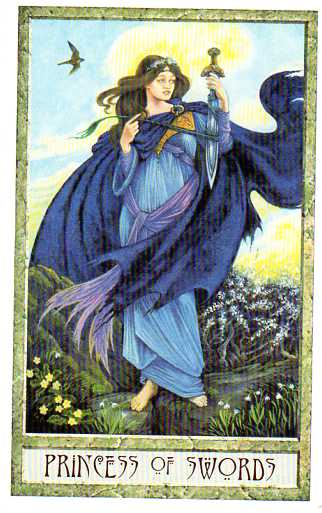
    is this, The Princess of Swords?

    Hot on the heels of the Carr-Gomms’ highly successful Druidcraft video-conference sessions  hosted by Linda Marson at GlobaI Spiritual Studies, I was very honoured when they both took time out of their busy schedules to answer some questions for Tarot Thrones about the Druidcraft’s wonderful Courts.

    Me (A):  First of all – thank you so much for agreeing to be interviewed for my blog!  You are a Tarot duo that I have admired ever since I laid eyes on the DruidCraft 🙂


    Philip and Stephanie (P&S) “Thank you! And now we can start a mutual admiration society because we’ve discovered your blog and love the way you’ve given it the focus of the Court cards, which – as you know – is of great interest to us and starts off our book and the training we’ve developed that we’re calling Integrative Tarot.”  


    (Ali: more on this powerful Integrative method in a future post!)

    A: Quite often the Court Card section of a Tarot deck can be a real disappointment: very little thought or symbolism seems to be included in the cards.  Not so with the Courts of the DruidCraft who are exquisitely detailed characters both in the artwork and on the written page.  You and Stephanie put great emphasis on the Court Arcana with the Druidcraft – what prompted you to do that?”
    P&S: “The Hanged Man perspective! Looking at things in a completely different way – turning things upside down and inside out, certainly helped. When we worked on the DruidCraft Tarot, after looking at hundreds of decks, dozens of books, we noticed exactly what you have said. It’s as if the authors and artists focus on the amazing Majors first, then the pips, and by the time they reach the courts they’re exhausted and don’t seem to give the same level of attention to them. What convinced us was not turning things around and saying – “if everyone finishes with them, let’s start with them,” as a sort of attempt to be different or unique. No – it was because we realised that the Courts represent the Tarot’s own special typology – just as astrology has twelve, the enneagram nine types, and so on, the Tarot has sixteen. And when I remembered that the most commonly used personality typing system in psychology is a 16 fold one – the MBTI – that clinched it for me, particularly since the MBTI evolved out of Jung’s four-fold typology which correlates so beautifully with the principles of Druidcraft. Later I discovered in Mary Greer & Tom Little’s book that various others had made correlations, which was fantastic.

    “But the story goes on, because at that time I was working on the book in New Zealand. Steph was in Sussex, Will was in Manchester, the publisher’s art director was in London. Steph and I were skyping about the project, and emails were whizzing between all of us. A friend in NZ had trained with a teacher called Glynn Braddy who used the four elements as a key part of his teachings. This friend talked at length to me about his teachings and in particular about the different facial and body types associated with the elements, explaining that predominantly airy people had thin faces, aquiline noses, and piercing blue or grey eyes, while Earthy types were more likely to be stocky, with round flat faces,and so on. I relayed this information to Will, and so we have very consciously delineated differences between the Court figures of each suit. 

    “Incidentally, Glynn Braddy seems to have influenced a number of people, including Stuart Wilde, and an internet search will reveal comments such as:

    “Glynn Braddy, an Australian, was another lecturer who was particularly brilliant and of course controversial (almost all the greats are). Some considered him a metaphysical genius with his ability to combine science, nutrition, philosophy and metaphysics in his teachings. His mind traveled over a vast landscape. I use the past tense because I don’t think he teaches anymore but I attended a few of his workshops and they were in a league of their own. I use the information I learnt from Glynn on a daily basis.” James Wild. Leon Davis has produced a novel based on his four element teachings: ‘The Seasons Within’  as has Geof Spalding with his book The 33rd Sage .

    A: I e-mail interviewed  Mary K Greer (for my blog) and we spoke about the Personality Profiling that she and her colleagues did in her wonderful Understanding The Tarot Court and she said that they couldn’t agree on how to allocate the 16 types to match the 16 personalities of the Tarot Courts.  Do you think that this is because the Courts aren’t people, but facets of people’s character?”
    P&S “No I don’t think so. When you go into the subject of personality profiling and typology it becomes really quite complex and subtle – as it should do! After all we’re all quite complex contradictory creatures! And so I think it would take a lot of work to refine our understanding of the correlations between the MBTI types and the Tarot types, and maybe it isn’t an exact correlation anyway. But I think this requires more research and it’s rather nice to know that not everything has been discovered and worked out! I hope one day someone with a few years on their hands – perhaps a psychology graduate with a real interest in typology – will tackle this and let us all know their findings.”
    A: “Yes, that would be wonderful!

    “I very much enjoyed the two sessions that you and Stephanie did with Linda Marson’s Global Spiritual Studies and was impressed by the two sets of questions that you had developed to help people work out which suit and rank best represented them.  Do you think that one’s answers (and therefore Court personality card) to these questions will change, depending on the nature of the question that the sitter is contemplating?”  


    (Ali:  Those two sets of questions will go up here on  m’blog, with full permission from P&S next week!)

    P&S “That’s an interesting idea! The questionnaire as you know is very basic – but despite that it seems to often be quite accurate. I tried it last night on my mother and daughter – both Geminis – and they absolutely refused to go for one answer in each section. It took ages of saying ‘Yes but if I put a gun to your head which would you choose?’ before we could work out their types and I think they got a good fit. Your idea suggests that if – for example – you were struggling with an emotionally upsetting issue and you were feeling particularly vulnerable, you would be more likely to choose a statement that related you to a Cups Court, while if a day or so later you were wrestling with a practical or financial issue you’d be more likely to select a Pentacles court. I guess that’s certainly a possibility. One way around that would be to do the questionnaire separate from any reading, and to do it several times over a few months. If you consistently came up with the same Court I think it would be pretty accurate. “
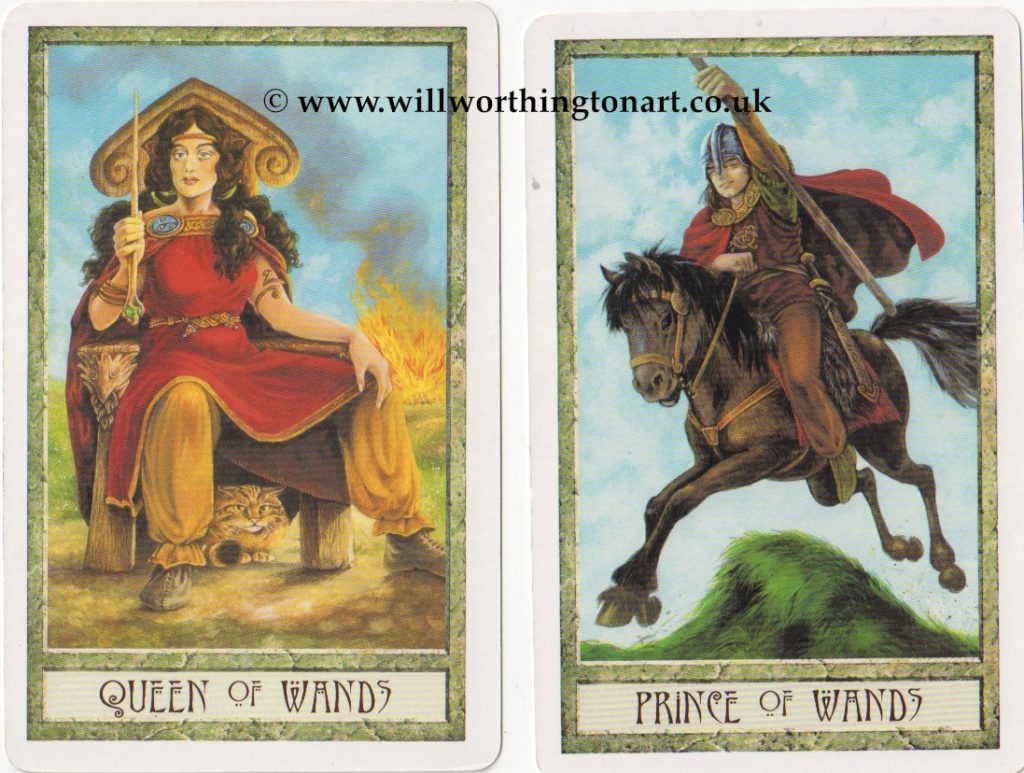
    A: “My favourite card is the Queen of Wands – I love the expression on her face, the billowing fire, her pose, the cat beneath her throne…..THAT wand!  Which Court personality card is your personal favourite – and why?”
    Philip: “I love the Princess of Swords. In the original paintings the egg tempera blues of her dress and cloak are just stunning!”
    Stephanie: “I really like the Prince of Wands – he looks so joyful bounding along on his horse, over rolling waves of grass, he’s just having so much fun!”


    My favourite DruidCraft court card alongside Stephanie’s favourite!
    A: “We’ve had to wait a very long time for dedicated DruidCraft workshops to materialise – will you be running any more?”
    P&S:“We weren’t sure how a webinar would go – but we found that it’s a great medium to teach Tarot because the cards are a visual tool and therefore a visual medium like a computer screen is perfectly suited. And in addition, being able to interact with participants AND have it all recorded so students can go back over the material later is fantastic. So yes we’ll be doing more I reckon!”
    A: “I’m very interested in the creative process between deck authors and deck artists, can you tell me how you and Will Worthington went about creating these expressive cards? Did you send very detailed remits as to what you wanted to see in the images or did Will have a lot of creative leeway?”
    P&S: “For most we sent quite detailed briefs, but for some we said to Will ‘Why don’t you go ahead and just see what comes to you, as long as you have these two or three symbols/elements in there.’ Most of the time we agreed, but occasionally we struggled together but that’s good – that shows creativity is taking place. Giving birth isn’t easy after all, is it? It was definitely a joint process, for instance – ‘Death’ which we absolutely love, was our vision, which Will executed brilliantly. ‘The Wheel’ on the other hand was Will’s inspiration – and it’s fantastic, one of our favourite images!”

    A: Thank you so much to Philip and Stephanie for taking the time to answer all these questions! I hope that your interest is piqued by the Integrative Tarot style mentioned.  You can find out about the 16 personality types in much more detail in Philip’s book: The Book of English Magic, pp 45- 465


    See the full range of books by Philip Carr-Gomm:  
    http://philipcarrgomm.druidry.org/books.htm
    Read Philip’s blog:  http://philipcarrgomm.wordpress.com
    Find out more about OBOD:   www.druidry.org

  • Meet The King and Queen of Cups

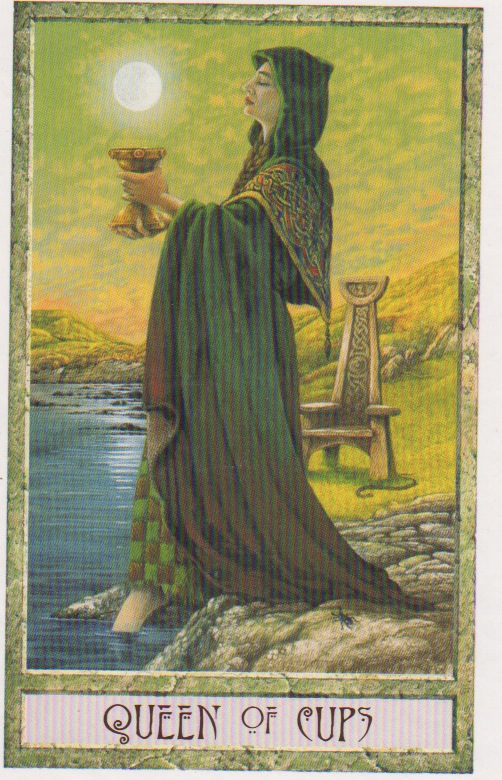
    Reverting once more to the glorious Court Cards of the Druidcraft Tarot, I’m introducing you to Mr and Mrs Cups.

    The Queen of Cups stands on the shore of some tranquil waters, her bare toes dipping into the glassy cool depths.  Unlike the other Queens of the Druidcraft, she is standing, her throne can be seen some steps away with a serpent lying close at hand.

    Her hair is covered by an elaborately embroidered hood and she stands, eyes closed (or downcast?) as she holds her golden cup before her, as if she is working a ritual.

    The full moon floats eerily above the chalice, almost like an accessory in a conjuring trick.

    The sky is changing – either dawn or dusk.  I like to think of it as dusk because the Cups rule the Autumn and the West and so dusk is the time of day that resonates with these qualities (Wands being midday, Pentacles being midnight and Swords being dawn).  These times of the day are special – offering us gateways to travel between worlds.

    There is also a black beetle near the edge of her cloak. …. some people think that this is a scarab beetle, but I’m not sure and the book is silent – as is the Druid Animal Oracle by the same creators (Will Worthington and Phillip & Stephanie Carr-Gomm).  But I’ll find out 😀

    The atmosphere in the card feels silent, but somehow charged-up by the Queen’s actions.  The characters feel like Irish Celts – from the embroidery and colouring of her robes to the snake on the ground.  In Ireland the Christian church drove out the druids (the adders) and that’s why there are no snakes in Ireland.  Or so the story goes.  So she’s definitely got Irish Druidy connections for me.

    As Water of Water, she vibrates to a single element – love, compassion, empathy and the creative impulse are very strong.  An ‘unhealthy’ Queen of Cups (ie reversed position) could be manipulative, selfish, clinging and *cough* wet.

    She doesn’t need her eyes to see you, she can tap into your emotional state.  This can leave her vulnerable to energy vampires (oh, you know what that is – the toxic friend that leaves you washed out and exhausted after a self-absorbed telephone call)

    To remain healthy, she needs to ensure that it’s only her toes that get into that emotional water!

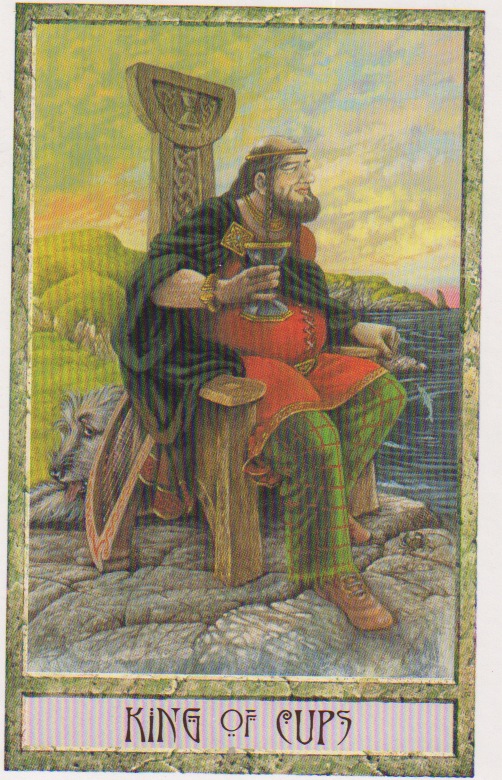
    Take a look at the King.  He sits on his throne like a well-stuffed sofa!

    His crown is bald and he wears a circlet of gold.  He does not face out towards us like the Wands King and his close relation the King of Swords.  Instead he looks off to the right, an attitude that I associate with looking to the future.

    He is musical – his harp lies by his side.  And a great wolfhound lies behind his throne.  This is a loyal husband and a wise man (see the salmon of wisdom in the watery depths).

    He does not enter the water.  Unlike the Queen, the King is Water and Fire. He is aware of the emotions (he looks out over rippling water) but he does not act from them. He can understand your emotions but is perhaps better at knowing what needs to be actually DONE.  In this respect he is a master of diplomacy.

    But he can be found working in the caring professions, where what you need is a compassionate response, but someone who is still able to take action.

    There can be a conflict going on within this man.  Sometimes what he needs to do is at odds with how he really feels.  So he can really feel stressed out by situations when this conflict arises.

    He sits in a similar dusky landscape with the sun just going down.  But whereas the Queen has Irish connections for me, the rock formation in the distance of the King’s card looks like the Old Man of Hoy, which is on the Orkney islands of Scotland.  So you can make up your own mind about this duo’s Celtic origins!

    There have been ruins found on Orkney of a settlement called Skara Brae that archaeologists are increasingly convinced are the ruins of a centre of artistic/spiritual leaders…. perhaps like Anglesey was for the Druids?  Perhaps the Cups are from this community?

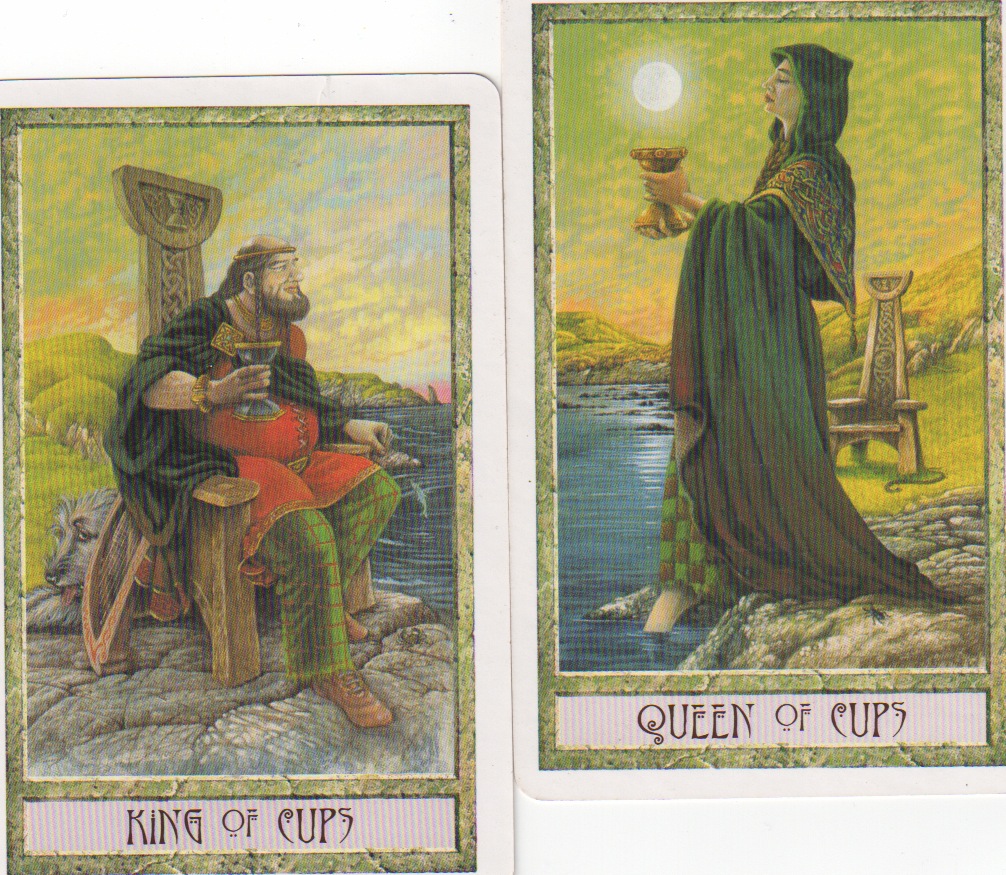
    Placing them side by side, The King looks at his Queen.  More specifically,  he looks at her cup.  In fact, even if you line up their horizons, the King still looks at her Cup.  His focus is not on her beauty or form, even though they face each other.  And her eyes, as we have noted, are closed.

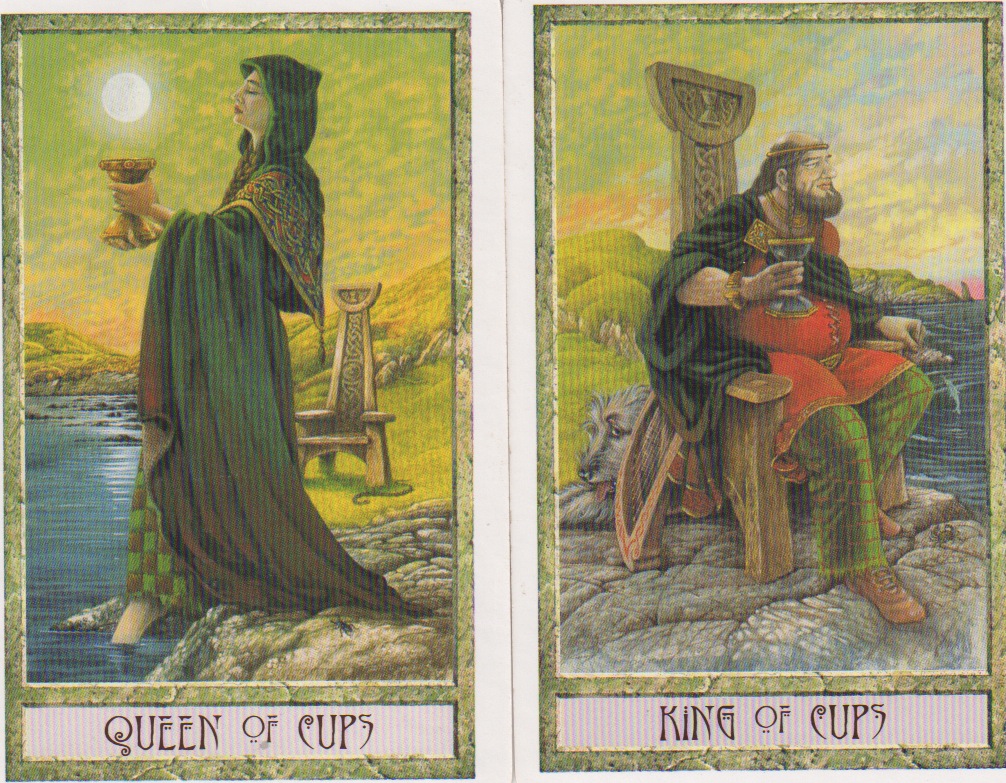
    Placing them the other way around, the figures are back to back.  With the Queen looking to the left which is, for me, looking back to the past, to the Old Ways.  Whereas the King looks out to the right, to the future….

    What do you think? What would you add to the King and Queen of Cups?

  • Meet the Swords!

    So far we’ve met the Wands family and today it’s the turn of the Swords – which is entirely appropriate given the recent Spring Equinox.  As with the Wands, I find that taking a look at the rest of the Swords realm gives me good clues as to what I can expect from the ruling family.

    Decision, Frustration, self-limiting beliefs, grief, thought, mental agility, drama queen behaviour, honesty

    In my system, Swords are associated with:

    Air
    Spring Equinox
    Dawn
    Mental faculties/communication
    East

    Other systems are available, so just find one that works for you and stick with it!


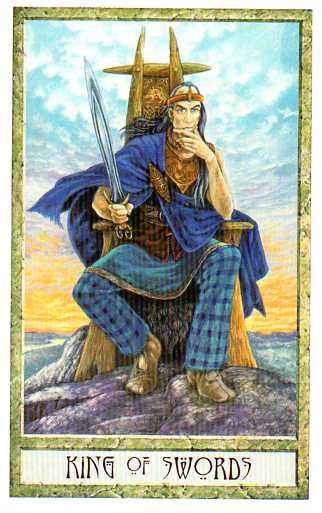
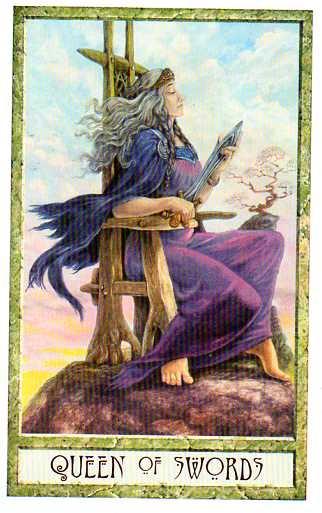
    The first thing that I notice about these two cards is the wind lifting their clothing and hair.  Their thrones are quite plain – which suits them, they’re plain-speaking sort of people. Behind them both we have a sky unfolding into a bright, but cloudy dawn.  The landscape that they sit in is harsh, with little in the way of greenery to take the hard edge off.  The Queen at least sits by a distant tree – but it looks gnarled by the wind at best or bonsai-ed to tiny, clipped perfection by the Queen’s blade.

    Neither of the two of them looks much like fun.

    The King engages with us, looking out directly, but the Queen faces off to the right, her eyes downcast, focusing on the blade in her hand.  She is barefoot – on stone – her feet will be cold; she feels austere, distant.  She looks self-contained.  What do you think her positioning with her back to her Consort means.  Even if you place them the other way around, she is still not engaged with him, her gaze is elsewhere.

    The King of Swords is Fire of Air – a productive mingling of elements that means he is well-suited to his Kingly role – able to take action, but more importantly, able to think through the ramifications of his actions before he steps away from his throne. But left unattended – air and fire can rage out of hand! He’s not got great emotional input into what he does – he’s hard on others, and hard on himself too.

    The Queen is Water of Air – another blending of elements that show that her emotional base and her thoughts are quite congruent (think of air and water coming together to make bubbles!) Although she doesn’t look it, there IS an effervescence about the Queen of Swords.  Witty and clued-up, she’s ideal company at a party.  Just watch out that she doesn’t get too handy with that little blade though – her honesty can be cutting.

    Traditionally, she is associated with a woman on her own.  Not necessarily a widow or divorcee.  One can be married and feel quite alone too.

    They both seem older than the Wands – the King with his high forehead (receding hair?!) and the Queen with her beautiful grey locks.

    What about the Juniors?

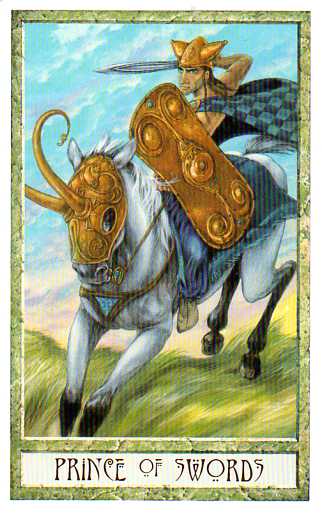
    The Prince of Swords is not on a hilltop like his parents – therefore he’s not got the same breadth of vision as they do.  Look at the Wind in this card!  The grass is blown flat, his cloak flies out behind him.  This character is Air of Air – with no other elements to moderate him.  He’s someone whose thoughts are still being formed and as a result, he flies about – latching on to one thing only to discard it when he learns something else.  Consistency is not his strong point!

    Although his parents have their swords drawn, neither of the two of them look much like they are going to give you a jab.  Not so the Prince of Swords – shield up, sword out, riding to the attack.  He has much in common with the Prince of Wands – both rattle into action at the drop of a hat – but whereas the Prince of Wands is motivated by the thrill of the chase, the Prince of Swords is motivated by what he believes is right or wrong.  Trouble is, he’s not always right about what he thinks is wrong!

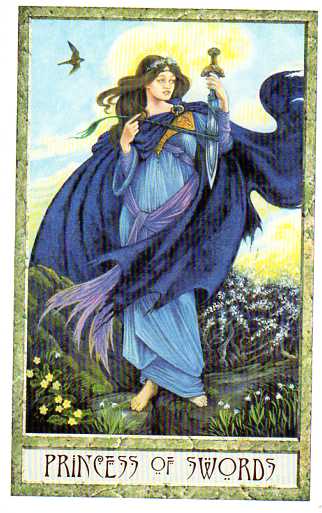
    The most junior member of the clan is the Princess of Swords.  Again, a lot of wind in this card! The Princess’s robes are whipped almost to shreds by the wind blowing around her.  Like her mother, she stands barefoot, but unlike her mother, her stony surroundings are tempered into softness by the beauty of spring blossom.

    As far as elemental associations go, the Princess of Swords has the most trouble – she’s Earth of Air.  Look how she winds a green ribbon (earth) around her blade (air).  That’s just going to get ripped to bits!  Still, she’s got to learn…..also, she might want to think about how she’s holding her sword – that’s going to be a lot worse than a paper cut!

    Blessed with a quick mind, The Princess is also shackled to a slow experiential curve.  She’s keen to learn a lot of things, but it will take time to put them into practise – this can manifest as frustration, bad temper, and a tendancy to gossip…and shredded ribbons 🙂

    What do you think about the Swords?

    The Sword family are provided courtesy of the DruidCraft Tarot.  Published by Eddison Sadd (Connections). Artwork Will Worthington and words by Philip and Stephanie Carr-Gomm.