Tag: Lo Scarabeo

  • Total Tarot| New Magazine

    Total Tarot| New Magazine

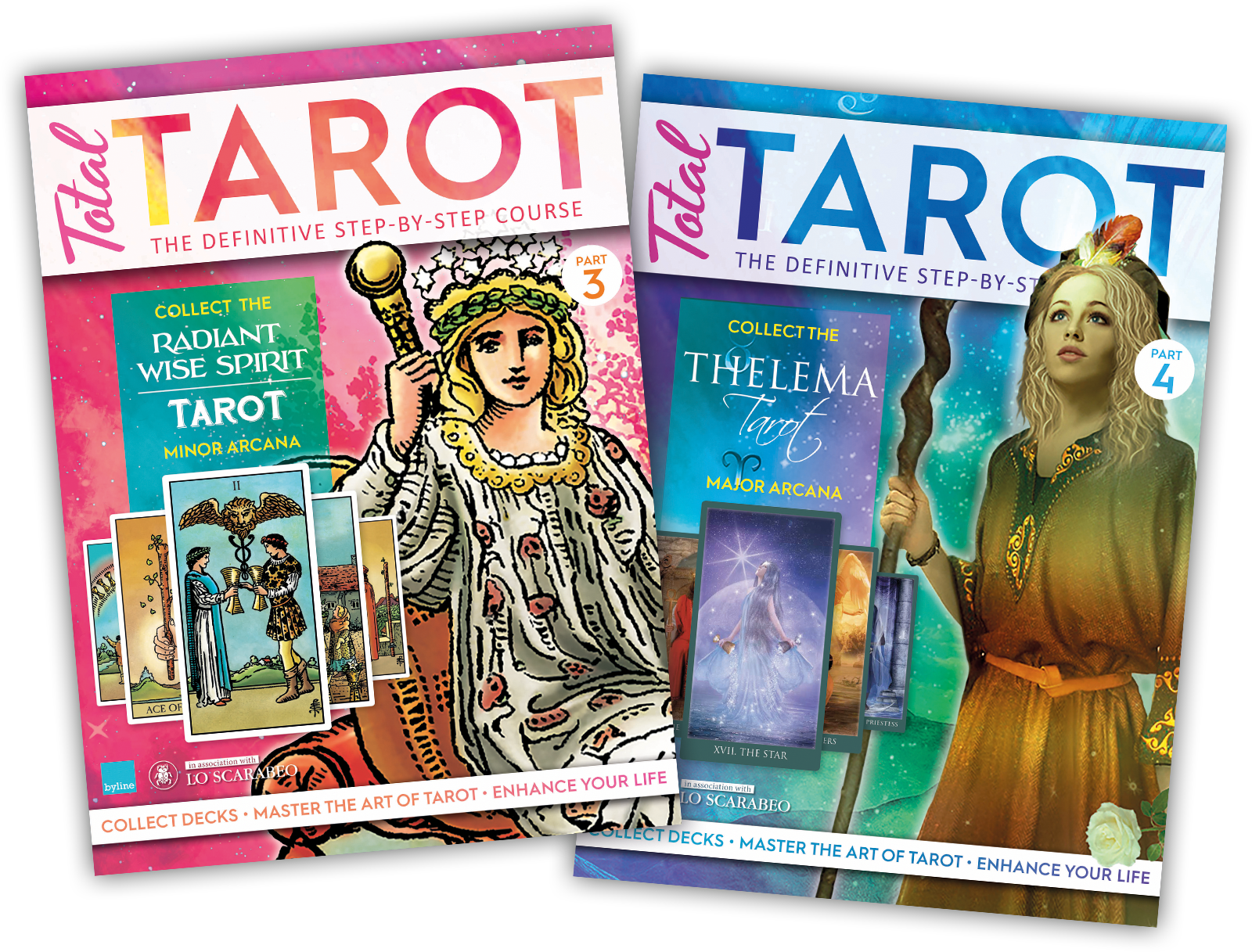
    You may already be familiar with The Esotoracle (UK-based) and The Cartomancer (US-based) magazines but there is a new Tarot mag kid in town, Total Tarot.

    What sets Total Tarot apart from the other two marvellous magazines is that it has exclusive links with the well-known publishing house, Lo Scarabeo.

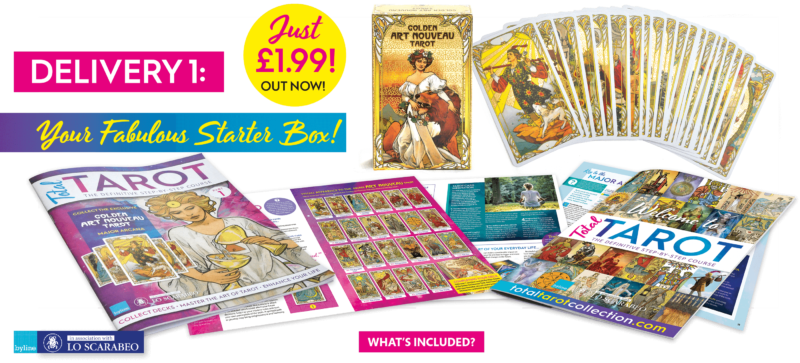
    Details of Delivery 1

    The magazine is a marriage between Byline Publishing in London and the Italian publishers Lo Scarabeo and the first edition of their glossy mag became available in October 2020.

    I believe that the magazine may only be available to UK- residents at the moment, (I need to double-check that) but perhaps it will be rolled out in the USA with a local publisher there too?

    To have such close links with an established publishing house is very interesting. On one hand, this means that every issue of the magazine comes with a full Lo Scarabeo deck, which is AMAZING … but on the other, it might mean that content is limited to the confines of one publisher.

    However, this is not a magazine that is intended to go on forever. There will be a finite number of issues of Total Tarot – very appropriately, 78 issues will be published.

    There are a variety of subscription levels that you can sign up for – and you’ll want to sign up for at least one of them if you intend to collect all 78 cards of the Golden Art Nouveau Tarot which will be released piece-meal across the magazines 78 issues.

    I confess that I find the different ‘Delivery’ options a bit confusing, but if you love the full Lo Scarabeo decks and marvellous freebies that are included with each issue, then this is a fun way to get hooked on collecting decks!

    Have you signed up for this? I’d love to hear from you if you have!

    Do you recommend any other divination magazines?

  • The Tarot of The Masters | Lo Scarabeo

    I am getting to grips with my imovie, although not quite confident enough yet to hit you with the full effect of my Glasgow accent.  But maybe one day 😀
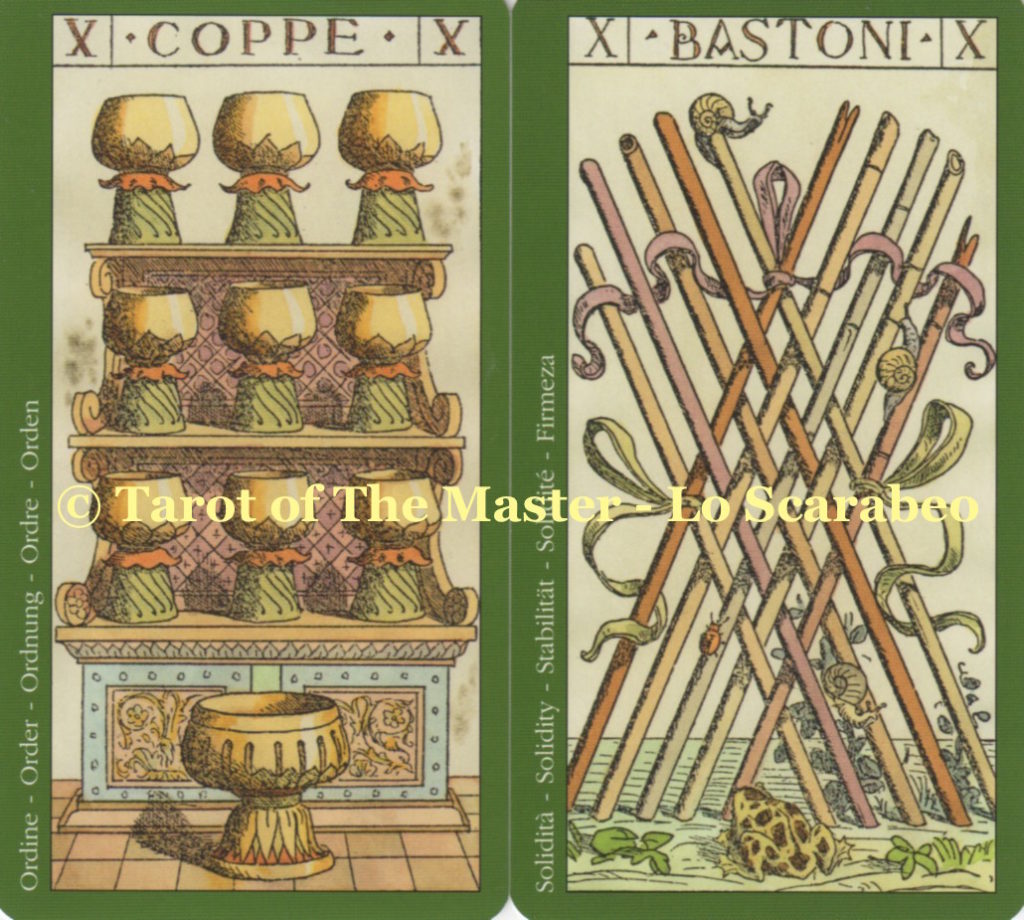
    Anyhoo – here is my latest offering, based on the court cards of Lo Scarabeo’s Tarot of The Master.  A really pretty deck that, I think, I heard about from Anastasia Hayler.  It’s a 78-card deck with semi-illustrated pips that are absolutely charming!

    It was originally published in Turin in 1893 with the title ‘I Naib di Giovanni Vacchetta’.  This version was re coloured and published in 1992.  This title interests me because the name for the 15th century Mamluk game of cards that became the Tarot’s Minor Arcana was known as Naib too 🙂
    So, let’s talk about those Pages.
    Four youthful characters, each holding the symbol of their suit are depicted in a scene that is associated with the keyword for their card
    Page of Wands – Message
    Page of Cups – Offer
    Page of Swords – Loyalty
    Page of Coins – Reflection  
    Interesting to see the Sword used purely as a symbol and not as a weapon throughout the courts of this deck.
    When we move on to the Knights, we see each character on horseback.  However, we see the Knight of Wands depicted as a Jester – with bells sewn on to just about everything.
    Knight of Wands – voyage
    Knight of Cups – Poetry
    Knight of Swords Boldness
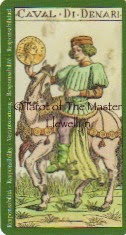
    Knight of Coins – Responsibility
    So far the Swords are coming out of this quite well as far as keywords are concerned, which is refreshing!
    When we move on to the Queens though, this start to feel a bit wobbly…
    Queen of Wands – Innocence!
    Queen of Cups – Nourishment
    Queen of Swords – Determination
    Queen of Coins Wealth
    Let’s just back up a little there… Queen of Wands is innocence! That’s a far cry from how we tend to see her these days – all knowing, sexy and dangerous.  And the Queen of Cups, shown in a kitchen setting taking a welcome drink as she toils amongst the roast chickens, more closely resembles what we might associate with a contemporary Queen of Pentacles.   And the Queen of Swords is depicted as Judith … a headless corpse lies in the tent behind her, no guessing which bit of Holofernes she’s got in the bag. And not a hair out of place either!  Yet she carries her bloodless sword by the blade…  The Queen of Coins is sitting with her back to us – she’s been too busy working at her yarn balling to pay close attention.  She holds up her Coin, waiting to get back to work!
    So on to the Kings:
    They are all depicted as older, more mature men, with the exception of the King of Swords who is young, armoured and unbearded.
    King of Wands – Nobility
    King of Cups – Celebration
    King of Swords – Authority
    King of Coins – Undertaking
    I adore the slightly squiffy-looking King of Cups who has clearly been celebrating quite a lot.  The King of Coins stands with his wrists bare, hard at work literally MAKING money.  The King of Wands uses his ceremonial wand almost like a walking stick.
    It’s a lovely deck to handle with glorious recolouring of the cards by Lo Scarabeo.  Some foxing is incorporated into the cards to keep them aged looking.  
    This would make a great deck for someone who was thinking about exploring cards that have semi-illustrated pips.

    if you click this image you can go straight to Amazon!

    What do you think of it? What do you think of the imovie?!

    I’ve got hardly any followers on my youtube channel (well, only 4 videos so not exactly unexpected lol!), but if you could become a subscriber to the channel, it will cheer me up no end 🙂

  • Full Moon | March | Virgo

    It’s that time of the month again, when the moon becomes full and we turn our attentions to the Court Card that bathes in its glorious light!  Yes, on 5 March, our Full Moon rides again!
    This month, the sun sign is Pisces and so our full moon lands in the opposite sign, Virgo.

    In Tarot, Virgo is represented by the Knight of Pentacles.


    I’ve saddled up a small collection of Knights for you to peruse.  Feel free to run your hands lovingly over their fetlocks…

    Consider first the Knight of Pentacles from the Alexander Daniloff Tarot.

    In warm shades of russet and gold, he proudly sports an enormous hat and announces that he is an Earth sign by gently holding his coin like a trophy against his torso.

    He carries no weapon, just a money bag at his belt.  His only concession to his military rank is his shield and his helmet.  Items purely for defence.

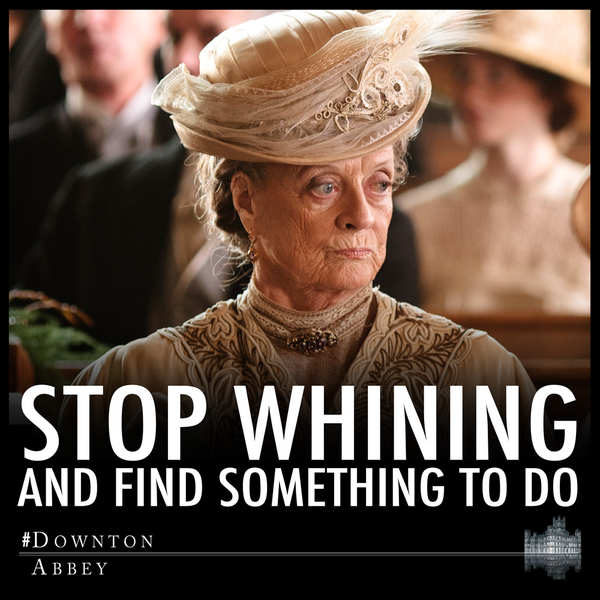
    Let’s take another look at that hat.  It would not look out of place on the redoubtable Dowager Countess of Grantham:

    It features some outstanding feathers – reminding us that Knights have an airy and unpredictable component.  However, when married to the solidness of Earth, they don’t sit comfortably together.

    He can find his Knightly duties a little tough: He is called to be adventurous and an explorer, but he’d really rather do his exploring a little closer to home.  ‘Why try to conquer outer space when we have not yet understood our oceans?’ thinks this Knight.

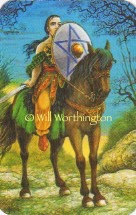
    In the Druidcraft we see him, almost shy, peeping over his shield as he rests his sword arm on his horse’s flank.  He’s in no rush to go anywhere.

    He is slow to anger or rouse to passion, but once his heart is engaged, he will not be swayed from his course.  He represents dogged determination and slow but steady progress.

    Of all the Knights that might set off looking for you, the Knight of Pentacles is the guy that WILL find you.  Yes, long after the Knights of Wands and Swords have galloped off on a new quest, long after the Knight of Cups rededicates his ballad to another fair maiden, no matter how long it takes, he’ll be there.

    In Lo Scarabeo’s The Tarot of The Masters, his keyword is ‘Responsibility’.

    The Knight of Pentacles can be a frustrated character – someone who longs to travel, but who is somehow prevented from doing so, either by home commitments, lack of finances or even health issues.

    Or he might be someone far from home who longs for the delights of her own fireside.

    This character is stubborn, the least flexible of the Knights, practical and single-minded in a way that the other, more exciting Knights are not.

    He directs us to:

    • Take on an adventure – even a tiny one!
    • Follow one project through to the end!
    • Explore new ways to make your money work harder (but not high risk!)
    • Try a new type of exercise – nothing too fast-moving!

    Sorry that it’s been a whole MONTH since I last posted.  I am still here reading and writing like mad.  I’m hoping that you’ll still drop by Thrones for a comfy chair and a coffee.  Maybe even Eccles cakes …

  • Full Moon | Leo | February | King of Wands

    As the moon trundles around its orbit, we find her passing through Leo for February’s full moon tonight (3 February).

    This means that we shall find ourselves acquainted with the energies of that most magnetic of the Tarot court personalities, the King of Wands.

    Someone who is working their King of Wands energy is someone whose inner life and outer life are as one – there is no conflict between what’s going on in his head and heart and what he is called to do. And, by Jingo – they are called to be active in the world!

    His appearance in your life encourages you to take action in those matters that you feel passionately about.  And you don’t take action in a small, quiet way – my goodness no! The King of Wands is someone that you can see for miles off!  Let people see you walking your talk with confidence and enthusiasm!

    This character likes people to look at him! He’s fond of nice things and doesn’t mind showing them off.  That could make him a royal pain in the arse, but fortunately his show-off gene is accompanied by a generous gene too – so if you hang around with King of Wands people, there’s a good chance that you will benefit from their largesse!

    King of Wands people are very good at seeing the Big Picture in a situation.  They seem to be able to rise above the fray and see all the horizons with clarity.

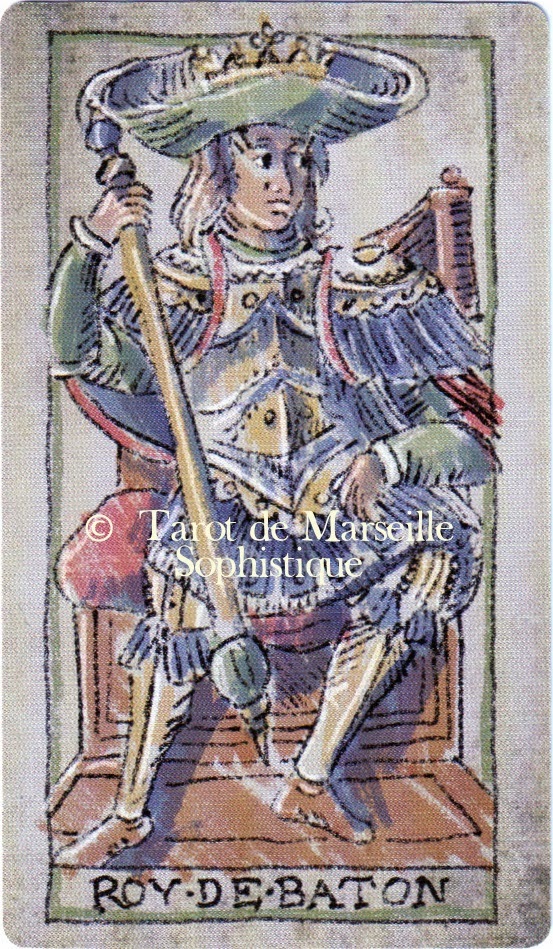
    All the Wands Courts are forwards-looking energies and this King from the Kickstarter-funded Marseille Sophistique is pictured looking off to the right.  For me, the right is the direction of the future.

    It’s a good time, says the King of Wands, to take action and get moving towards your bright and beautiful future!

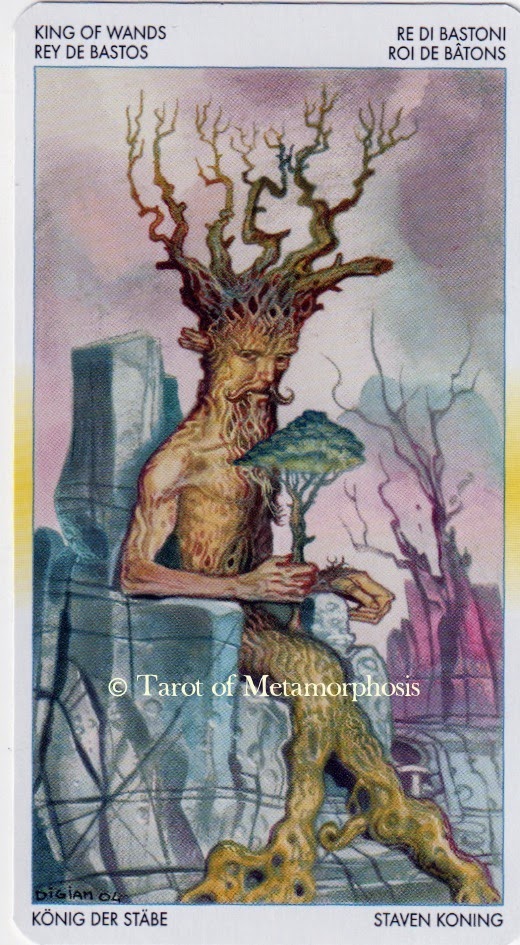
    Here in the King of Wands from the Tarot of Metamorphosis, we see clearly how he is associated with the strength and growth.  There are smokey grey and pink clouds behind this King – makes me think that there is a forest fire somewhere!

    That reinfoces the idea that when this King catches fire, you can see the results from quite a distance!

    Today the King of Wands asks:

    What do you feel passionately about? What BOLD steps can you take today that move you towards that passion?

    Are there any confusing situations that can be grasped with more clarity right now?

    The King of Wands says:  It’s time to look forward with confidence!

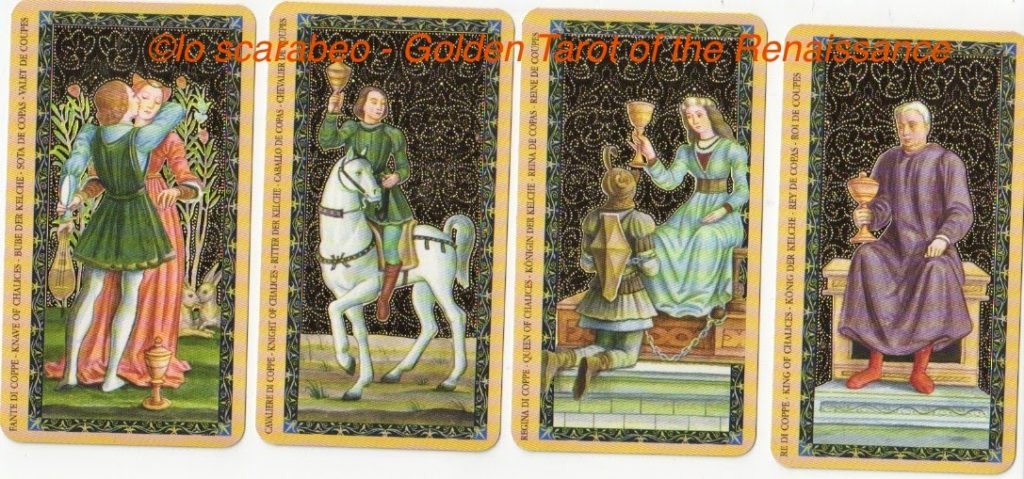
  • Meet The Families! | Golden Tarot of Renaissance | Estensi Tarot

    Another Renaissance deck for you to drool over!

    The majority of cards in this deck have been lost and the surviving cards – 16 Major Arcana cards and a Page of Swords – can be found in the Bibliotheque Nationale in Paris.  There they are attributed to Jacquemin Gringonneur as ‘The Charles VI Tarot’, which would make them an exceptionally early deck indeed (late 1300s).

    However, as with so much in Tarot, the origins of the cards are less clear cut! Tarot Historian, Giordano Berti, who was commissioned to design a complete 78-card deck by Lo Scarabeo, attests that they are more likely to be from the mid to late 15th century and from either Venice (Tarot Encyclopedia Vol 1) or the nearby city of Ferrara (deck’s LWB also suggests 1470).

    I asked Giordano which city was more likely to be correct and he said: ‘A lot of scholars have demonstred that the dress of the characters of the so-called Charles VI Tarot, that inspired the Major Arcana of my deck, is the same of the nobleman at the Estense court of Ferrara during the years 1470-1480.’

    Wherever they were created, this must have been a magnificent set of cards when it was originally painted.  The cards were hand-painted in tempera and decorated with a delicate gold-leaf filigree – the filigree being a feature carried over in the reproduction of the deck.

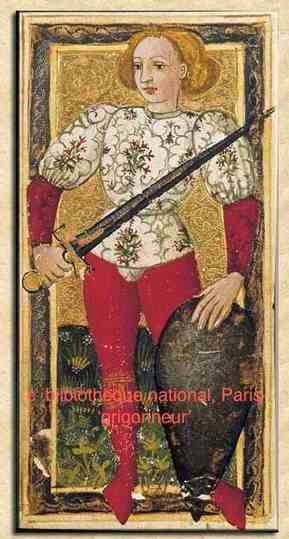
    Of the originally commissioned cards, only 16 Majors remained plus a tenacious Page of Swords.

    The original Page of Swords

    When Giordano Berti was commissioned to design a complete 78-card deck by Lo Scarabeo,  he decided to draw on existing Trionfi cards from Ferrara from the late 15th and early 16th century, to ensure that the style matched contemporary artwork from the deck’s region of origin.

    The courts warranted some inspiration and the existing blondie-bobbed Page of Swords was abandoned and a whole new set of courts was created, based on the magnificent frescos from Hall of The Months at the Palazzo Schifanoia, built for the Duke d’Este at Ferrara.  The frescoes were created between 1469 and 1471 – perfectly in synch with the original card paintings.

    The artist behind the orginal frescoes was Pellegrino Prisciani and Jo Dworkin is the contemporary artist behind the finished Lo Scarabeo Golden Tarot of the Renaissance deck.  The deck is a Justice VIII/Strength XI,  fully-illustrated pip deck, but be warned,  the images don’t always readily associate with the meaning of the card.

    Before we delve in, can I just point out that the ‘black’ background in the cards below IS actually gold foil.  My scanner can’t cope with gold foil!

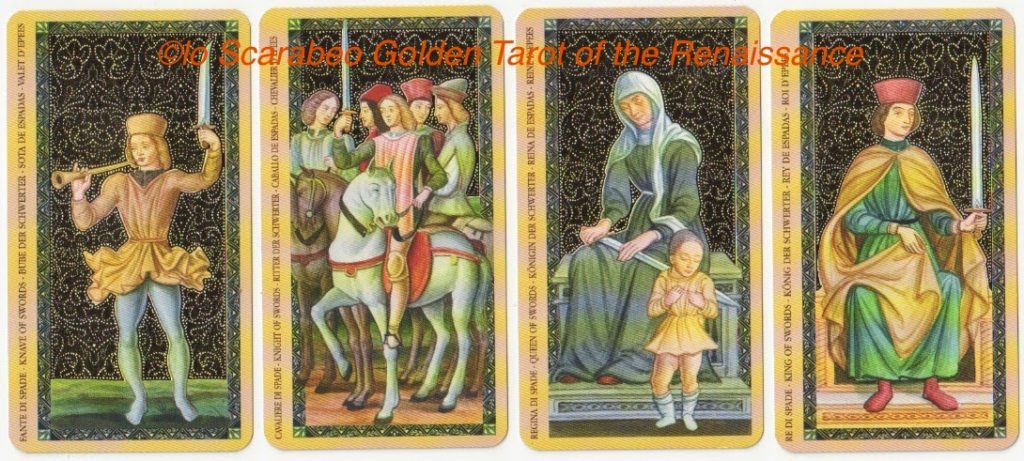
    Let’s look at the Swords family first:

    Page: Message
    Knight: Alliance
    Queen: Widowhood
    King: Administration

    All the Pages from this deck carry some sort of sword or knife, except than the Page of Cups who prefers to go in for a full-on Barry White Walrus of Lurv experience. Here in the suit of Swords, our Page blows on a long horn (check out that ever so correct raised little pinkie!) and holds his sword aloft, wind catching at his tunic.  The Knight appears on a white horse (how Rider Waite!) along with some knightly cohorts (which strengthens this idea of ‘alliance’ as an interpretation for the Knight).  The poor Queen of Swords looks as though she needs a fortnight’s stay at a luxury spa somewhere and I allowed my self a wry snort when I read that she also stands for ‘divorced woman with emotional problems’.  That’s pretty much all of us then, right? Or is it just me? The King is very youthful (perhaps her son, seeing as how she is a widow?) and tugs his cloak somewhat suspiciously over his groin…. hmmmm let’s not go there.

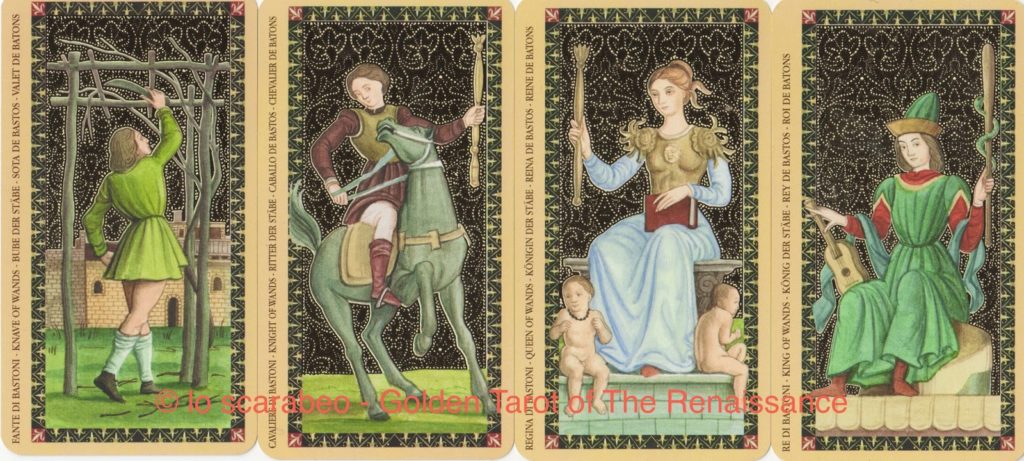
    Let’s move onwards (hastily!) to the castle of the Wands family:

    Page: Open to new ideas
    Knight: Adventure
    Queen: Confidence
    King: Authority
    The Wands are a busy family. The Page is out in the garden, just about to chop down a branch to whittle into a Wand. The Adventurous Knight has a very excited horse (which we luff in a Knight of Wands, do we not?).  The King is a very youthful looking chap who holds his wand, entwined with a snake (thereby turning the Wand somewhat bafflingly into a Rod of Asclepius) and what can only be described as a ukelele.  I’m not fond of a ukelele.  *hideous memories of George Formby records*  However, clearly the Queen of Wands is – look at those little twins at her feet.  I don’t know where she finds the time to read that book!
    Let’s meet the Cups!

    Page: Young Seducer
    Knight: Preaching
    Queen: Ideal companion
    King:  Mature man who helps

    Aside from the Page grappling with a less-than-enthusiastic-looking lady-friend, the first thing that I notice about the Cups family is that the King is a pretty old looking dude to have such a lovely young wife.  And what’s that? The Queen is holding her cup aloft in the company of a young knight? Well, it could almost be a scene from a Jackie Collins novel: ‘Ye Olde Lucky Santiago’.

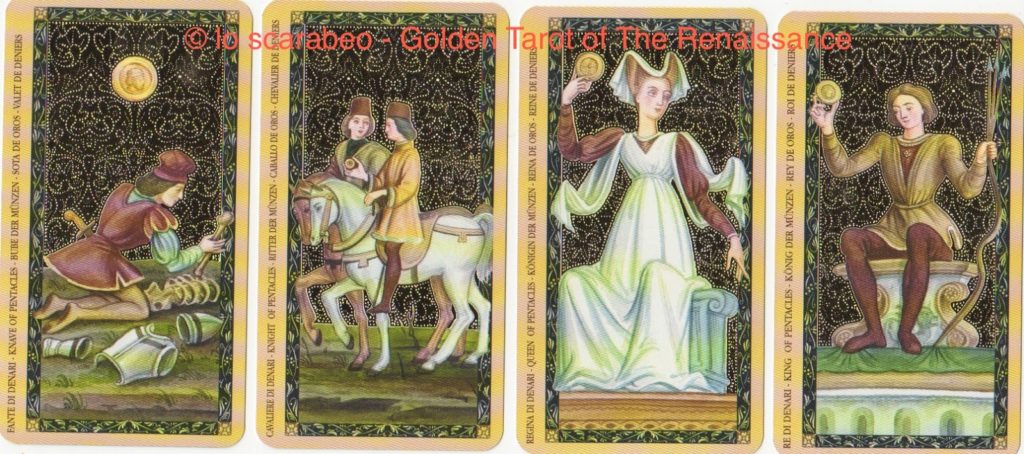
    Shall we pop round to the Pentacles’ place and see whether they’ll invite us in for tea?

    Page:  Lover of mysteries
    Knight: Consultancy (expert from far away)
    Queen: Entrepreneur or heiress
    King:  Unscrupulous business dealings

    Gosh, I’m not sure that I want to eat anything in there after looking at the Page energetically hauling a bone from a Knightly skeleton!  As a ‘Lover of Mysteries’ perhaps he’s working his inner Columbo here and working out Whodunnit.  Not so keen on the alternative titles for the Page of Pentacles – spy and thief.  Page of Swords perhaps, but not our earnest little Pentacle!

    I love the pose that the Queen strikes here, with her robe caught upon a breeze or carried by two invisible putti! I can see how she could be an heiress, that could almost be Tamara Ecclestone sitting there.  Minus the skyscraper heels.

    Again we have a very youthful King and one whose weapon of choice seems to be a long bow.  I usually see the King of Pentacles as a Gordon Gekko sort of a guy – prepared to do what it takes to get what material goodies he needs, even if a little on the shady side. But the alternative interpretation for the King feels slightly schizo as a ‘bold but honest dealer’.

    What do you think of these Courts? Not one of them hails from the surviving cards, but they do dove-tail nicely into the Major Arcana cards that still exist.

  • The Ancient Tarots of Lombardy | Meet the Families!

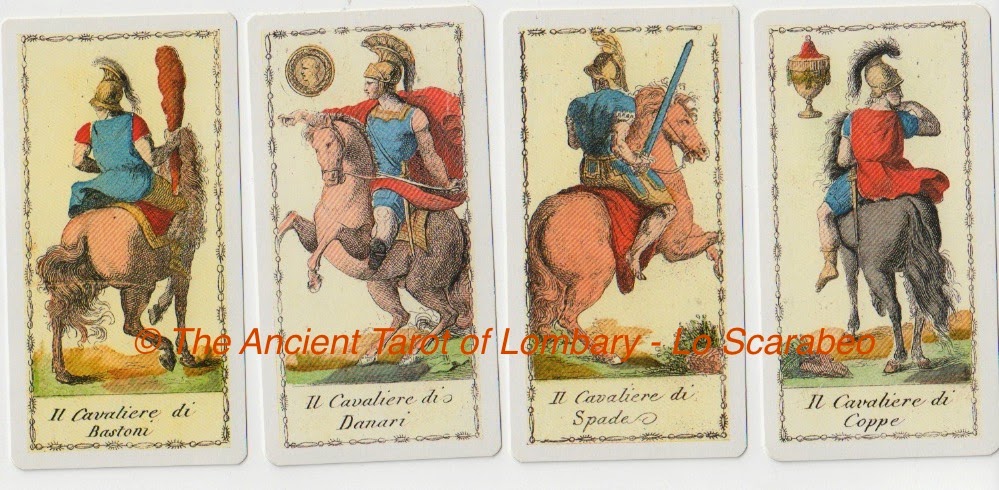
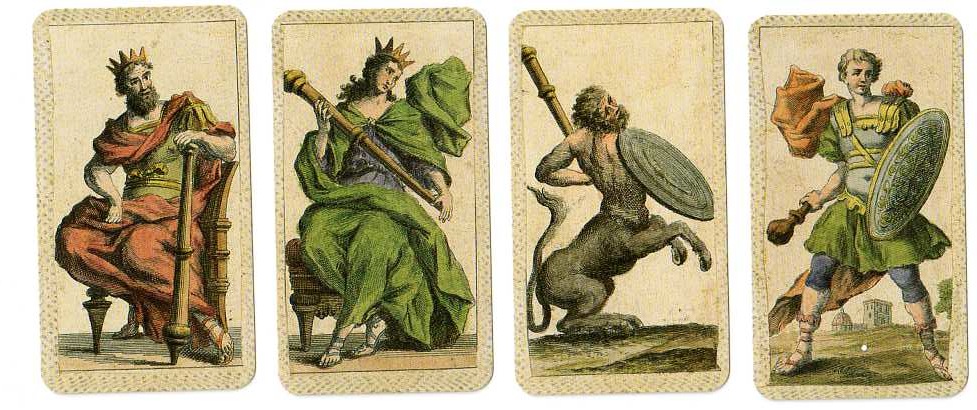
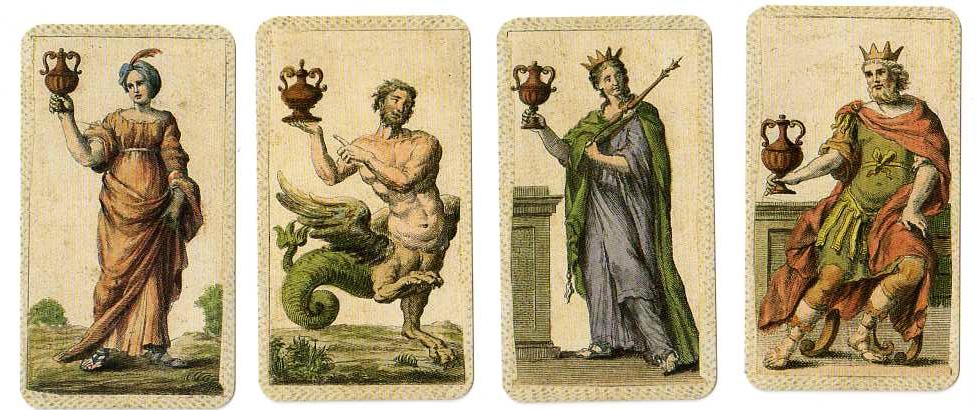
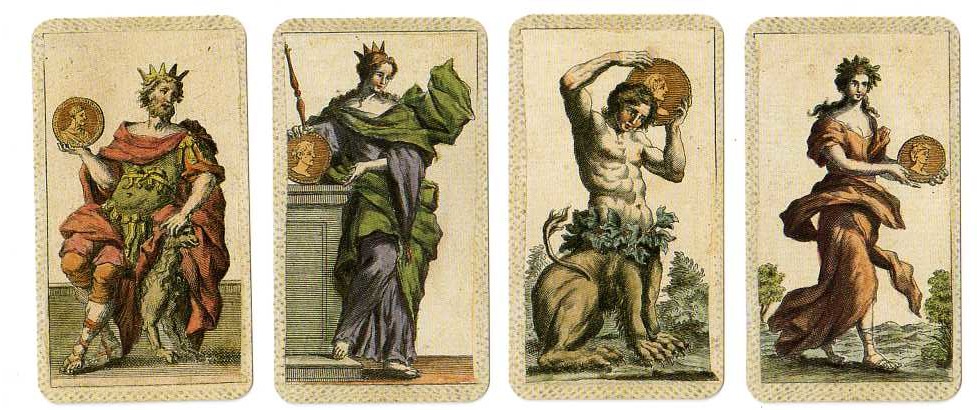
    I recently bought a handful of Marseilles-type Tarot decks and the Ancient Tarots of Lombardy is one of them.  This design dates from 1810, according to the box. It is published by Lo Scarabeo and comes with the LWB details (written by Giordano Berti) on cards, rather than a leaflet.  I find this a bit of a faff trying to find the English section amongst the cards.  But that probably says more about my untidy nature than anything else!

    Although I will be looking at the Court cards, I would just add (for review purposes) that the Tower is simply a tower – no flash of lightning or falling figures.  Strength is Major Arcana card XI and shows a powerful man pulling open the jaws of a lion (you wouldn’t put your fingers in his mouth if you were pulling it closed, imo!).  Minors are unillustrated pips.

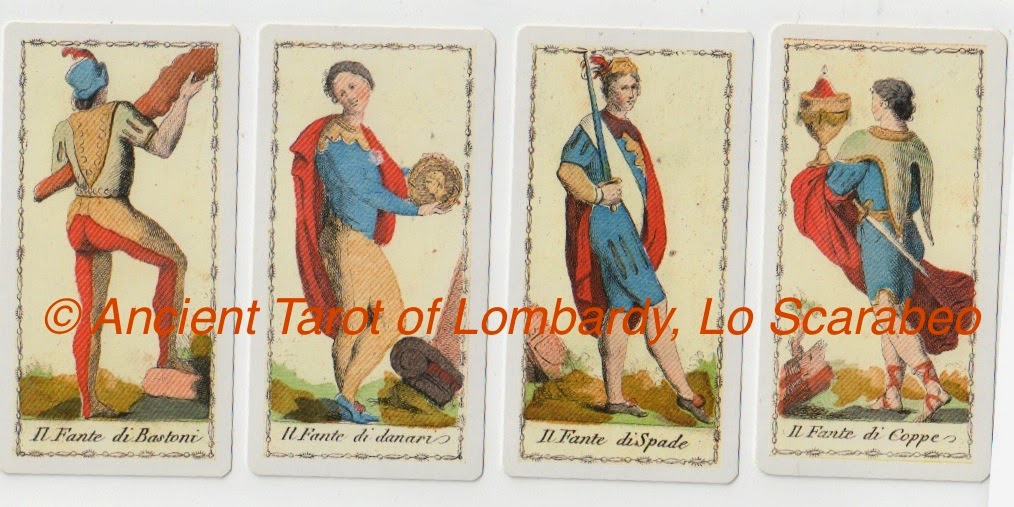
    FoB – Young friend, messenger
    FoD – Study, reflection, news from a child
    FoS – Espionage, secrecy
    FoC – love messenger
    The Fante equates to the ‘Page’ in other decks.
    What do you think of the Danari and Coppe Fante cards being shown from a rear view (and what a pert little rear that Bastoni chap has, don’t you think?!)  And what’s with the swan neck on the Fante of Danari (Pents)?  Nice to see the Fante of Spade (Swords) marching like a little soldier and the dreamy Fante of Coppes (Cups) has decided to wander off somewhere……  
    CoB – Enterprising, fiery man
    CoD – Useful, obliging strange person
    CoS – Ability, hot temper, imprudence
    CoC – young lover, intimate friend
    The Cavale equates to the Knight card.
    Look at all these Cavale – or rather look at their horses’ asses, because that’s pretty much what we’re presented with here!  By presenting us with the back view of these cards, how do you feel? That you are witnessing action, unseen? 
    The Cavale of Wands and the Cavale of Spade are in almost identical poses (with the exception of the activity levels of their horses).  The Cavale of Coppe looks absolutely lost….but the Cavale of Danari looks like a young Alexander The Great, or Napoleon.
    Note that the Cavale of Danari and Cups don’t hold their symbols.  The Cups Knight isn’t even looking at his symbol….
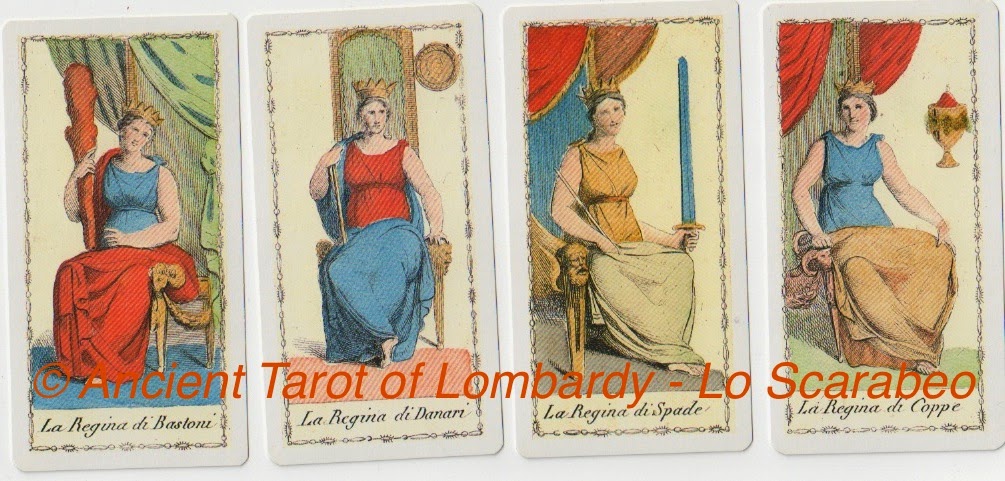
    RoB – Friendship with mature woman
    RoD – Severe but generous woman
    RoS – Widowhood, sadness
    RoC – Woman friend, wife, fiancee
    No surprises here – Regina equates to the Queen cards.
    The Queens are, other than the symbol of their suit, quite personality-less. Queen of Swords has sceptre and sword and looks quite cheerful for a widow.
    Again, notice how Danari and Cups do not hold their symbols
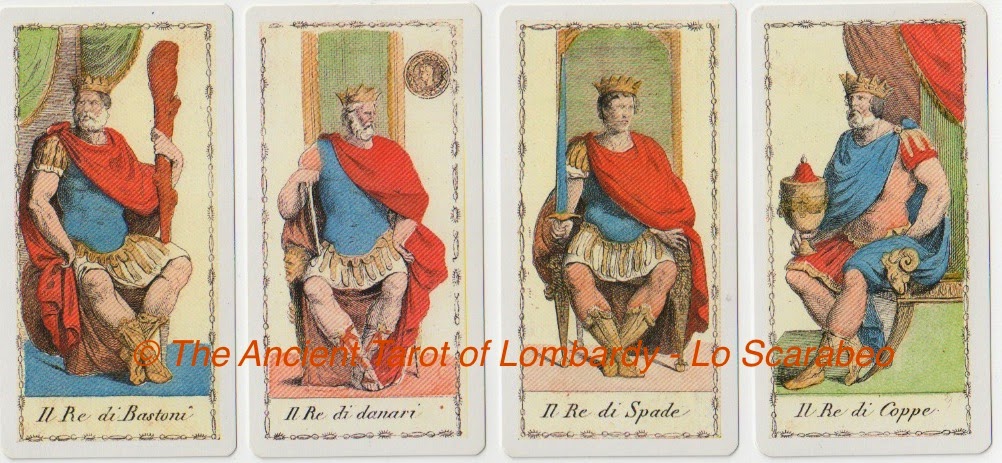
    RoB – good relations with mature man
    RoD – Well-disposed speculator
    RoS – Legal actions
    RoC – Business or law man
    Re equates to the standard King card.
    The Kings are all mature, except King of Swords who looks substantially younger than the others.
    All sit in more or less same position.  Danari doesn’t hold his suit symbol, but does hold some kind of sceptre.  Take a good look at the King of Swords – he looks genuinely startled – see his left hand and expression.
    King of Cups has ram’s head on throne and the King of Pentacles has man’s head on throne, neither of which correlate to astrological associations currently used for these Courts.
    Summary
    I’ll be honest, I didn’t like this deck when I started examining it.  The long neck of the Fante of Cups was a bit freaky (and a couple of the head/necks in the Major arcana are similar) and the bog-standard representation of the Queens left me cold.  However, the style of the deck is growing on me and I must admit, the etchings are beautiful.
    If you like a lot of symbolism in your decks then this might not be for you, but if you are an experienced reader, looking for something classically-inspired to add to your collection, this might just be for you.
    Do you own this deck? What do you think of it?  

  • Meet The Family | Ancient Italian Tarot | Lo Scarabeo

    I don’t know about you, but I’m increasingly drawn to antique Tarot decks and this Ancient Italian Tarot from Lo Scarabeo is currently one of my favourites.

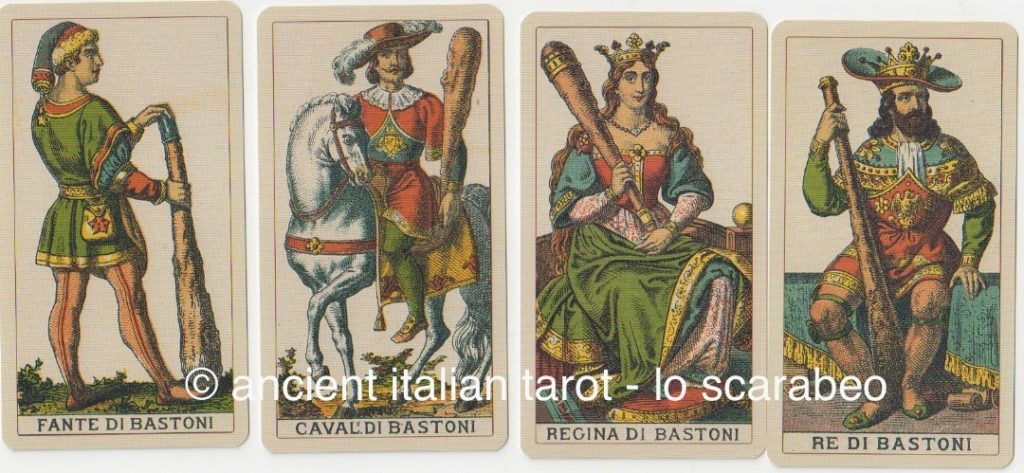
    I believe that the original engravings for this deck were made by a prominent Milanese engraver named Carlo Dellarocca.  This is the 1880 version of the deck, published by Lo Scarabeo (my copy dates from 2000).  As far as traditions go, this deck is a Marseilles-based deck (unillustrated pips, Justice VIII/Strength XI) with Majors and Court titles in Italian only.  These old decks are untrammelled by Golden Dawn influence and I find them extremely refreshing!

    One of my Tarot bug-bears is that the Court section of a deck can feel poorly thought out, with little or no consideration going in to the personalities of the 16 characters and the traits that each conveys. But in this deck, they are very distinct personalities – even if they are not quite what you expect!

     Let’s meet the Fantes, Cavales, Reginas and Res!

    Page (unexpected news) Knight (traveller) Queen (friend) King (entrepreneur)

    We have the Bastoni family, or Wands to you and me.  Notice how the club is quite different in each image.  The Fante (or Page) holds a large, rough-hewn club emphasising the unformed, beginning nature of the Page…the Cavale (Knight) holds something that seems to have a bit of a dent in it, the Queen’s club is very decorative and the King’s enormous  ……. club…..leaves us in no doubt that he’s the main man!

    Colour-wise – this family show a lot of green – the living, vital wand.  There is also red for the fire of Wands.  But heck – colour might not count for anything other than what the printers had available to them at the time – this is a pre-GD deck after all!

    Take a good look at the Pages in the Ancient Italian – they’re all considerably older than many modern decks portray them!

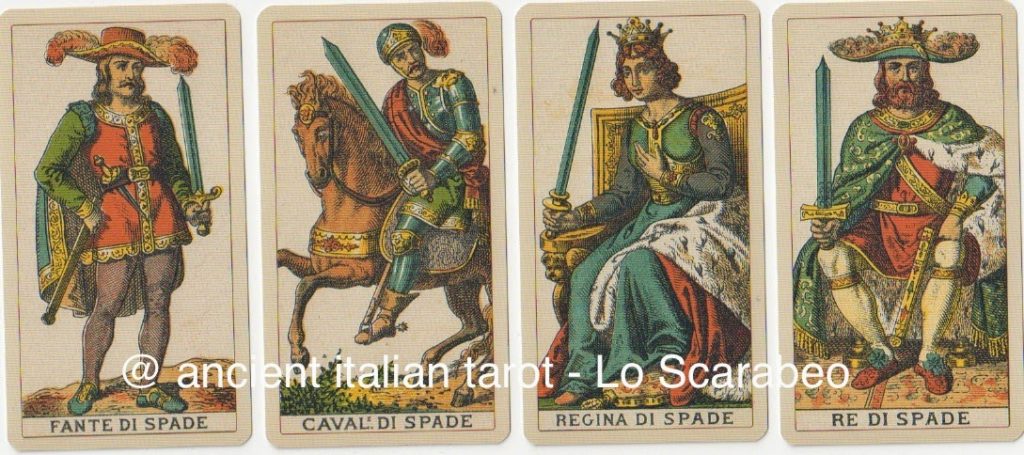
    Page (researcher) Knight (mercenary) Queen (widow) King (lawyer)

    The Spade (Swords) family look quite pleasant sorts, even though every last one of them is tooled up for a fight!  What do you make of the Queen’s robe, folded into an opening between her legs? One of the LWB meanings for her is ‘sterility’  Hmmm – maybe I’m reading too much into the folds of that robe, which looks to me like a ‘fachina’ (as my son used to call it).

    Colour-wise – one might say that a sky blue is the common denominator?  Suitable for Airy Swords! But look! Also a lot of red!

    Notice how all the swords are depicted at an angle, except the King’s – his sword is bolt upright and he is, of course, scrupulously fair in his dealings with people. The Fante’s sword is almost upright, but he also sports a little dagger at his waist – suggesting that duplicitous nature that we know and luff about the Page of Swords.

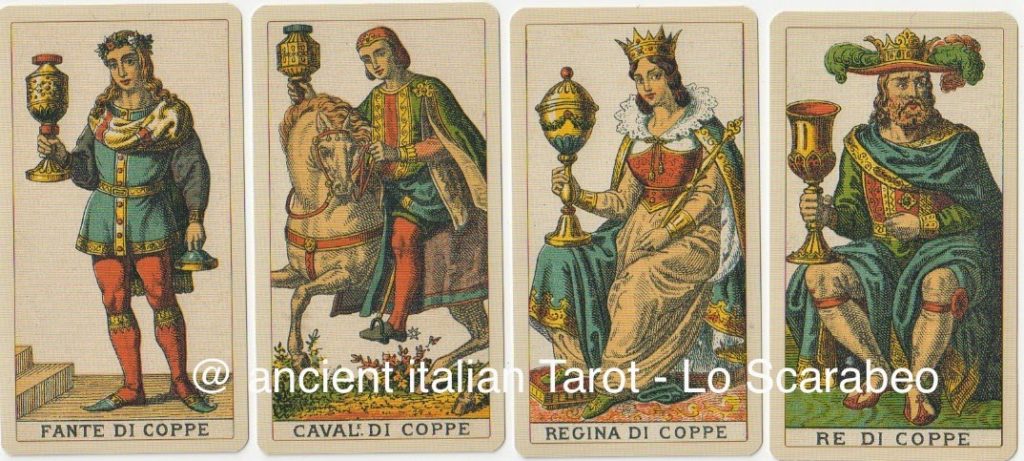
    Page (messenger of luff) Knight (passionate but unfaithful lover) Queen (lover/wife) King (Artist/mature person)

    Take a good look at the Cups or Coppe family – this is the only family group where there is not a single weapon on show (the King of Danari has a sword too).  This family’s power is founded in relationship – the love is mightier than the sword, if you will.

    The Coppe family memberes are decked out in blue – suitable for a suit associated with Water.  And red prevalent in this lot too!

    All the Knights in the deck approach their family from the right hand side (except Danari enters from the left!) and have horses moving at different speeds, but the slowest looking horse is given to the Knight of Wands.  In post-Golden-Dawn decks, this is the VERY boy you would expect to have the fastest horse!

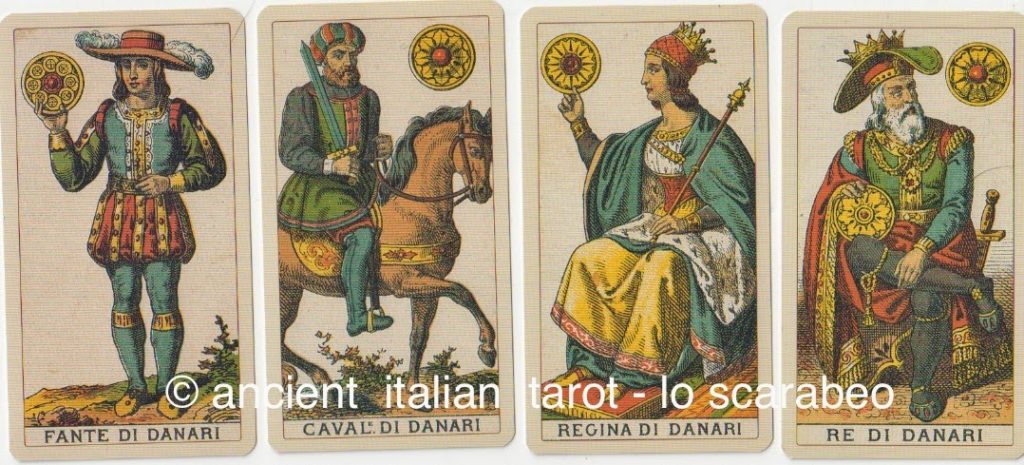
    Page (student) Cavale (consultant/arrogance) Queen (Heiress, greed, marriage of convenience) King (business/rich man)

    Meet the Danari family AKA Pentacles.  Notice how in this family, the Cavale and King both have Swords in addition to their suit symbol.  For the Cavale the coin hangs in the air in front of him and he doesn’t look hugely interested in it as he canters along behind it with his unsheathed sword resting on his breast.  The King also has a sword, but it remains in its scabbard behind him.  He is the only King who LOOKS at his suit symbol and holds another one on his knee – the getting of material goodies is important to this guy!

    The meanings ascribed to the Page and Cavale are more what I would expect from the Swords characters….. the ‘mercenary’ nature of the Swords Knight I would probably associate with the Knight of Pentacles.  In this deck, the Knight of Danari is so clearly following the money!

    Colourwise? Nothing really jumps out at me – other than the Queen’s golden skirt! Lots of red, blue and green *sigh*

    So, what conclusions can I draw about the Courts of the Ancient Italian Tarot?

    They are very attractively portrayed and each one is a unique character.  There is no real colour-coding of the suit families, but then we are looking at a deck that predates this tendency.  The etchings are refined and the cards are beautifully coloured throughout the deck

    The meanings ascribed to the cards are, on the whole, as we generally understand them to be, with the exception of the Fante and Cavale of Danari who are described more like Swordy types.  And the Cavale of Swords is described more like the Danari chap should be.  Solution? I suggest just swapping around those descriptions so that they keep with your understanding of these courts.

    What do you think of the Ancient Italian Tarot families?  What’s your favourite Marseilles-type deck?

  • King of Swords | Olympus Tarot | Lo Scarabeo

    It seems only a few days ago that I posted my Queen of Pentacles card. I blame the school holidays – days either drag their heels or fly out of the window, depending on how busy my son is!

    I really enjoyed my Queen of Pentacles moment – I busied myself with my son, travelling to Stirling and Glasgow, enjoying each other’s company rather than me just nagging him to wash dishes/tidy his shoes away etc.

    I’ll miss her….

    But now that the school holidays are ending and my small boy has to face up to the fact that school is looming large on his horizon again, I guess that it’s appropriate that I’ve got the King of Swords.

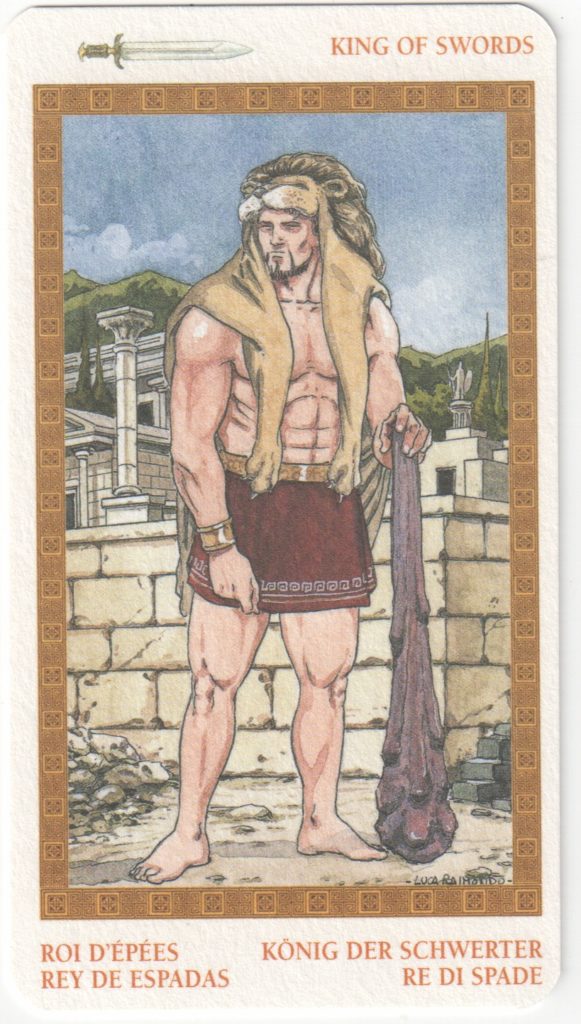
    This is the King from the Olympus Tarot by Lo Scarabeo, illustrated by Luca Raimondo.  Meet Hercules, son of Zeus, complete with the skin of the Nemean Lion.  The skin of this lion was impervious to damage – to the extent that even when Hercules killed the beast (one of his many Labours of Hercules) it could only be skinned using one of its own claws.

    This is a much more active and dynamic King of Swords than we are usually presented with.  Famed for completing his 12 Labours, set for him by the Gods, Hercules is revered more for his great strength than his brain power.

    Yet this is who is to suffuse me with his energies over the coming weeks.

    Perhaps his DETERMINATION will be of use when Sonshine returns to school next week and homework rears its ugly Hydra head?

    Perhaps I too shall use my connections (he was ably assisted by various Gods – to whom he was related – throughout his Trials) or am I to beseech the deities themselves?  I can see quite a lot of Gods’ names being taken in vain as I try to cope with Sonshine, work, marking homework for TABI and cleaning the house for the imminent return of my own domestic demi-god from 6 weeks at sea.

    Perhaps the blend of brains and physicality are key.  I do a lot of sitting around *gestures to self sitting at keyboard* and I really should be more active.  I *know* this, but I don’t do it.

    Time for a change, methinks!

    What does Hercules as the King of Swords mean for you?

  • Court Couples | King and Queen of Swords

    Court Couples | King and Queen of Swords

    The Fey Tarot published by Lo Scarabeo is one of my favourites, even though it’s jam-packed with fairies, I confess.  I find that it’s a great deck to read with, especially if you’re a RWS devotee.

    Today I’m presenting the King and Queen of Swords to you *sweeps a long, low bow*…..

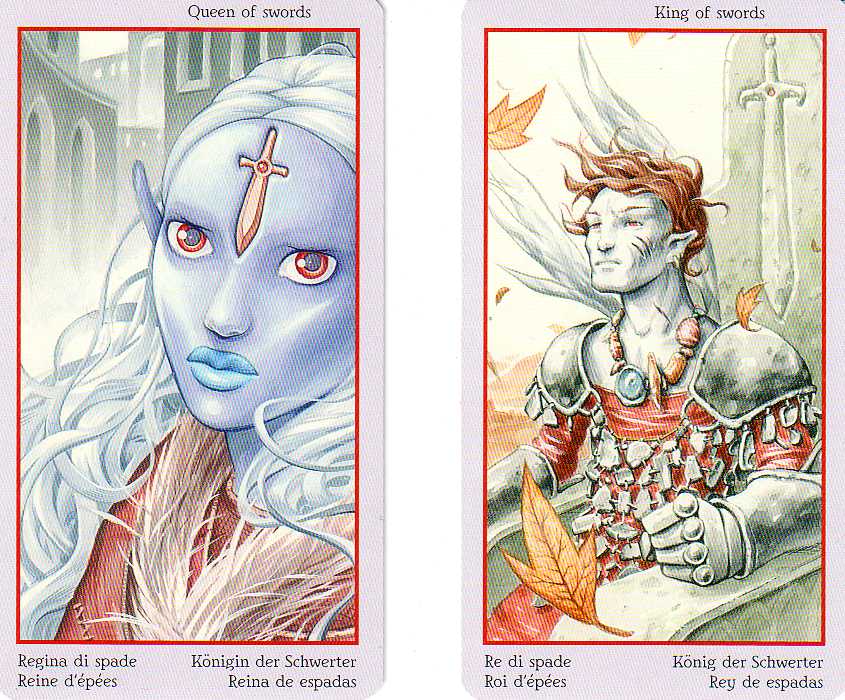
    I’m a little bit in love with this King of Swords, if I’m honest.

    Even though the wind buffets him relentlessly, blowing the autumnal leaves hither and thither, he remains at his post.  The scars of battle (life? love?) have marked him and even on his throne he is clad for conflict.

    His hands are encased in armour- even his finger tips – can he no longer feel anything (emotionally? physically?)  Does he need to remember that you don’t need your armour at all times, that sometimes it’s safe to let yourself be exposed? Even if it leads to more wounds?

    His consort is the Queen of Swords.  Her hair tumbles around her face and shoulders like water and she gazes out at us with a serious demeanor.  Unlike the king who is in some desolate wilderness, she is in a built-up area – civilisation.   And indeed this Queen is erudite, witty, clever and – I suspect – an excellent dancer and chess player.

    If the eyes are windows to the soul, what are the windows in this card? The eyes of the soul?  Although she is beautiful, her blue lips and skin tone make her chilly-looking – ‘Noli Mi Tangere

    Does she look like the sort of woman that the King needs to cuddle up to?!

    Maybe her sword, emblazoned onto her third eye, cuts her off from the King.  Introspective and thoughtful, I can imagine the verbal traps that she could set for him (‘what do you mean my bum doesn’t look big in THIS? Are you saying that it looks big in other things?’)

    Even when you switch the King and Queen around, there’s not much change in the tension between them, is there?

    The Fey Tarot has colours allocated to the suits and Swords are allocated red – something that I associate more with Wands, to be honest.  The passion of red doesn’t really suit the cerebral approach of the Swords family – but here, I think it works on these two cards.  I think their love of order and of duty – doing The Right Thing, just because it IS the right thing – doesn’t mean that they don’t have strong passions – far from it.  And the red border reminds me that they are passionate people.

    But I wonder where that leaves them?

    Perhaps if I got into full Queen of Wands mode, I could persuade him to come down from that throne and step out of his armour?!

    The Fey Tarot is published by Lo Scarabeo,  accompanying book by Riccardo Minetti, artwork by Maria Agham.

    King | Queen | Swords | Fey Tarot | Tarot Thrones
  • My Family | Minchiate Courts

    Thought I would start a regular meme where we can look at the Courts of various decks – especially decks that are a bit different to the RWS style.

    Have you ever taken a look at the Minchiate Tarot? It’s massive!  Not only are there your standard Major Arcana cards (give or take one or two), Minors and Courts – but all the Zodiac cards, Virtues and Elements, giving a grand total of 97 cards.  I *know*.  Fascinating.  Murder to learn though 🙂

    The Court Cards are intriguin.  Of course, they are a the sort of courts that can make you weep because not only is there a dearth of helpful symbolism, but their names aren’t even on the cards.

    The accompanying book offers a fascinating insight into how THESE courts are to be interpreted.

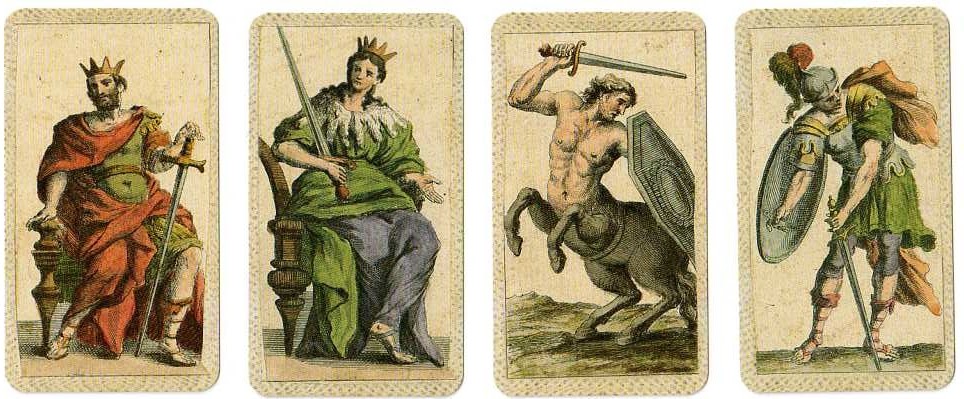
    This is the Sword family – running from King on the left down to the Knave on the right.
    The book, by Andrea Vitali, defines them as:
    Knave – Young man who causes suffering
    Knight – Man who vehemently inflicts pain
    Queen – Authoritarian woman who inflicts pain as a means to an end
    King – Authoritarian man who causes pain without having to justify his actions
    Yes, in this deck, Swords are simply ‘painful situations’ – think of their Swords used solely for hurting.
    Wands don’t fare much better. Here’s their family:
    And here’s what the Minchiate book says about them…..
    Knave – young man who creates problems
    Knight – young man who creates problems with certain outbursts
    Queen – ambiguous woman who creates problems
    King – authoritarian man who creates problems without having to justify his actions
    Yep – Wands are aaaaaalllll about problems – think of their Wand as a wooden spoon, stirring it!
    Do the Cups family score any better?

    Of course, this time I scanned the Cups with the Knave to the left and the King on the right.  Consistent? You must be getting me mixed up with someone else…..
    Knave – Young woman offering gifts
    Knight – Youn man who offers positive opportunities regularly
    Queen – Authoritarian woman who acts out of affection as an end to a means
    King – Authoritarian man who offers gifts, affection, love and help without having to justify himself to anyone
    Clearly the Cups are regarded as uniformly positive guys (the book calls them ‘positive situations’) – think of that cup as a loving gift to someone.
    And what of the Pentacle clan?  
    ….and back to King on the left and Knave on the right….like I said, consistency is not my strong suit 😉
    The book describes the realm of Coins as ‘Happy Situations’, so they’re going to be Goodies.
    Knave – a young woman who creates situations that bring happiness
    Knight – a man, present for a long time, who offers love, availability and great affection.
    Queen – an authoritarian woman who intentionally inflicts pain …….

    WWWWoooooooaaaaa *slams on brakes* This is clearly an error.  I checked with the Italian words in the same book and then typed off a query missive to Lo Scarabeo .  They kindly (and immediately) replied with the correct translation ‘an authoritive woman who gives good things for the right reason.’

    King – an authoritarian man who offers beautiful things without having to justify himself.

    Actually,  Andrea Chiarvesio of Lo Scarabeo suggested replacing ‘authoritarian’ with ‘authorotative’ for that definition – which could then apply to the other Queens that have been labelled that way. This makes them all feel a bit less imperious, don’t you think?

    So the Minchiate Courts are full of Kings who answer to no-one and Queens who act consciously with an outcome in mind.  The Swords and Wands are without doubt troublesome characters in the Minchiate with no redeeming features whatsoever and the Cups and Pentacles are the families whom you want living next door.

    And the Knight of Pentacles seems to be Mr Right…..  Something that I hadn’t much considered.  But, now that I think about the RWS knights – aren’t the Knights of Wands and Swords the first into battle and the dogged Knight of Pentacles the one who remains there after the other three have left the field? Yep he would do me fine as Mr Right 🙂

    Do the descriptions of the Minchiate Courts rock your own thoughts about particular courts – or could they add clarity?
    What do you think? 
    Copyright information:  Deck: Minchiate, Published by Lo Scarabeo, accompanying book written by Andrea Vitali
    You can buy it here